


 English
 Español
 عربى


Get Social
Choose DEIF for the perfect blend of
performance and aesthetics.
 Get Free Sample

Content
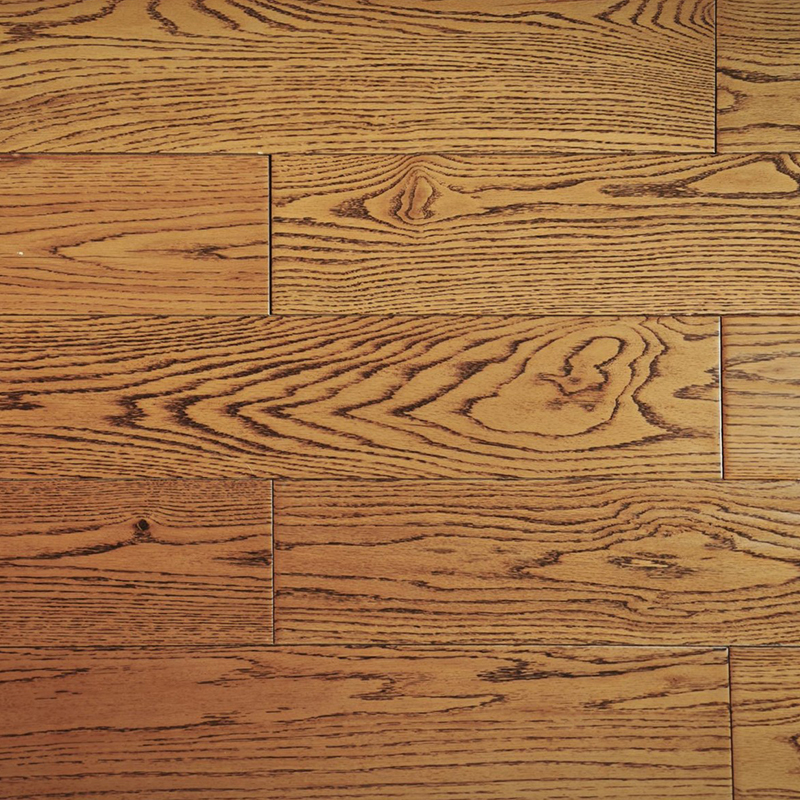
Black Walnut Natural Tone Solid Wood Flooring is designed for interiors that require more than a practical walking surface. It combines the visual depth of American black walnut with a 100% solid hardwood core, carefully considered surface options, precision profile machining, and a specification suitable for luxury residential and selected commercial environments. Its dark natural tone, individual grain movement, and warm underfoot feel create an atmosphere that is calm, refined, and unmistakably natural.
Identified as DF-R607, this flooring belongs to the Solid Walnut Wood Flooring collection. The standard product is supplied in a plank format measuring approximately 29.53 inches by 4.76 inches by 0.71 inches, equivalent to approximately 750 mm by 121 mm by 18 mm. The 18 mm solid construction provides substantial material presence, dependable load-bearing support, and the tactile character expected from premium wood flooring.
Unlike products built around composite cores or synthetic decorative layers, this flooring is made from solid hardwood throughout its primary structure. The result is a floor with authentic grain continuity, natural texture, and the ability to express the distinctive character of black walnut. Every plank is naturally different, making the finished surface more individual than a printed or heavily standardized alternative.
For distributors, contractors, architects, and interior designers, the product also offers practical flexibility. Surface texture, finishing system, dimensions, color direction, and installation configuration can be customized according to project requirements. This makes it appropriate for high-end residences, villas, boutique hotels, premium offices, studies, home offices, and other interiors where material authenticity and long-term presentation are important.
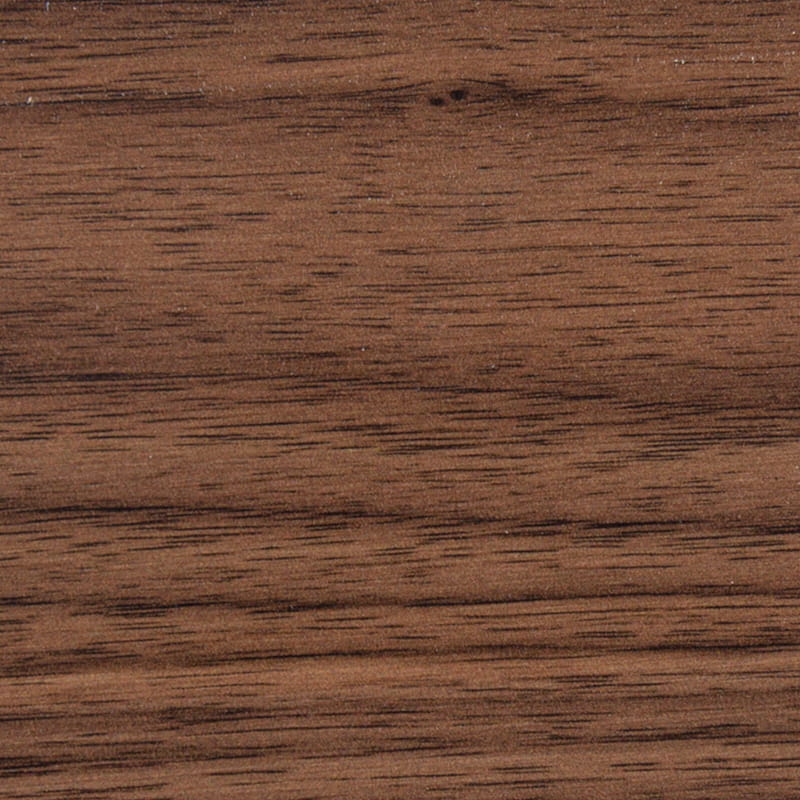
Black walnut is valued for its rich brown to near-black color range, expressive grain, and naturally elegant appearance. Rather than relying on artificial pigmentation to create a luxury effect, Black Walnut Natural Tone Solid Wood Flooring allows the material itself to establish the visual identity of the room. The planks can display subtle variations in tone, figure, and grain direction, producing a floor that feels collected and architectural rather than repetitive.
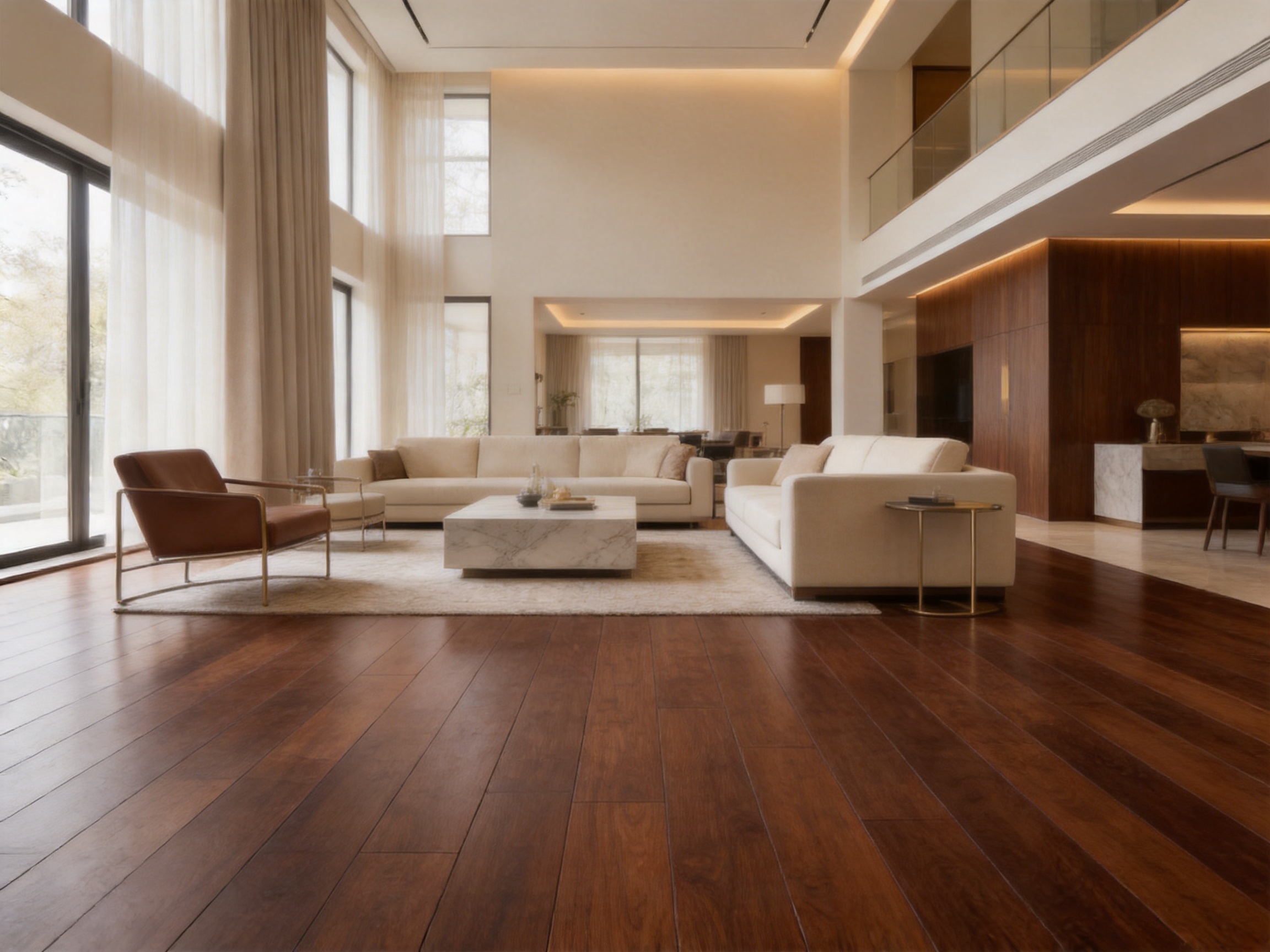
The natural tone is particularly effective in spaces that seek a calm and grounded atmosphere. Dark walnut flooring can visually anchor large rooms, balance bright walls, and provide contrast against pale stone, neutral textiles, brushed metal, and glass. It is also well suited to interiors that use marble furniture, crystal lighting, leather, wool, linen, and other soft or high-quality materials.
In a high-end modern interior, the flooring can provide warmth beneath clean architectural lines. In a classic or transitional setting, its deep color can support decorative moldings, tailored furniture, and traditional detailing. Its versatility comes from the fact that the visual interest is contained within the wood grain itself, allowing the floor to remain distinctive without becoming excessively decorative.
Because the product uses a natural wood species, color development should be understood as part of the material experience. Exposure to daylight and the application of a suitable maintenance oil may gradually influence the appearance of the surface. Prolonged direct sunlight can lighten the visible tone over time, so window treatments, appropriate furniture placement, and sensible ultraviolet exposure management are recommended for projects seeking consistent color.
The ABC natural grade allows the floor to retain a genuine wood appearance rather than presenting an artificially uniform surface. Depending on the approved production specification, natural features may contribute to the character of the finished floor. For projects requiring a more controlled appearance, grading, plank selection, surface treatment, and color approval can be coordinated during the customization process.
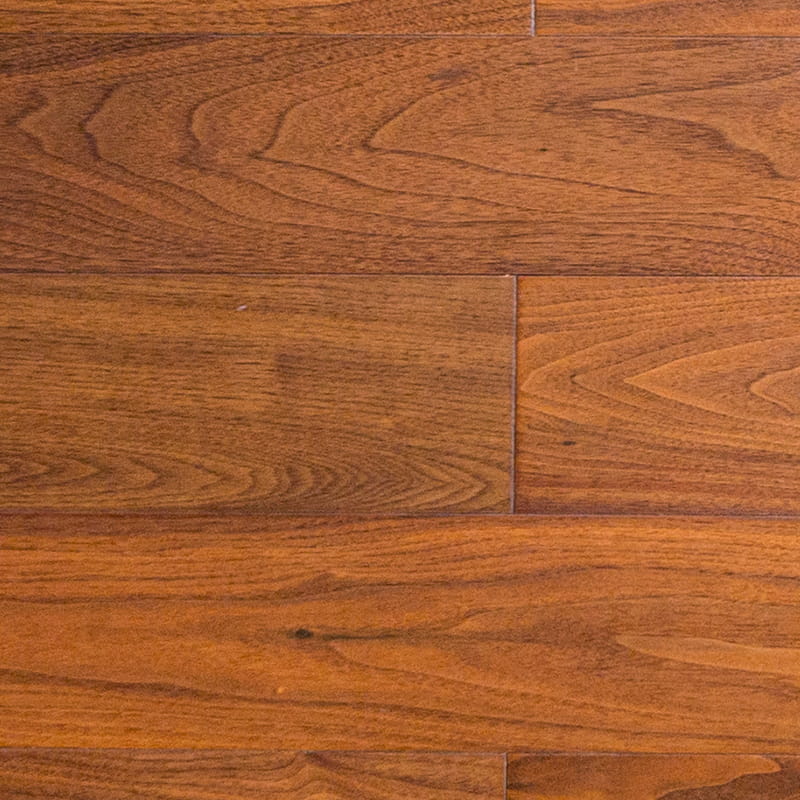
Black Walnut Natural Tone Solid Wood Flooring
The central performance advantage of DF-R607 is its solid hardwood core. Each plank is made from 100% solid hardwood matched to the selected flooring species, in this case American black walnut or black walnut. There are no composite layers forming the primary board structure and no decorative paper layer intended to imitate real timber.
This construction gives the floor a direct connection between material, appearance, and performance. The grain that the eye sees is the grain of the wood itself. The tactile response underfoot is also determined by the solid timber, which contributes to a warm and natural walking experience that many synthetic or multilayer products cannot reproduce in the same way.
A solid 18 mm thickness provides a substantial feel and supports a long service-life approach when the floor is correctly specified, installed, cleaned, and maintained. The thickness also contributes to a stable visual proportion at doorways, transitions, skirting boards, stair connections, and other architectural details. For renovation and new-build work, the required finished floor height should be coordinated with the complete flooring assembly and adjacent materials.
Solid timber naturally responds to changes in temperature and humidity. This is not a defect; it is an inherent characteristic of real wood. Professional acclimatization, moisture testing, subfloor preparation, expansion planning, and climate control are therefore important parts of a successful installation. When these factors are managed correctly, the flooring can deliver the stability and service life expected from a premium solid hardwood product.
Compared with many thin decorative floors, the solid construction gives designers a stronger material story. Compared with some engineered products, it provides a more direct natural wood experience. The choice between solid and engineered flooring should always reflect the building environment, moisture conditions, installation system, and project objectives, but DF-R607 is particularly compelling where material authenticity, thickness, repair potential, and luxury presentation are priorities.
| Construction | 100% solid hardwood core |
| Wood species | American black walnut or black walnut, subject to approved specification |
| Standard thickness | Approximately 18 mm or 0.71 inch |
| Visual character | Natural dark brown to black tone with individual grain variation |
| Natural grade | ABC Grade, with project-specific selection available |
| Primary applications | Luxury residences, villas, boutique hotels, studies, home offices, and premium commercial interiors |
Black Walnut Natural Tone Solid Wood Flooring can be configured with several surface texture and finish options. This allows the same underlying walnut material to support different design languages, from quiet contemporary interiors to more tactile, handcrafted schemes.
Wire brushing gently emphasizes the softer grain areas and creates a subtle linear texture. On dark walnut, this treatment can make the natural grain more legible while adding a refined tactile quality. It is suitable for interiors that want visual depth without a heavily distressed appearance.
Handscraping introduces a more expressive surface character. Small variations in texture can reinforce the perception that the floor is individually crafted. This option works particularly well in villas, boutique hospitality spaces, traditional interiors, and projects where a lived-in luxury atmosphere is desired.
A smooth sanded surface presents the walnut in a cleaner and more continuous manner. It can support minimalist rooms, modern residential interiors, executive studies, and spaces where furniture, lighting, or architectural elements are intended to provide the main decorative focus.
The available finish options include UV lacquer, UV oil, and hardwax oil. Each finish can influence the appearance, tactile response, cleaning routine, and maintenance expectations of the completed floor. The most appropriate selection should be made in relation to traffic level, desired sheen, project aesthetics, repair strategy, and the maintenance resources available to the owner or facility operator.
UV lacquer can provide a consistent protective surface and is suitable for projects seeking a controlled appearance and straightforward routine cleaning. UV oil can preserve a more natural visual impression while adding a practical protective layer. Hardwax oil is often selected where a soft, tactile surface and localized maintenance approach are valued. Final performance depends on the approved formulation, factory application, site conditions, and maintenance program.
Surface treatment should not be considered a purely decorative decision. The selected finish affects how the floor reflects light, how clearly the grain is expressed, how minor marks appear, and how the floor can be refreshed in the future. For this reason, project samples should be reviewed under the actual lighting conditions and alongside the intended furniture, wall colors, and other finish materials.
The product is available with a tongue-and-groove locking system configured as required. The detailed specification also identifies a four-sided click system with a V-bevel profile. These options reflect the importance of matching the connection method to the project’s installation requirements, installer preference, and approved production configuration.
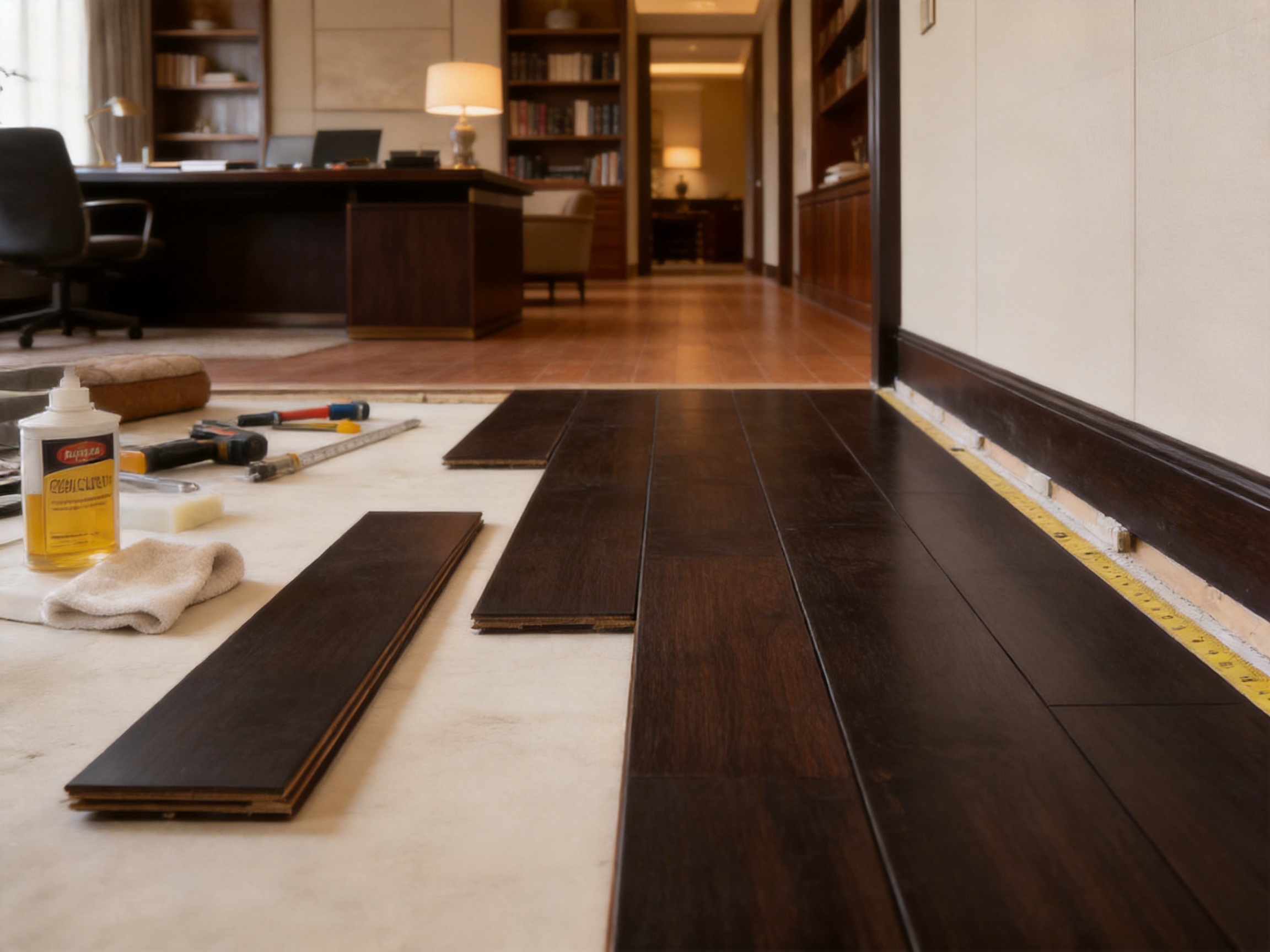
A properly machined connection system helps create tight, orderly plank joints and supports a clean finished appearance. It also assists with alignment during installation. Depending on the selected configuration, the flooring may be installed using glue, staples, or another approved method. The final installation method must be confirmed before ordering because the subfloor, room layout, plank format, and locking profile all influence the appropriate approach.
The tongue-and-groove option can support a traditional solid wood installation approach. A click configuration may provide efficient positioning and an orderly joint pattern when the project has been engineered and approved for that system. Neither system eliminates the need for correct subfloor preparation, perimeter expansion allowances, acclimatization, and qualified installation.
V-beveling can emphasize the individual plank format by creating a subtle shadow line between boards. This can make the floor layout more visible and reinforce the scale of the planks. A square-edge alternative, where available and approved, can create a more continuous visual field. The choice should be coordinated with the desired room proportions and the selected surface finish.
Installation flexibility is a commercial advantage because different markets and project types often require different site methods. A distributor may need to supply products for glue-down residential work, staple-fixed projects, or a click-based specification. By offering configurable profiles and installation arrangements, the manufacturer can respond to more project conditions than a single fixed-format product allows.
The subfloor should be clean, structurally sound, dry, and level within the tolerances required by the selected installation system. Moisture readings should be taken using an appropriate method, and the results should be documented before the flooring is delivered or installed. Uneven or damp substrates can create movement, open joints, squeaks, finish problems, or other avoidable failures.
Planks should be acclimatized according to the flooring specification and the conditions of the installation environment. Interior temperature and relative humidity should be stabilized before, during, and after installation. Expansion gaps should be planned around walls, columns, thresholds, pipes, and fixed joinery. The installer should follow the approved technical instructions for adhesive selection, fastener placement, joint layout, and transition details.
For underfloor heating, the heating system should be tested and commissioned according to the system manufacturer’s requirements. The flooring’s moisture content, maximum surface temperature, heating cycle, and installation adhesive must be reviewed together. Solid walnut can be considered for compatible underfloor-heated applications, but suitability depends on the complete system rather than the flooring board alone.
Natural solid wood provides a warmer and more comfortable sensory experience than many hard, cold, or synthetic surfaces. Walnut’s visual warmth reinforces this effect, helping rooms feel more welcoming even when the design language is formal. This quality is especially valuable in living rooms, bedrooms, libraries, studies, and private offices where occupants spend extended periods indoors.
Black walnut is a durable hardwood species with a dense natural structure. When correctly manufactured and maintained, it can support long-term residential use and selected light commercial applications. The flooring is designed for environments where owners expect the interior to retain a premium appearance over many years rather than being replaced after a short decorative cycle.
Durability should be understood as a combination of material strength, finish protection, installation quality, cleaning discipline, furniture protection, and indoor climate management. Even a premium hardwood floor can be damaged by standing water, abrasive grit, unsuitable cleaning chemicals, dragged furniture, or uncontrolled humidity. The product’s performance is strongest when the entire care system is treated as part of the specification.
Natural walnut has a timeless character that can remain relevant as furniture and decorative styles change. Its color works with contemporary, classic, transitional, and hospitality-inspired schemes. Unlike a highly fashionable printed pattern, natural grain variation can continue to feel authentic as the room evolves.
The product is well matched to luxury villa living rooms, high-end studies, home offices, boutique hotels, and premium commercial interiors. In these settings, flooring is not merely a background finish. It helps communicate quality, permanence, and attention to detail. The deep walnut tone can also create a sense of enclosure and acoustic softness when paired with rugs, upholstered furnishings, curtains, and timber joinery.
The flooring specification identifies an E0 environmental standard with formaldehyde emissions of no more than 0.05 mg/m³, applicable to solid wood flooring within the stated product range. This low-emission positioning supports projects where indoor air quality and material responsibility are central considerations.
The product is also identified as CE and FSC certified within the general product information. CE-related compliance and FSC-related sourcing documentation should be confirmed against the specific order, production batch, market, and certification scope. Project teams should request the relevant current documentation during the approval process rather than relying only on general catalog language.
Solid wood construction can support a material-efficiency and longevity strategy. A durable floor that remains in service for a long period may reduce the frequency of replacement and the associated disruption. Walnut also offers the possibility of future surface renewal where the remaining wear layer, floor condition, and manufacturer or installer guidance make this appropriate.
Environmental performance should be evaluated across the complete product life cycle. Responsible sourcing, low-emission materials, efficient manufacturing, durable finishes, packaging, shipping, maintenance products, and eventual disposal all contribute to the final environmental profile. A well-designed specification should therefore combine the product’s E0, FSC, and CE-related attributes with responsible project management.
The manufacturer behind this flooring operates as a wood solutions producer with experience in wood flooring, wooden doors, and custom cabinet solutions. Its manufacturing background extends across residential and project-based applications, allowing knowledge from different interior wood categories to inform material selection, machining, finishing, and quality management.
Production facilities cover approximately 20,000 square meters, supported by German imported production lines and automated quality control systems. This combination is important for a product such as solid walnut flooring, where the natural beauty of the raw material must be preserved while dimensions, moisture content, machining accuracy, surface consistency, and finish quality remain under control.
Solid wood is naturally variable. Advanced manufacturing does not mean eliminating every natural difference; rather, it means managing the differences responsibly so the delivered material matches the approved standard. The manufacturer’s process is intended to combine natural character with repeatable production control, helping distributors and project teams receive flooring that is consistent with the approved sample and specification.
A strict three-step quality inspection process is identified as part of the company’s manufacturing strengths. In practical terms, a robust inspection system should address incoming timber and moisture conditions, machining and structural accuracy, and final appearance and packaging. The exact internal checkpoints should be confirmed through the manufacturer’s quality documents, but the principle is clear: quality should be reviewed throughout production rather than only at the end.
Incoming material inspection helps identify species, grade, moisture, color range, and visible defects before machining. Process inspection can verify thickness, width, length, profile accuracy, joint fit, surface texture, and finish application. Final inspection can assess the completed planks, carton quantities, labeling, packaging integrity, and order conformity before shipment.
This approach offers an advantage over informal or inconsistent production because it reduces the risk that a problem will pass through several stages before being discovered. It also gives project buyers a clearer basis for managing approvals, sample comparisons, replacement discussions, and installation planning.
The product information identifies a moisture content range of 8% to 10%, with a tolerance of plus or minus 2%. Moisture control is one of the most important technical factors in solid wood flooring. It affects dimensional movement, installation behavior, joint stability, and the floor’s response to the indoor environment.
Moisture content should be checked during production and again as part of site receiving and acclimatization procedures. The correct target depends on the intended climate, building conditions, and technical standard governing the project. A professional installation team should compare product moisture readings with the subfloor and room conditions before proceeding.
For large developments and repeat distribution programs, supply reliability is as important as individual plank quality. The manufacturer reports an annual production capacity of approximately 2,400,000 square meters of flooring and 5,000 sets of doors. This scale provides a foundation for serving multi-room residential projects, hospitality developments, commercial interiors, and ongoing distributor programs.
Capacity alone does not guarantee delivery performance, but it can improve planning when supported by documented production scheduling, raw material management, packaging control, and export experience. The company has more than 10 years of export experience and serves over 100 global partners across Europe, North America, and Southeast Asia. This international exposure supports familiarity with different project expectations, packaging requirements, communication processes, and compliance needs.
For purchasers, a scalable production partner can reduce the need to coordinate flooring, doors, and cabinetry through multiple unrelated suppliers. The company’s wider product range allows project teams to explore coordinated wood solutions across different interior elements. This can be especially useful when a development requires consistent wood tones, matched custom components, or consolidated procurement.
Supply discussions should include approved samples, order quantities, production lead times, packaging, spare material allowances, inspection arrangements, shipping terms, documentation, and the treatment of natural color variation. For walnut flooring, a clear sample approval process is particularly important because the natural range of tone and grain is part of the product’s identity.
Customization is a major strength of the product platform. Custom sizes and colors are available, and the surface can be specified as wire brushed, handscraped, or smooth sanded. UV lacquer, UV oil, and hardwax oil are also available as finish directions. These options enable the flooring to support a project’s architectural language rather than forcing the project to adapt to a fixed catalog product.
OEM customization can be valuable for distributors that require private-label packaging, market-specific dimensions, or a defined finish collection. ODM support can assist architects, developers, and interior brands that want to create a distinctive flooring specification from an established manufacturing base. The company also identifies 72-hour rapid prototyping as part of its service capabilities, which can accelerate early-stage sample development and design decisions.
Rapid prototyping does not replace full production approval. A prototype should be evaluated for color, texture, edge detail, finish sheen, plank dimensions, and compatibility with the final material batch. Nevertheless, faster sampling can help design teams compare alternatives earlier, coordinate flooring with furniture and joinery, and reduce delays during concept development.
The first stage is project briefing. The buyer should provide the intended application, country or market, approximate quantity, preferred dimensions, surface texture, finish, installation method, grading expectations, and performance requirements.
The second stage is material and appearance development. The manufacturer can prepare reference samples or prototypes showing the walnut tone, grain direction, surface texture, finish sheen, bevel treatment, and any requested color adjustment. Samples should be reviewed under representative lighting.
The third stage is technical confirmation. The approved specification should state board dimensions, tolerance, moisture range, grade, profile, locking system, finish, packaging, certification documents, and installation guidance. Any deviation from the standard DF-R607 configuration should be recorded clearly.
The fourth stage is production and inspection. The approved sample and technical specification should guide manufacturing, with quality checks carried out through the production stages. Pre-shipment inspection or third-party inspection can be arranged where required by the contract.
The final stage is delivery and installation support. Cartons should be inspected on arrival, site conditions should be confirmed, and installers should receive the appropriate technical documentation. A coordinated process reduces ambiguity and protects the appearance and performance of the finished floor.
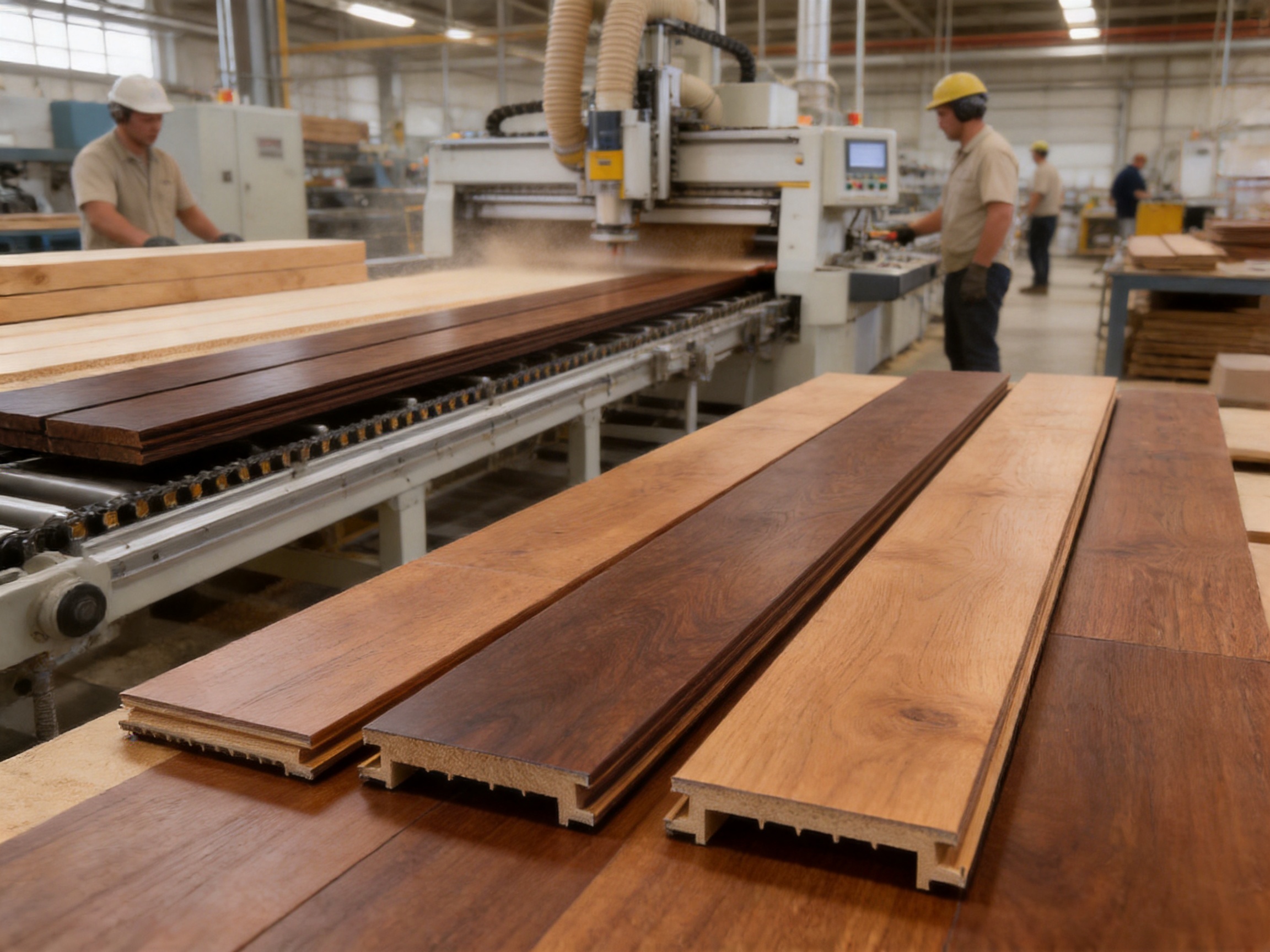
The standard packaging information identifies 20 pieces per carton, approximately 1.81 square meters per carton, or 19.54 square feet per carton. The approximate carton weight is 20.9 kilograms. These figures support initial freight planning, warehouse calculations, installation scheduling, and project quantity estimation.
| Pieces per carton | 20 |
| Coverage per carton | Approximately 1.81 m² |
| Coverage per carton | Approximately 19.54 ft² |
| Approximate carton weight | 20.9 kg |
| Standard plank dimensions | Approximately 29.53 in × 4.76 in × 0.71 in |
| Approximate metric dimensions | 750 mm × 121 mm × 18 mm |
| Moisture content | 8%–10%, plus or minus 2% |
| Installation methods | Glue or staple, subject to approved configuration |
Project quantities should include an allowance for cutting, sorting, layout adjustments, future repairs, and the natural selection of walnut planks. The appropriate allowance depends on room geometry, plank length, installation pattern, and the degree of visual selection requested. A professional quantity surveyor or installer should calculate the final order quantity rather than relying only on the net room area.
Carton coverage and weight may vary when custom dimensions, different packaging arrangements, or special project requirements are approved. Buyers should confirm the final packing list before shipment, especially when ordering flooring for multi-level projects or sites with limited lifting and storage capacity.
Routine care is essential to preserve the rich appearance of black walnut. Daily or frequent cleaning should generally use dry methods, such as a soft broom, dust mop, or suitable dry cloth. Fine grit can act as an abrasive when walked across the surface, so entrance mats and regular dust removal are useful protective measures.
Excessive water exposure should be avoided. Solid wood can absorb moisture through joints, edges, and surface imperfections, potentially causing swelling, staining, finish deterioration, or dimensional movement. Spills should be removed promptly using a lightly damp, well-wrung cloth followed by dry wiping where appropriate.
Cleaning products should be compatible with the selected finish. Strong alkaline chemicals, abrasive powders, steam cleaning, furniture polish containing unsuitable oils, and unapproved detergents may affect color or surface protection. The maintenance product should be tested in an inconspicuous area or confirmed with the manufacturer before widespread use.
The product information recommends applying black walnut-specific wood oil every six months to help maintain color and texture. The actual interval should reflect traffic, finish type, climate, sunlight exposure, and the condition of the floor. UV lacquered surfaces may require a different care routine from hardwax-oiled or UV-oiled surfaces.
Before applying any maintenance oil, the floor should be cleaned, fully dry, and free from incompatible residues. The oil should be applied according to the product instructions, with excess material removed as required. Uneven application can create patches or differences in sheen, so larger commercial areas should be maintained by trained personnel.
Furniture legs should be fitted with suitable protective pads. Heavy furniture should be lifted rather than dragged. Rugs should use flooring-compatible backing, and rubber or plastic materials that trap moisture or cause discoloration should be avoided unless approved. Indoor humidity should be kept within a stable range to reduce excessive seasonal movement.
Every flooring type has a suitable application. The advantage of Black Walnut Natural Tone Solid Wood Flooring is not that it replaces every alternative, but that it provides a strong combination of authentic material, premium appearance, substantial thickness, customizable finishing, and manufacturer support for projects that prioritize these qualities.
Printed wood-look flooring can offer design consistency and may be practical in selected applications, but it does not provide the same solid timber structure, natural grain depth, or possibility of future surface renewal associated with real hardwood. DF-R607 offers an authentic walnut surface in which each plank has naturally occurring variation rather than a repeated image.
Thin decorative products can reduce material use and may suit certain construction systems, but they may not provide the same substantial foot feel or long-term refinishing potential as an 18 mm solid floor. DF-R607 is intended for buyers who see the floor as a durable architectural material rather than a short-term decorative layer.
Light woods can make rooms feel bright and open, while black walnut creates greater visual depth and contrast. The walnut option may be especially advantageous in formal rooms, executive interiors, and luxury spaces where the flooring should contribute richness and a sense of permanence.
Many flooring programs offer limited choices in width, surface, finish, or profile. The configurable nature of this product gives project teams more control over the final appearance. Customization can help a manufacturer, distributor, or design studio develop a coherent collection for a particular market or project identity.
Large living rooms benefit from walnut’s ability to create a composed, grounded visual field. The flooring can support open-plan arrangements, feature fireplaces, sculptural furniture, and large windows. Careful coordination of plank direction and room geometry can make the space appear more organized and intentional.
Dark walnut is a natural fit for studies and home offices because it pairs effectively with bookshelves, leather seating, metal task lighting, and tailored textiles. The material’s visual depth can create a focused environment without requiring excessive ornament.
Boutique hospitality projects often seek a balance between individuality and durability. Natural walnut can help create memorable guest rooms, suites, lounges, private dining spaces, and executive areas. For these applications, the finish, cleaning schedule, replacement stock, and traffic expectations should be agreed at the design stage.
Executive offices, private clubs, high-end showrooms, and client-facing spaces may use walnut flooring to communicate quality and confidence. Light commercial use is identified as a suitable general application, subject to the approved specification and maintenance plan. Areas with unusually high traffic or demanding rolling loads should receive a project-specific technical review.
The product information identifies the flooring as suitable for underfloor heating. This is a valuable feature for contemporary homes, hospitality interiors, and energy-conscious buildings, but the complete heating and flooring assembly must be reviewed before approval.
Solid wood flooring can respond to heat and humidity differently from multilayer flooring. The heating system should provide even, controlled temperature distribution. Sudden temperature changes, excessive surface temperatures, or low indoor humidity can increase the risk of gaps, cupping, checking, or other movement. The heating supplier, flooring manufacturer, installer, and project consultant should coordinate the technical limits.
The adhesive or fixing method must be compatible with both solid walnut and the heating system. The subfloor must be dry and stable, and the system should be commissioned gradually according to the relevant instructions. A written installation method statement is recommended for commercial projects and high-value residential work.
A premium flooring product is not defined only by species or color. Its value also depends on whether the manufacturer can convert a natural raw material into a repeatable, documented, and serviceable finished product. This requires experience in timber selection, kiln and moisture management, profile machining, surface preparation, coating application, packaging, and export coordination.
The manufacturer’s specialization in flooring, doors, and custom cabinets provides a broader understanding of interior woodwork. This can be beneficial when projects require coordinated finishes across multiple elements. A walnut floor may need to relate to walnut doors, wall panels, built-in cabinetry, or reception furniture. A supplier with experience across these categories can discuss color matching, grain direction, finish behavior, and production coordination more effectively.
The reported German imported production lines and automated quality control systems support the precision needed for solid timber flooring. Automation can improve repeatability in cutting, profiling, sanding, and inspection, while skilled personnel remain essential for grading, visual review, finish assessment, and the interpretation of natural wood variation.
The company’s stated compliance with CE, FSC, CARB P2, and ISO 9001 standards further supports its position as an international manufacturing partner. As with all certifications, buyers should verify the current certificates, scope, validity, and applicability to the exact product and destination market. Proper documentation is especially important for architects, public projects, hospitality operators, and distributors working under formal procurement systems.
Before placing an order, the project team should confirm the wood species, grade, plank dimensions, thickness, moisture range, surface texture, finish, profile, locking system, installation method, packaging, coverage, and certification requirements.
A physical sample should be approved for color, grain, texture, sheen, bevel, and general natural variation. If the project involves a large volume, the team should establish how much variation is acceptable and whether a production sample or pre-shipment sample is required.
The installation team should receive information about acclimatization, site conditions, expansion gaps, subfloor moisture, underfloor heating, adhesives, fasteners, cleaning, and post-installation protection. These instructions should be integrated into the construction schedule rather than left until the day of installation.
For international shipments, buyers should confirm carton labeling, palletization, export documentation, customs requirements, insurance, delivery terms, and spare material policy. It is also advisable to reserve replacement planks from the same or a closely related production batch for future repairs, because natural walnut color may vary between batches.
It is a solid walnut flooring product identified as DF-R607. It uses a 100% solid hardwood core and presents the natural dark brown to black tone and individual grain character associated with American black walnut or black walnut.
The listed standard size is approximately 29.53 inches long, 4.76 inches wide, and 0.71 inch thick. In metric terms, this is approximately 750 mm by 121 mm by 18 mm. Custom dimensions may be available after technical confirmation.
The stated construction is solid hardwood. It does not use composite layers as its primary core. This gives the product a direct natural wood structure and authentic walnut surface.
The product information identifies it as suitable for underfloor heating. The full system must still be reviewed by the flooring and heating specialists. Correct subfloor moisture, gradual commissioning, temperature control, compatible adhesive, and stable indoor humidity are essential.
The listed texture options are wire brushed, handscraped, and smooth sanded. Each option produces a different visual and tactile effect, so project samples should be evaluated before approval.
The listed finish options are UV lacquer, UV oil, and hardwax oil. The selected finish should reflect the desired appearance, traffic level, maintenance program, repair strategy, and project conditions.
The packaging and specification information identifies glue and staple installation methods. A tongue-and-groove system or a four-sided click system may be configured as required. The exact installation method must be confirmed for the specific order.
It is identified as suitable for light commercial use and premium commercial interiors such as boutique hotels and refined offices. Higher-traffic or unusually demanding environments should receive a project-specific assessment.
Routine cleaning should use dry methods such as a soft broom, dust mop, or dry cloth. Excessive water exposure should be avoided. Cleaning products must be compatible with the selected finish.
The product information recommends applying black walnut-specific wood oil every six months to help maintain color and texture. The actual schedule should be adjusted according to the finish, traffic, climate, sunlight, and manufacturer guidance.
Custom sizes and colors are available, subject to project review and production confirmation. Texture, finish, profile, and locking system can also be discussed as part of an OEM or ODM specification.
The provided information identifies E0 environmental performance, CE and FSC certification, and broader company compliance with CE, FSC, CARB P2, and ISO 9001 standards. Buyers should request current product-specific documentation for the intended market.
The manufacturer reports approximately 20,000 square meters of production facilities, annual flooring capacity of about 2,400,000 square meters, more than 10 years of export experience, and service to over 100 global partners. It also offers OEM/ODM customization and 72-hour rapid prototyping.
No. Natural variation in color, grain, and figure is part of the character of black walnut. A project should approve representative samples and define the expected range rather than require an artificially uniform appearance.
The most important precaution is to coordinate the flooring with the building conditions. The subfloor must be dry and level, the planks must be properly acclimatized, expansion must be planned, and the installation method must match the approved profile and site conditions.
Black Walnut Natural Tone Solid Wood Flooring offers a combination of premium natural appearance, solid hardwood construction, flexible customization, and manufacturing support for demanding interior projects. Its dark walnut tone creates a calm and luxurious atmosphere, while its individual grain ensures that each completed floor has a distinctive material identity.
The 18 mm solid structure provides a substantial underfoot experience and supports a long-term approach to residential and selected light commercial flooring. Wire-brushed, handscraped, and smooth sanded textures allow the surface to be adapted to different design concepts, while UV lacquer, UV oil, and hardwax oil provide alternative finish directions.
Its E0 environmental positioning, stated CE and FSC certification, configurable installation systems, underfloor heating compatibility, and customizable dimensions make it practical as well as visually refined. However, the best results depend on responsible specification, professional installation, controlled indoor conditions, and a maintenance program suited to the selected finish.
Behind the product is a manufacturer with substantial production capacity, international export experience, OEM/ODM capabilities, rapid prototyping, German imported production lines, automated quality control systems, and a three-step inspection approach. These strengths give distributors, architects, contractors, developers, and interior designers a foundation for sourcing not only a beautiful walnut floor, but also a reliable and adaptable wood solution for global projects.
1. Product specification for DF-R607, Black Walnut Natural Tone Solid Wood Flooring.
2. Manufacturer-provided technical information on solid wood construction, dimensions, profiles, finishes, packaging, moisture content, and installation methods.
3. Manufacturer-provided company profile covering production facilities, export experience, annual capacity, OEM/ODM services, quality inspection, and global partnerships.
4. General guidance on solid hardwood flooring installation, acclimatization, subfloor preparation, expansion planning, and maintenance.
5. General principles for responsible timber sourcing, indoor air quality, certification review, and project-specific compliance documentation.

We provide customers with sustainable and eco-friendly
engineered wood solutions and services.
Choose DEIF for the perfect blend of
performance and aesthetics.
