


 English
 Español
 عربى
عربى


Get Social
Choose DEIF for the perfect blend of
performance and aesthetics.
 Get Free Sample

Content
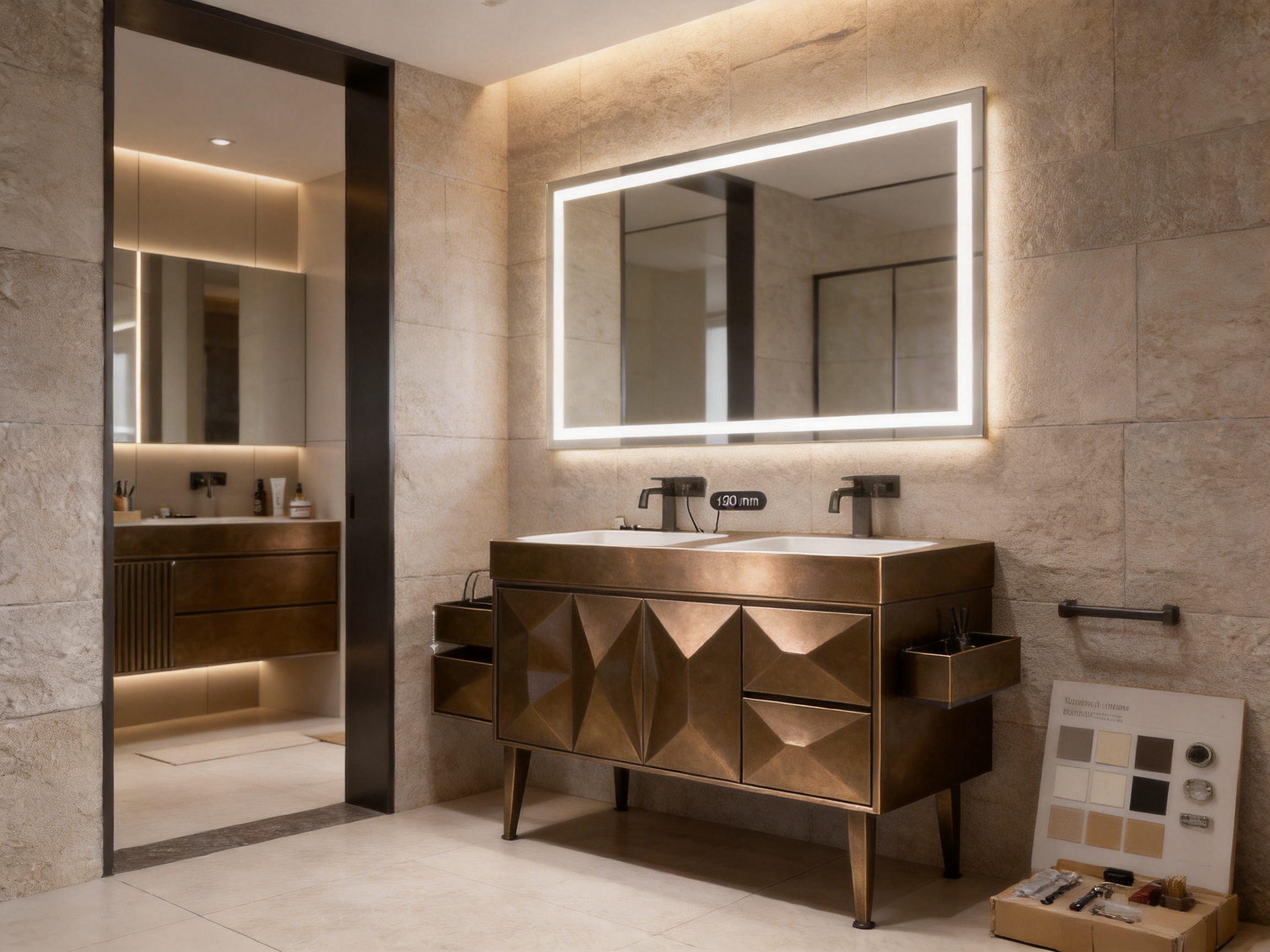
Bathroom vanities are no longer treated as purely functional storage units. In contemporary residential, hospitality, and commercial interiors, the vanity often becomes one of the most visible architectural elements in the room. It defines the relationship between the basin, mirror, wall finish, lighting, and floor surface while providing essential storage for everyday use. The Phantom Geometric Faceted 3D-Visual Bathroom Vanity responds to this changing expectation with a combination of sculptural design, moisture-resistant construction, precision manufacturing, and project-oriented customization.
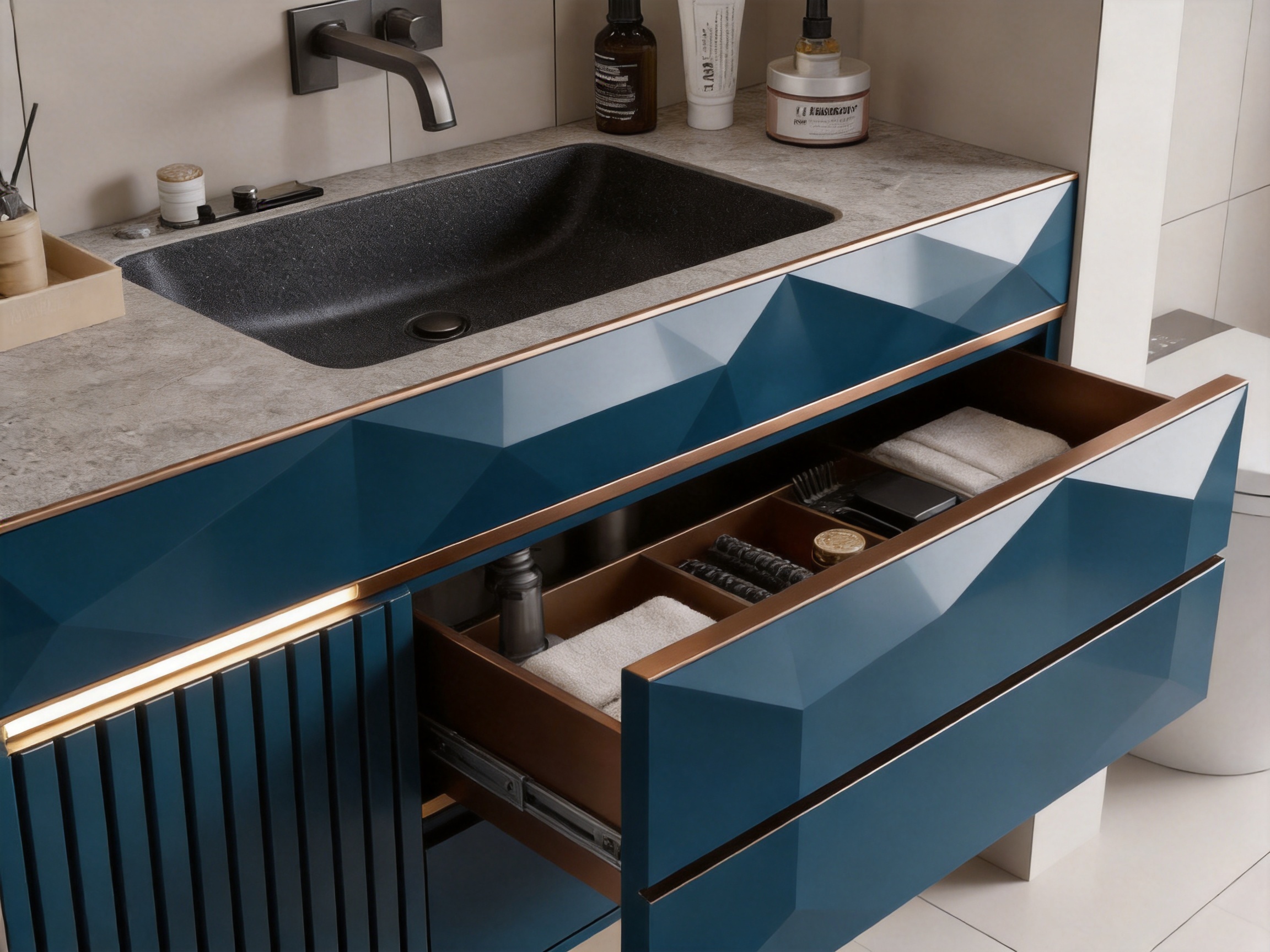
Inspired by architectural geometric facets, the Phantom series moves beyond the conventional flat-front cabinet. Its three-dimensional façade uses directional planes, folded linear structures, and carefully controlled transitions to create a continuously changing relationship between light and shadow. From one viewing angle, the surface can appear restrained and linear; from another, it reveals a more dramatic layered rhythm. This visual movement gives the vanity a strong design presence without relying on excessive decoration.
Behind the expressive exterior is a practical bathroom storage system developed for demanding environments. Marine-grade waterproofing options, corrosion-resistant hardware, drainage-pipe avoidance, certified anti-mold finishes, integrated basin configurations, and adaptable installation structures make the collection suitable for both individual interiors and larger development projects. The design is available in wall-mounted floating and floor-standing formats, allowing architects, contractors, and distributors to select the configuration that best matches the room layout and operational requirements.
Manufactured by Suzhou Dicosbo Wood Co., Ltd., the product benefits from more than two decades of experience in wood flooring, wooden doors, and custom cabinet manufacturing. The company combines German-imported production lines, automated quality-control systems, OEM/ODM capability, rapid prototyping, and project-based engineering support to provide a bathroom vanity solution that is not only visually distinctive but also repeatable, scalable, and suitable for international supply chains.
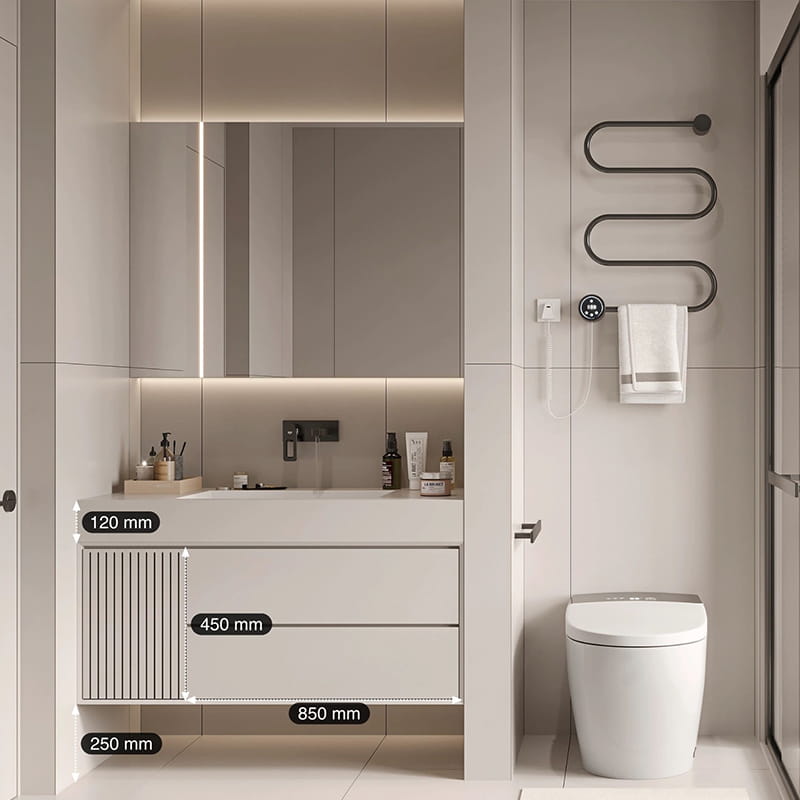
Phantom Geometric Faceted 3D-Visual Bathroom Vanities
Traditional bathroom vanities generally rely on rectangular boxes, flat drawer fronts, and predictable horizontal lines. These forms are efficient, but they can make many bathrooms look interchangeable. The Phantom Geometric Faceted 3D-Visual Bathroom Vanity introduces a stronger architectural identity by treating the cabinet façade as a three-dimensional surface rather than a simple plane.
The geometric faceted language is based on the controlled arrangement of angled and folded sections. Each plane contributes to the overall visual rhythm, creating subtle variations in depth and reflection. The result is a cabinet that changes character as the user moves through the room. Under soft daylight, the surface may present calm tonal transitions. Under integrated LED lighting or directional ceiling lighting, the facets can produce sharper highlights and deeper shadow lines.
This design approach is especially valuable in spaces where the vanity serves as a focal point. A master bathroom can use the cabinet to reinforce a minimalist architectural theme. A boutique hotel can use it to establish a recognizable guest-room identity. A designer showroom or creative studio can display the collection as an example of contemporary industrial craftsmanship.
Although the façade is visually complex, the design does not sacrifice usability. Interior compartments remain organized for routine bathroom items, cleaning supplies, towels, and personal care products. The external geometry is coordinated with drawer movement, cabinet access, countertop dimensions, and plumbing requirements. In this way, the product balances visual impact with the practical expectations of a daily-use bathroom fixture.
A major advantage of the Phantom concept is that it creates a distinctive surface without adding ornamental components that can become difficult to clean. The pattern is formed through the cabinet structure and precision-machined panels rather than through loosely attached decorative parts. This integrated approach supports a cleaner overall appearance and reduces the risk of visual disorder.
The three-dimensional face also offers a controlled alternative to highly glossy or heavily patterned finishes. Instead of depending entirely on color contrast, the cabinet achieves depth through light direction, material texture, and shadow. This allows the same design language to work in architectural grey, matte metallic bronze, deep sea blue, or minimalist pure white.
The vanity is suitable for residential projects that emphasize linear aesthetics, restrained material palettes, and carefully coordinated details. It can be paired with stone walls, microcement, porcelain slabs, wood flooring, large-format tiles, or dark metal accessories. The faceted surface provides a sculptural counterpoint to smooth wall finishes while remaining compatible with modern minimalist interiors.
In hospitality settings, the collection can help differentiate rooms, suites, restaurants, spas, and public washrooms. Designers can coordinate basin materials, mirror cabinets, lighting, and side storage to create a consistent guest experience. For multi-unit developments, the design can be repeated across rooms while allowing selected adjustments in width, color, countertop, and internal configuration.
Many standard bathroom cabinets are designed primarily around basic cost and mass-production efficiency. They may use generic flat panels, ordinary hardware, limited plumbing clearance, and surface materials that are not optimized for prolonged humidity. The Phantom series addresses these weaknesses through coordinated design engineering and material selection.
The most visible difference is the faceted front. A conventional flat cabinet presents a single uninterrupted surface. The Phantom cabinet introduces directional planes and precise relief that create a richer visual relationship with the room. This can help a project achieve a premium appearance without adding separate wall cladding or complex decorative features.
The geometric form is not merely cosmetic. The design is developed through CNC composite processing, which allows the manufacturer to control angles, transitions, alignment, and repeatability. This is important for project buyers who require multiple units to maintain the same visual language across different rooms or buildings.
Low-quality bathroom furniture can swell, delaminate, discolor, or develop mold when exposed to repeated humidity. The Phantom series offers material and finish options intended for the demanding bathroom environment. Depending on the project specification, construction may use multi-layer solid wood plywood with protective wax coating or high-density PVC-based materials. Eco-friendly high-density particle board is also available as a customizable carcass option.
These material choices are selected to improve resistance to water exposure, temperature variation, and high humidity. Waterproof edge-banding options include PUR eco-friendly waterproof edge banding and seamless laser edge banding. Properly sealed edges are particularly important because exposed board edges can become vulnerable when water repeatedly contacts the cabinet near the basin or floor.
One of the practical problems in vanity installation is the conflict between drawers, shelves, and drainage pipes. Generic cabinets may require extensive on-site cutting, reducing storage capacity and increasing installation time. The Phantom series addresses this issue by designing drawers and internal shelves with U-shaped clearances that correspond to wall-drain or floor-drain positions shown in engineering drawings.
This approach allows the storage layout to be planned before production. It can reduce unexpected modifications, improve the appearance of the finished cabinet, and help installers work more efficiently. For projects with multiple bathroom layouts, the cabinet can be adapted to the relevant floor plans and plumbing conditions rather than forcing every room to use an identical internal arrangement.
The collection supports several countertop and basin approaches. Options include integrated mineral composite stone basins, minimalist dark ultra-thin sintered stone basins, ceramic integrated basins, light luxury slab stone, marble countertops, and single- or double-basin configurations. This flexibility gives designers more control over the relationship between the vanity and the surrounding finishes.
An integrated basin can provide a clean, continuous appearance and simplify the visual transition between countertop and wash area. Sintered stone and slab materials can create a more architectural expression, especially in luxury residences and hospitality environments. The ability to select different basin widths and configurations also makes the system suitable for compact guest bathrooms, spacious master bathrooms, and shared commercial washrooms.
Wall-mounted floating vanities create an open zone beneath the cabinet. This makes floor cleaning easier, visually enlarges smaller bathrooms, and supports a lighter contemporary appearance. Floor-standing versions extend storage capacity and can be appropriate where maximum volume, stronger visual grounding, or simpler installation is preferred.
Offering both structures is an important advantage for project planning. The same design language can be used in different room types without forcing the architect to compromise on the preferred installation method. The final choice can be based on wall strength, plumbing position, cleaning requirements, storage expectations, and overall interior composition.
The Phantom series uses 304 stainless steel and moisture-resistant electroplated hardware options for hinges and related components. Soft-close concealed hangers and hinges are available, helping drawers and doors operate smoothly while reducing impact noise. Hardware reliability is particularly significant in bathrooms, where ordinary metal components can corrode, stiffen, or develop visible discoloration.
Corrosion-resistant hardware does not eliminate the need for ventilation and routine care, but it provides a stronger foundation for long-term performance. For hotels, apartments, and other high-use environments, smooth and dependable opening action contributes directly to user satisfaction and maintenance efficiency.
The Phantom bathroom vanity is configured as a customizable project product rather than a single fixed-size retail cabinet. This allows material selection, dimensions, basin integration, color, hardware, and storage features to be adjusted according to the design brief and engineering documentation.
Component |
Available Specification |
Door surface finish |
Solid wood multi-layer frame with matte vintage paint or light relief detail treatment; customizable |
Countertop and basin |
Integrated mineral composite stone, minimalist dark ultra-thin sintered stone basin, ceramic, marble, or slab stone options |
Carcass material |
18 mm solid wood plywood or eco-friendly high-density particle board; customizable |
Side panel and shelf |
18 mm board thickness |
Back panel |
9 mm board thickness |
Edge banding |
PUR eco-friendly waterproof edge banding or seamless laser edge banding |
Color options |
Architectural grey, matte metallic bronze, deep sea blue, minimalist pure white, and custom colors |
Base dimensions |
Customized according to floor plans and project blueprints |
Standard hardware |
Blum soft-close concealed hangers and hinges, with customizable hardware selections |
Optional upgrades |
Geometric sensor LED strips, modular drawer storage systems, and suspended matching side cabinets |
Environmental certifications |
CARB Phase 2, EU E0 grade, and FSC-certified material options |
The 18 mm side panels and shelves provide a solid basis for daily-use storage. The 9 mm back panel helps maintain structural stability while accommodating the practical requirements of cabinet assembly and wall positioning. For projects where appearance and edge durability are especially important, seamless laser edge banding can create a cleaner transition with reduced visible joint lines.
The surface finish can be selected to complement the architectural concept. Architectural grey supports neutral contemporary palettes. Matte metallic bronze introduces warmth and a refined industrial character. Deep sea blue provides a more expressive, hospitality-oriented appearance, while minimalist pure white supports bright, clean, and compact bathroom designs.
Bathroom furniture must be evaluated as a system. A moisture-resistant board alone is not enough if the edges, joints, hardware, basin connection, and installation details are not properly considered. The Phantom product approach coordinates these elements so that the cabinet can perform as a complete bathroom unit.
Water should still be removed from exposed surfaces rather than allowed to remain for extended periods. Proper ventilation, correct installation, sealed plumbing connections, and routine cleaning all contribute to the service life of the cabinet. The materials and finishes provide resistance, but responsible maintenance remains essential in any bathroom environment.
The visual success of a faceted cabinet depends on manufacturing accuracy. If adjacent planes are misaligned, if angles vary between units, or if surface transitions are rough, the design loses its architectural clarity. For this reason, the Phantom series relies on high-precision CNC composite processing and controlled production methods.
CNC manufacturing allows digital design information to be translated into repeatable cutting, routing, shaping, and drilling operations. This is particularly valuable for three-dimensional panels because the process can maintain consistent geometric relationships across multiple components. It also makes it easier to produce customized dimensions without abandoning the original design language.
Project-based vanity manufacturing begins with design information. Floor plans, wall dimensions, drain positions, basin requirements, mirror locations, electrical points, and installation conditions are reviewed before production. The use of engineering drawings allows the manufacturer to coordinate cabinet depth, drawer clearances, pipe avoidance, wall mounting, and side-cabinet placement.
This pre-production coordination can reduce errors that often occur when a standard cabinet is modified on site. It also provides a more predictable basis for quantity planning and installation scheduling. For architects and contractors, the ability to review and confirm details before manufacturing is a major benefit when working on high-value interiors.
DEIF operates German-imported production lines designed to support stable processing quality. Advanced equipment helps improve dimensional consistency, surface preparation, edge treatment, and component repeatability. For a product with complex geometric details, controlled equipment is essential to achieving smooth transitions and reliable assembly.
Automated production does not replace professional craftsmanship. Instead, it provides a stable technical foundation on which skilled operators and quality personnel can manage material selection, finishing, inspection, packaging, and project-specific requirements. The combination of automation and experienced supervision supports both repeatable production and flexible customization.
The company applies a strict three-step quality inspection process. Although inspection details may vary according to the project specification, a structured quality system generally reviews material and component condition, processing and assembly accuracy, and final product presentation before shipment.
For the Phantom vanity, quality attention should include the alignment of faceted surfaces, consistency of color and finish, smoothness of edges, correct positioning of U-shaped drainage clearances, operation of hinges and drawers, basin integration, and the completeness of installation components. Packaging condition is also important because countertops, finished panels, and hardware must arrive safely after international transportation.
DEIF offers 72-hour rapid prototyping capability for selected development requirements. Rapid prototyping can help designers and purchasing teams evaluate a new dimension, finish, faceted pattern, basin arrangement, or hardware combination before committing to a larger quantity.
For hospitality and residential developments, this process can shorten the decision cycle. A physical sample helps stakeholders judge scale, color, surface reflection, drawer operation, and compatibility with adjacent materials more accurately than a digital image alone. It also provides an opportunity to identify installation issues before the project enters mass production.
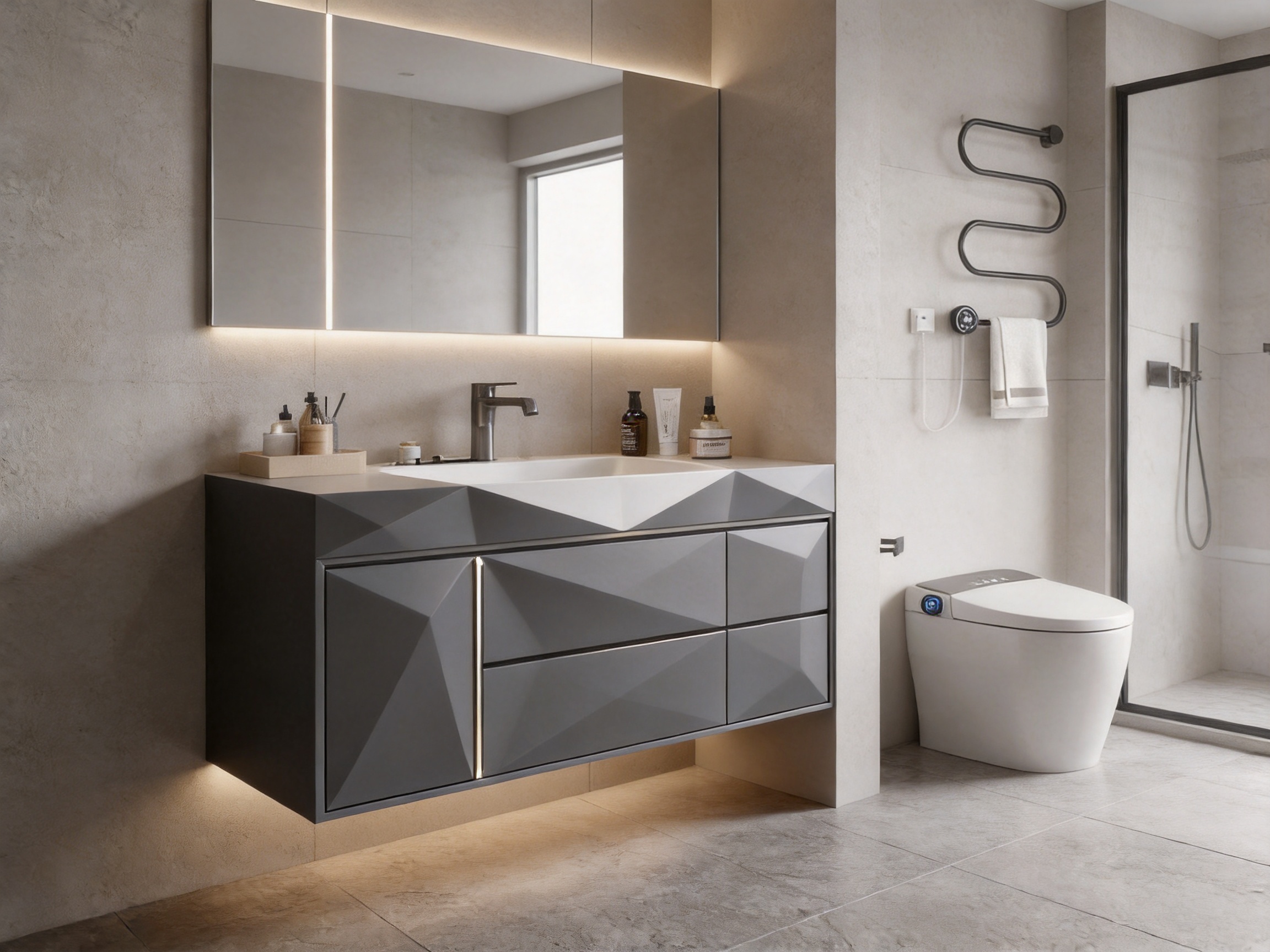
The product is engineered for project customization. Base dimensions are determined according to the floor plan and project blueprints, which means the vanity can be developed for narrow wall conditions, large double-basin arrangements, irregular plumbing locations, or coordinated furniture packages.
Customization may include width, depth, height, drawer division, basin quantity, countertop material, surface color, edge treatment, side cabinet configuration, mirror cabinet wiring, lighting, and mounting method. The purpose is not to create an entirely unrelated product for every project, but to adapt a coherent product platform to different architectural conditions.
Single-basin vanities are suitable for compact bathrooms, guest rooms, and many apartment layouts. Double-basin versions support shared master bathrooms and larger suites. Basin placement can be coordinated with wall dimensions, mirror sizes, lighting, and user circulation.
Material selection also affects the atmosphere of the room. A mineral composite basin can provide a smooth integrated appearance. A dark ultra-thin sintered stone basin may support a dramatic luxury concept. Ceramic can deliver a familiar clean surface, while marble or slab stone can reinforce a high-end architectural specification.
The cabinet structure can be pre-reserved for concealed wiring and installation holes associated with defogging smart mirrors, LED lighting, and hair dryer sockets. Planning these requirements early helps avoid visible cables and uncoordinated site drilling.
Smart mirror integration should be coordinated with the electrical contractor and the project’s local safety requirements. The cabinet can accommodate the design intention, but final electrical installation must be completed by qualified professionals using approved components and appropriate bathroom zoning practices.
Custom geometric sensor LED strips can emphasize the faceted structure or provide functional illumination near the vanity. Lighting temperature, brightness, activation method, and placement can be adapted to the interior concept. Sensor operation may be especially useful in hospitality and residential settings where convenient, low-contact activation is preferred.
Modular precision storage systems can be added inside drawers to organize cosmetics, grooming tools, cleaning accessories, and other small items. Suspended matching side cabinets can extend storage while maintaining a coordinated visual language. These additions allow the main vanity to remain orderly and reduce countertop clutter.
The pricing method can be customized according to projected area or unfolded area, depending on the project’s commercial and technical requirements. A mock-up order may begin with one set, while project quantities can be based on a minimum order of approximately 20 sets. Final quantities, packaging, dimensions, and price calculations should be confirmed against approved drawings and production specifications.
OEM and ODM support allows distributors, designers, developers, and contractors to work with a manufacturer that can produce according to their own project standards. This is useful when the buyer needs a private-label appearance, coordinated product family, or repeatable cabinet specification for multiple developments.
International project buyers increasingly evaluate furniture not only by appearance and cost but also by material emissions, responsible sourcing, documentation, packaging, and supply reliability. The Phantom series can be specified with CARB Phase 2, EU E0, and FSC-certified material options, depending on the selected components and project requirements.
CARB Phase 2 and EU E0 classifications are associated with low-emission wood-based panel requirements. FSC certification supports responsible forest-management objectives when certified material is selected and properly documented through the supply chain. These certifications can help architects and contractors align furniture procurement with environmental targets, green-building programs, and client expectations.
DEIF’s product portfolio complies with CE, FSC, CARB P2, and ISO 9001-related quality requirements as applicable to product and project specifications. Buyers should confirm the exact certification scope for the selected materials, hardware, electrical accessories, and destination market before placing an order.
Bathroom vanities contain finished surfaces, stone or composite components, hardware, and sometimes glass mirror elements. Packaging therefore has a direct influence on delivery quality. The product can be shipped in flat-pack RTA packaging using heavy-duty export cartons with EPS corner protectors. Glass doors and islands are secured in fumigation-free wooden crates for additional protection during ocean freight.
Packaging specifications can be adjusted according to shipping method, container loading plan, installation sequence, and destination requirements. Proper labeling and component grouping can also help installers identify panels, hardware, basins, and accessories during assembly.
DEIF operates production facilities totaling approximately 20,000 square meters and has an annual flooring capacity of about 2,400,000 square meters, together with the capacity to produce approximately 5,000 sets of doors. While bathroom vanity production must be scheduled according to design complexity and order volume, the broader manufacturing infrastructure demonstrates experience with large-scale wood-product supply and project coordination.
The company has more than 10 years of export experience and serves partners across Europe, North America, Southeast Asia, and other international markets. This background is valuable for buyers who require export documentation, consistent communication, packaging discipline, and repeat deliveries across different project phases.
In a modern residence, the Phantom vanity can serve as the central composition of a master bathroom or guest bathroom. Architectural grey and pure white are suitable for quiet material palettes, while deep sea blue or matte metallic bronze can create a stronger accent. The floating version is appropriate for interiors where the floor line should remain visible and easy to clean.
For master bathrooms, a double-basin configuration with integrated storage and a smart mirror cabinet can create a complete grooming zone. In smaller guest bathrooms, a narrow single-basin configuration can preserve circulation while adding a distinctive design feature.
Developers can use the collection as an upgrade option or as part of a premium interior package. Repeated use of the same geometric language across multiple apartments can establish product consistency, while color and size variations can differentiate unit types.
For large developments, early approval of a mock-up is recommended. The mock-up can confirm how the chosen finish interacts with bathroom tiles, stone, lighting, faucets, mirrors, and flooring. Once approved, the production specification can be repeated across the required units with controlled adjustments for room-specific conditions.
Boutique hotels often seek bathroom details that make guest rooms memorable. The faceted surface can support a distinctive design identity and provide a more artistic alternative to standardized hotel furniture. A coordinated mirror, LED system, side cabinet, and stone basin can create a complete visual statement.
Hotel environments also require dependable daily operation. Soft-close hardware, corrosion-resistant components, easy-to-clean surfaces, and planned drainage clearances help support housekeeping and maintenance routines. Floor-standing versions may be chosen where additional storage or a stronger furniture presence is required.
In spas and wellness facilities, the vanity should communicate cleanliness, calmness, and material quality. Light colors, integrated basins, concealed wiring, and floating installation can help create a refined environment. In public areas, durable finishes and practical maintenance access should be reviewed alongside the aesthetic concept.
Designer studios, galleries, and exhibition spaces can use the vanity as a demonstration of advanced cabinet geometry and industrial design. The product is particularly effective where the interior is intended to showcase material transitions, lighting effects, and precision fabrication.
Correct installation is essential to achieving the intended appearance and performance of a faceted vanity. Before delivery, the project team should confirm wall conditions, floor levels, drain locations, water supply points, electrical provisions, mirror dimensions, and access routes. Wall-mounted units require suitable structural support and properly selected fixing hardware.
The vanity should be installed level and square so that drawers, doors, basin connections, and faceted panels operate correctly. Plumbing should be connected without placing excessive stress on the cabinet or creating persistent water leakage. Where the design includes concealed wiring, electrical work should be completed in accordance with local regulations and by qualified installers.
Faceted surfaces should be wiped with a soft microfiber dry cloth for routine dust removal. If stains are present, use a mild neutral detergent diluted according to the cleaning product instructions. Apply the solution to the cloth rather than saturating the cabinet, and gently wipe the surface.
Water residue should not be allowed to remain on edges, corners, joints, or around the basin. After cleaning, dry the surface with a clean cloth. Abrasive powders, aggressive solvents, wire brushes, and rough scouring pads should be avoided because they can affect paint, edge treatments, or surface sheen.
The three-dimensional structure gives the cabinet its distinctive character, but projecting edges and folded transitions should be treated with care. Avoid striking the faceted surfaces with hard or sharp objects. Heavy bathroom accessories should not be dropped onto the countertop or used in a way that places concentrated force on cabinet edges.
Good airflow is one of the simplest ways to extend the life of bathroom furniture. After bathing, use the exhaust fan or open suitable ventilation openings to remove excess moisture. Wipe standing water from the countertop and basin area, and check plumbing connections periodically for leaks.
Moisture-resistant materials and corrosion-resistant hardware provide important protection, but no cabinet should be exposed to uncontrolled flooding or constant condensation. A well-ventilated bathroom supports the longevity of boards, finishes, hinges, drawer systems, electrical accessories, and mirror components.
A visually attractive vanity can still create problems if the supplier cannot maintain quality across production batches. This is particularly true for a geometric product, where small dimensional differences may become visible when multiple units are installed side by side. Manufacturing capability therefore has a direct relationship with design credibility.
DEIF’s experience in wood flooring, wooden doors, and custom cabinets provides a broader technical foundation for the Phantom vanity. The company has been established since 1999, operates substantial production facilities, and serves global partners with OEM/ODM services. Its focus on German-imported equipment, automated quality control, rapid prototyping, and a three-step inspection process supports a more controlled transition from concept to finished product.
The company’s combined capabilities are also useful when a bathroom vanity is part of a wider interior package. Buyers may be able to coordinate cabinet finishes with custom doors, flooring, wall paneling, or other woodwork through one experienced manufacturing partner. This can simplify communication, reduce material inconsistencies, and improve the overall coherence of a project.
Distributors need products that are visually differentiated, technically credible, and sufficiently flexible for different market segments. The Phantom series can be presented as a premium design collection with multiple material, color, basin, and installation options. A distributor can offer a standard configuration for faster quoting while retaining the ability to develop customized versions for architects and developers.
Contractors benefit from clear engineering coordination, planned drainage clearance, organized packaging, and repeatable components. When dimensions and plumbing requirements are confirmed before production, site modifications can be reduced. The result is a more predictable installation process and fewer risks associated with improvised cabinet cutting.
Design professionals can use the vanity as an architectural focal point rather than treating it as an afterthought. The ability to select faceted finishes, basin materials, smart mirror preparation, side cabinets, and lighting allows the product to be integrated into the design concept from the beginning.
A successful customized vanity project should begin with a clear design and technical brief. The brief should identify the intended room type, quantity, target dimensions, basin configuration, finish, color, hardware, installation method, mirror requirements, storage expectations, and destination market.
The next stage is drawing review. Floor plans and elevations should show wall lengths, drain positions, water supply points, electrical points, finished floor levels, mirror dimensions, and adjacent materials. This information allows the manufacturer to establish the cabinet structure and confirm the U-shaped pipe-avoidance details.
After preliminary confirmation, a finish and material sample can be reviewed. For projects with complex geometry or high quantities, a mock-up set is recommended. The sample should be inspected under the actual or representative lighting conditions, because faceted surfaces can change appearance significantly depending on light direction and color temperature.
Once the design is approved, the manufacturer can prepare production drawings, a component list, packaging requirements, and an installation plan. Any changes should be recorded before manufacturing begins. This is especially important for basin cutouts, drawer clearances, electrical reservations, and wall-mounting points.
During production, inspection should verify material, dimensions, finish, hardware operation, basin integration, and packaging protection. Before shipment, the buyer should receive the approved product information and installation documentation required for site coordination.
The Phantom Geometric Faceted 3D-Visual Bathroom Vanity occupies a distinctive position between ordinary modular bathroom furniture and highly specialized bespoke millwork. It provides a recognizable design concept while retaining the practical advantages of a configurable manufacturing platform.
Compared with basic flat-front vanities, it offers greater visual depth, stronger architectural identity, and more opportunities for premium positioning. Compared with fully one-off site-built furniture, it offers a more repeatable manufacturing process, controlled component quality, and the ability to produce multiple units with consistent geometry.
Its competitive value is also supported by bathroom-specific engineering. Waterproofing options, anti-mold and crack-resistant finishes, U-shaped pipe avoidance, corrosion-resistant hardware, integrated basin configurations, and concealed smart-mirror wiring address issues that are often treated separately in conventional furniture procurement.
For commercial buyers, this combination can improve the relationship between appearance, durability, installation efficiency, and long-term maintenance. For designers, it provides a flexible surface language. For developers and distributors, it creates a product that can be standardized, customized, and scaled according to project requirements.
The main difference is the three-dimensional geometric façade. Instead of using a flat cabinet front, the Phantom design employs faceted planes and folded linear structures that create changing light and shadow effects. It combines this visual identity with bathroom-oriented moisture protection, drainage clearance, customizable basins, and corrosion-resistant hardware.
Yes. The product can be specified with multi-layer solid wood plywood with protective treatment, high-density PVC materials, or other project-approved board options. Waterproof edge-banding and moisture-resistant hardware further support bathroom use. Proper ventilation, installation, and routine cleaning are still required.
Yes. Drawers and internal shelves can be designed with U-shaped clearances to avoid drainage pipes. The exact configuration should be confirmed from engineering drawings and the actual bathroom floor plan before production.
Yes. The collection supports wall-mounted floating structures and floor-standing structures. Floating designs simplify floor cleaning and create a lighter appearance, while floor-standing designs can provide maximum storage and a stronger furniture base.
Available options include integrated mineral composite stone, ceramic integrated basins, light luxury slab stone, marble countertops, and minimalist dark ultra-thin sintered stone basins. Single- and double-basin layouts can be customized.
Yes. Base dimensions are customized according to floor plans and project blueprints. Width, depth, height, storage layout, basin position, side cabinets, and mirror coordination can be reviewed during the engineering stage.
The cabinet can be pre-reserved for concealed wiring and installation holes for defogging smart mirrors, LED lighting, and hair dryer sockets. Electrical installation must comply with local regulations and be completed by qualified professionals.
Standard design directions include architectural grey, matte metallic bronze, deep sea blue, and minimalist pure white. Custom colors may be considered according to project requirements, finish samples, and production feasibility.
The product can be equipped with 304 stainless steel and moisture-resistant electroplated hardware. Blum soft-close concealed hangers and hinges are listed as standard hardware options, with other selections available for customization.
A mock-up order can begin with one set, and DEIF also offers rapid prototyping for selected requirements. A physical sample is recommended when the project involves complex geometry, special finishes, custom basins, or large quantities.
Material options may include CARB Phase 2, EU E0, and FSC-certified components. The exact certification scope should be confirmed for the selected materials and destination market before order approval.
Use a soft microfiber cloth for daily cleaning. For stains, use a mild neutral detergent and avoid leaving water residue on edges or corners. Abrasive tools and aggressive chemicals should not be used.
The product is suitable for modern residences, luxury apartments, boutique hotels, spas, hospitality facilities, designer studios, exhibition spaces, and other interiors that require a distinctive yet practical bathroom furniture solution.
Yes. DEIF specializes in wood flooring, wooden doors, and custom cabinet solutions. This broader manufacturing capability can support coordinated interior packages and consistent material specifications across different areas of a project.
The Phantom Geometric Faceted 3D-Visual Bathroom Vanity transforms a necessary bathroom fixture into an architectural design element. Its geometric façade creates dynamic light and shadow, while its internal structure remains organized for everyday storage and practical use. The collection is strengthened by moisture-resistant material options, waterproof edge treatment, drainage-pipe avoidance, integrated basin flexibility, floating or floor-standing installation, 304 corrosion-resistant hardware, and smart mirror wiring preparation.
Its greatest advantage is the integration of design ambition and manufacturing discipline. High-precision CNC composite processing supports accurate geometric transitions. German-imported production lines and automated quality control contribute to repeatability. Rapid prototyping helps buyers validate customized concepts, while a structured inspection process and export-oriented packaging support project delivery.
For architects, contractors, developers, distributors, and hospitality buyers, the Phantom series offers a balanced solution: visually distinctive enough for premium interiors, technically adaptable enough for project conditions, and structured enough for repeatable production. With appropriate material selection, installation, ventilation, and maintenance, it can provide a durable and memorable centerpiece for contemporary bathroom environments.
1. Suzhou Dicosbo Wood Co., Ltd. Product Specification Materials for Phantom Geometric Faceted 3D-Visual Bathroom Vanities.
2. Suzhou Dicosbo Wood Co., Ltd. Manufacturing and Company Capability Information.
3. Forest Stewardship Council. Principles and Criteria for Responsible Forest Management.
4. California Air Resources Board. Composite Wood Products and CARB Phase 2 Emission Requirements.
5. European Standards and Technical Guidance for Low-Emission Wood-Based Panels.
6. International Organization for Standardization. Quality Management System Principles and ISO 9001 Guidance.
7. General Technical Guidance for Bathroom Furniture Moisture Protection, Ventilation, and Maintenance.

We provide customers with sustainable and eco-friendly
engineered wood solutions and services.
Choose DEIF for the perfect blend of
performance and aesthetics.
