


 English
 Español
 عربى
عربى

Get Social
Choose DEIF for the perfect blend of
performance and aesthetics.
 Get Free Sample

Content
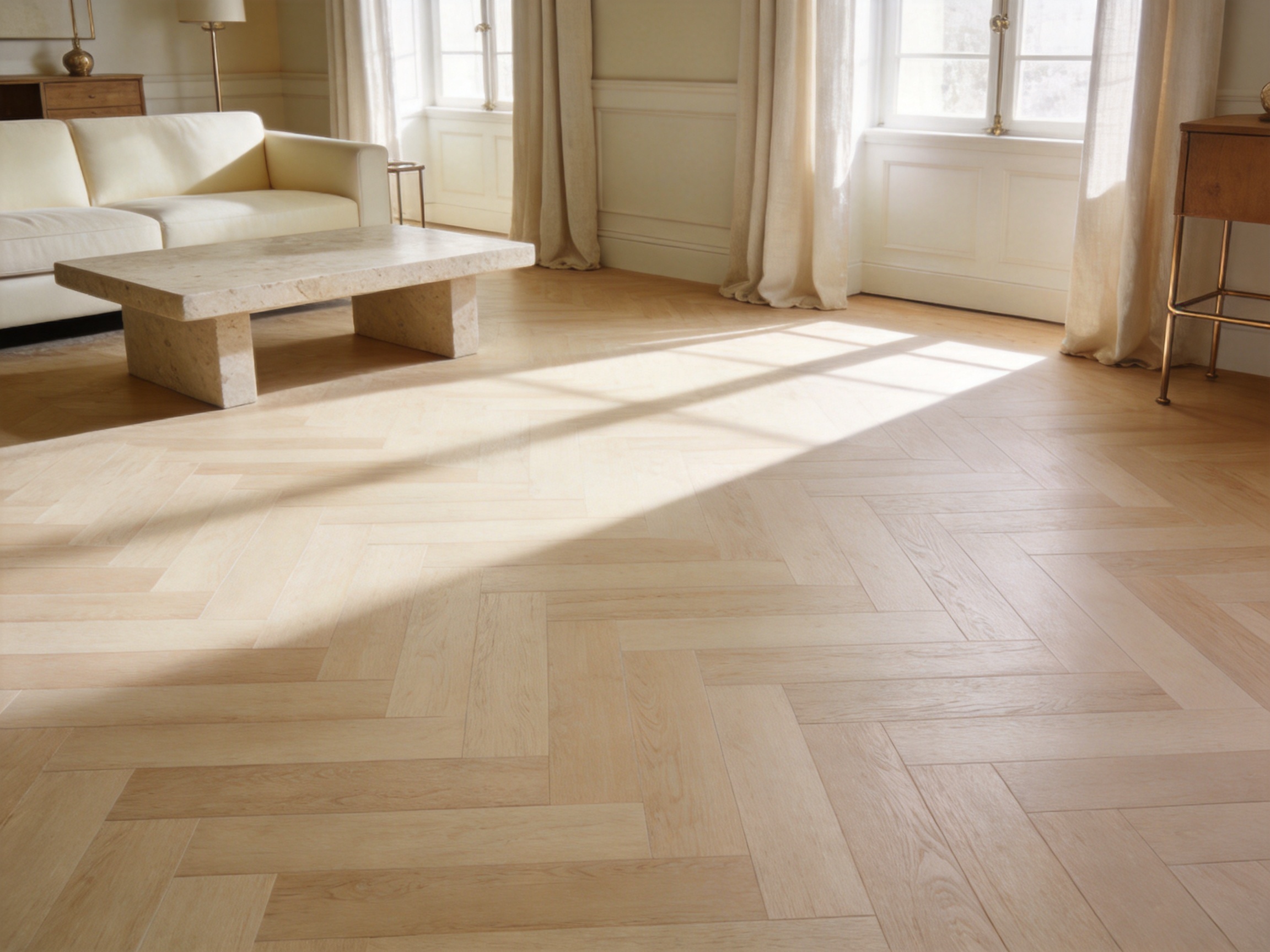
In contemporary residential and commercial interiors, flooring is no longer treated as a passive background material. It defines rhythm, reflects light, guides movement, and influences the emotional tone of an entire space. White Oak Herringbone Light Beige Matte Parquet Flooring is designed for projects that require a balance of natural warmth, refined geometry, durable performance, and visual sophistication. With its elegant herringbone pattern, soft light beige color, matte surface, and customizable production options, this flooring solution is especially suited to luxury residences, hotel lobbies, commercial showrooms, boutique spaces, bedrooms, living rooms, leisure areas, and architectural interiors where detail matters.
This product belongs to the broader parquet flooring family, with design flexibility for chevron and herringbone-inspired layouts. The herringbone arrangement creates a dynamic yet controlled visual flow. Unlike straight plank flooring, which emphasizes linear simplicity, herringbone introduces movement through repeated angled pieces. Unlike sharper chevron patterns, herringbone has a softer staggered geometry, creating a sense of fluidity and craftsmanship. The result is a floor that feels classic without being old-fashioned, decorative without becoming visually heavy, and distinctive without overpowering the interior design scheme.
The light beige tone is one of the product’s strongest design advantages. It brightens rooms, softens shadows, and pairs well with natural fabrics, pale stone, white walls, light wood furniture, brushed metal, muted greens, and warm neutral palettes. In Scandinavian interiors, it supports a clean and airy atmosphere. In light French-style interiors, it enhances elegance and texture. In commercial showrooms, it allows displayed products to remain the focus while still providing a premium architectural foundation. In hospitality environments, it creates a welcoming first impression that feels both natural and carefully curated.
White Oak Herringbone Light Beige Matte Parquet Flooring is developed for clients who require visual refinement, material authenticity, and reliable manufacturing quality. Its primary material impression comes from white oak, a wood species valued for its strength, attractive grain, and versatile color response. White oak has long been associated with premium flooring because it combines structural dependability with a grain pattern that can appear calm, architectural, or expressive depending on the cut, finish, and surface treatment.
The product features a matte finish that highlights the natural character of the wood without excessive gloss. This is important for modern interiors because high-gloss flooring can sometimes create glare, reveal scratches more easily, or appear less natural under strong lighting. A matte surface produces a softer, more contemporary effect. It allows the grain to remain visible while supporting a minimalist and elegant appearance. In everyday use, matte finishes also tend to blend minor surface marks more naturally than highly reflective coatings, making them practical for busy residential and commercial settings.
The referenced plank size is 510 x 102 x 15 mm, with an imperial equivalent of approximately 20.1 inches by 4.0 inches by 19/32 inches. This proportion is well suited to herringbone patterning because it is long enough to create flow while still maintaining the precise modular rhythm required for parquet layouts. The product also supports customization in sizes and colors, allowing architects, distributors, contractors, and project owners to align the floor with specific design briefs, installation areas, and market preferences.
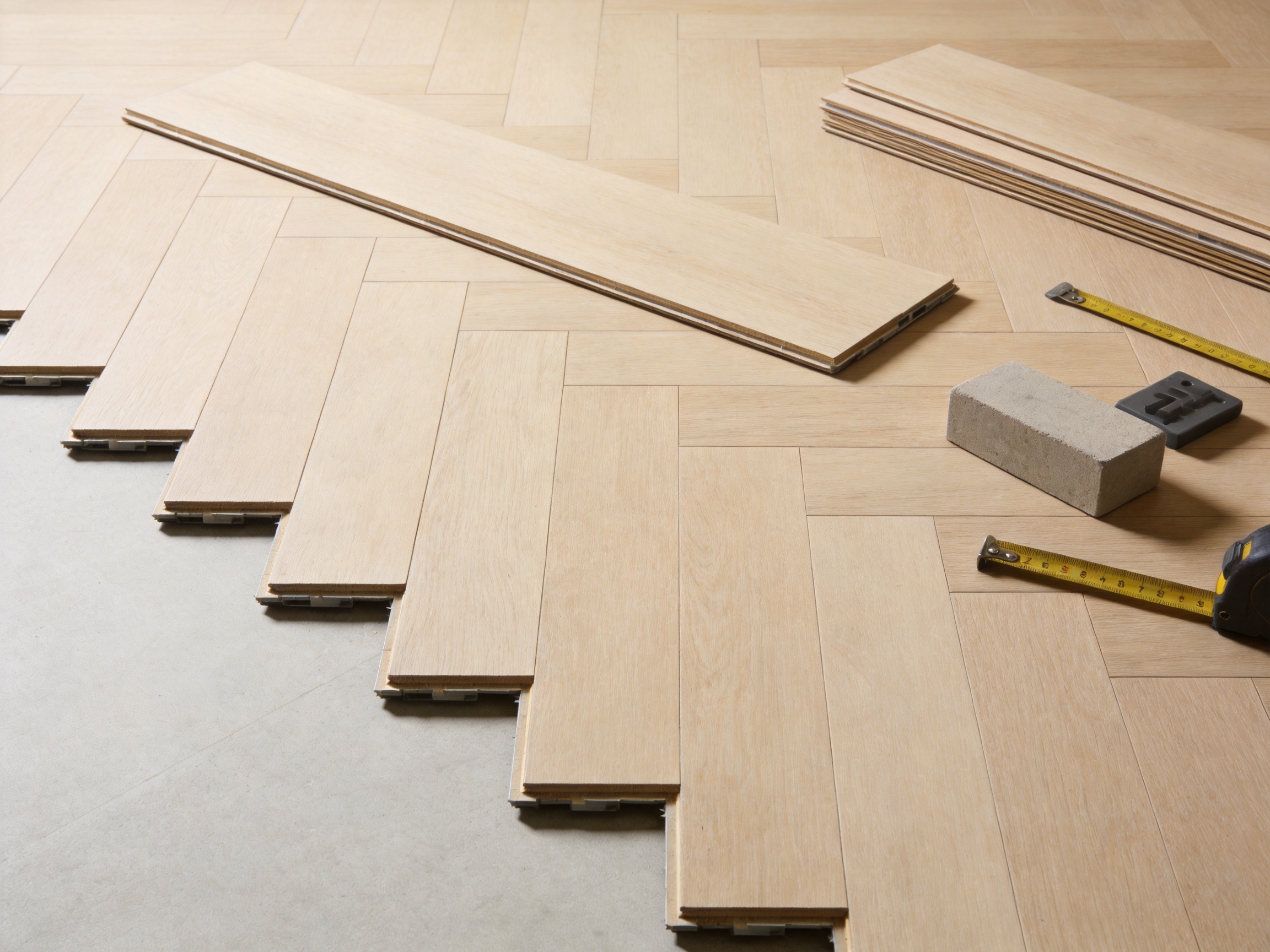
Beyond surface beauty, the flooring is designed with practical installation in mind. The click-lock system on four sides supports precise plank joining and efficient installation. In project environments, installation speed and consistency matter because flooring often affects the overall construction schedule. A reliable locking profile helps installers achieve tight joints, improved flatness, and reduced dependence on complex manual alignment. This is particularly valuable in herringbone and parquet applications, where pattern accuracy is essential for the final visual effect.
Herringbone flooring has a long architectural history, yet it remains relevant because it brings visual movement to a space without sacrificing order. The pattern is composed of rectangular planks laid in a staggered zigzag arrangement. This creates directional energy and a sense of hand-laid craft. The eye follows the pattern naturally, making rooms feel more designed and intentional.
Compared with standard plank flooring, herringbone delivers a higher level of decorative value. Straight planks can be beautiful, especially in natural oak, but they often create a simpler and more uniform surface. Herringbone introduces a layer of geometry that can elevate even understated interiors. It can make a living room feel more polished, a bedroom feel more carefully detailed, or a hotel lobby feel more luxurious.
Compared with chevron flooring, herringbone is often perceived as warmer and softer. Chevron pieces are typically cut at angles so the ends meet in continuous points, creating a more sharply directional V-shaped pattern. Herringbone, by contrast, overlaps rectangular ends in a broken zigzag layout. This makes it slightly more relaxed and less formal. For spaces that require elegance with comfort, herringbone is an excellent choice.
The light beige oak tone further enhances this balance. Dark parquet can feel dramatic and traditional, but it may reduce perceived room brightness. Gray floors can appear modern but sometimes feel cold. Warm beige oak provides an adaptable middle ground. It creates a natural and welcoming base while preserving the clean appearance desired in high-end contemporary interiors.
White oak is one of the most respected wood species in architectural flooring. Its grain is generally attractive, stable in appearance, and suitable for a wide range of finishes. It can show subtle straight grain, natural cathedrals, and fine mineral-like variation. These characteristics create depth without excessive visual noise, making white oak suitable for both residential and commercial interiors.
From a performance perspective, white oak is valued for its hardness and durability. While all wood floors require proper care, white oak provides a strong foundation for daily use. It can withstand normal household activity, showroom foot traffic, and hospitality use when properly specified, installed, and maintained. Its natural strength makes it a preferred choice for long-term flooring applications.
Another benefit of white oak is its compatibility with surface treatments. It accepts light beige tones beautifully because its natural color and grain structure support warm, pale finishes. The wood can appear fresh and organic rather than artificially colored. When finished in matte, the result is particularly refined: the floor reflects enough light to keep the room bright but not so much that the surface becomes visually distracting.
The product also offers customizable face veneer options such as oak, walnut, ash, and teak, depending on project requirements. Veneer grades can also be selected, including AB, ABC, ABCD, and CD. This flexibility allows buyers to balance visual consistency, natural character, and budget. For premium showrooms and residences, a cleaner grade may be preferred. For more rustic or character-driven spaces, a grade with greater natural variation can add warmth and individuality.
Parquet flooring demands a higher level of manufacturing accuracy than standard plank flooring. Each piece must be dimensionally consistent, precisely profiled, and carefully finished so that the pattern aligns cleanly during installation. Even small deviations can become visible across a herringbone layout. This is why production capability is a major factor when evaluating parquet flooring suppliers.
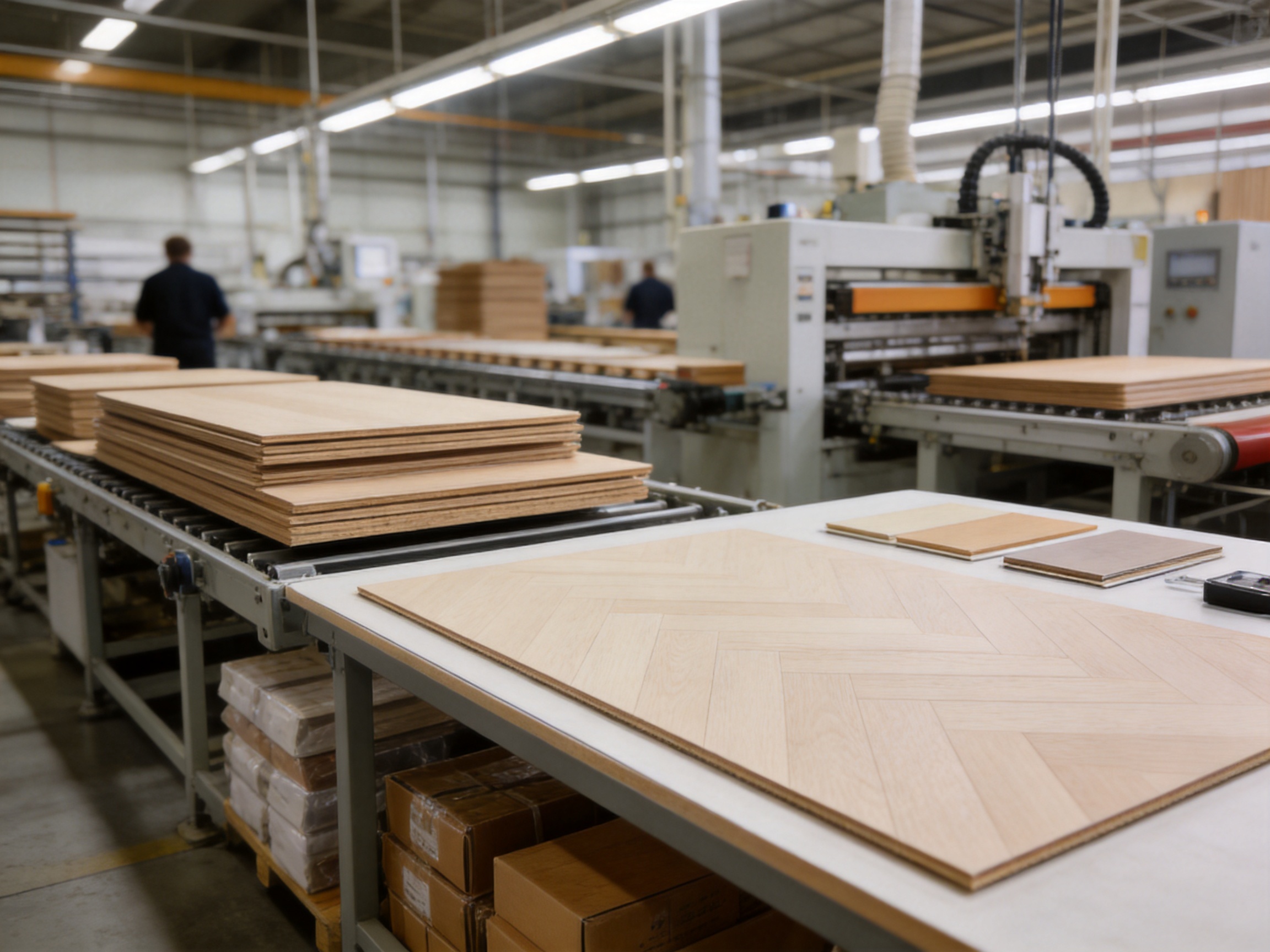
The product is supported by handcrafted splicing technology and precise assembly standards. Tight joints and high flatness are essential for a premium parquet floor. In herringbone installations, the repeated meeting points between planks create many opportunities for gaps or unevenness if machining is inconsistent. Advanced production equipment, controlled milling, and experienced craftsmanship help ensure that the final floor maintains both pattern clarity and surface continuity.
Suzhou Dicosbo Wood Co., Ltd., operating with the DEIF wood solutions platform, brings more than 20 years of manufacturing expertise to wood flooring, wooden doors, and custom cabinet solutions. Founded in 1999, the company has built production capabilities around large-scale output, project customization, and international compliance. Its 20,000-square-meter production facilities and German imported production lines support stable quality, repeatable machining, and efficient order fulfillment.
Advanced manufacturing is not only about machinery. It also requires material selection, moisture control, cutting accuracy, surface finishing discipline, packaging standards, and inspection procedures. DEIF applies a strict three-step quality inspection process, helping reduce defects before products reach customers. For distributors, contractors, and architects, this process lowers project risk. It helps ensure that delivered flooring meets expected specifications, visual standards, and installation requirements.
The following table summarizes key product and customization information for this parquet flooring solution. Actual project specifications may be adjusted according to client requirements, market standards, and application conditions.
| Item | Specification |
| Product Type | White oak light beige matte parquet flooring |
| Pattern Style | Herringbone visual layout with parquet collection customization; chevron 45° or 60° options available |
| Standard Dimensions | 510 x 102 x 15 mm |
| Imperial Dimensions | Approximately 20.1 inches x 4.0 inches x 19/32 inches |
| Face Veneer Options | Oak, walnut, ash, teak, and project-specific options |
| Veneer Grade Options | AB, ABC, ABCD, CD |
| Wear Layer Options | 2 mm, 3 mm, 4 mm, 6 mm |
| Core Construction | Eucalyptus or birch plywood options for engineered configurations |
| Surface Finish Options | UV lacquer, UV oil, wood wax oil |
| Surface Texture Options | Wire brushed, handscraped, smooth sanded |
| Profile Detail | Click system on four sides with V-bevel |
| Locking System | Click system |
| Installation Method | Floating installation |
| Pieces per Carton | 32 |
| Area per Carton | 1.665 square meters, approximately 17.92 square feet |
| Weight per Carton | Approximately 18 kg |
| Certification and Compliance | FSC, CE, CARB P2, ISO 9001 support depending on project documentation |
One of the most important advantages of this product is its ability to combine decorative design with practical flooring performance. Many competing floors provide either design value or installation convenience, but not always both. Traditional solid parquet can be visually impressive but may require more complex installation and stricter site conditions. Basic laminate or printed flooring may be easy to install but often lacks the authenticity and tactile depth of real wood. This white oak herringbone parquet solution occupies a stronger middle position by offering natural wood beauty, parquet geometry, customizable construction, and click-lock installation efficiency.
Another competitive advantage is the product’s color strategy. The light beige tone is broadly marketable because it works across multiple design styles. Some flooring competitors rely on trendy gray or overly dark tones that can become dated or limit interior flexibility. Light beige oak is more timeless. It supports Scandinavian minimalism, modern classic interiors, soft luxury apartments, boutique retail spaces, and hospitality projects. For distributors, this improves inventory relevance. For designers, it reduces the risk of color conflict. For homeowners, it creates a long-lasting aesthetic foundation.
The matte finish also offers a practical edge. High-gloss floors can look attractive in photographs but may be less forgiving in real use. They can show dust, footprints, and scratches more clearly. Matte flooring is more compatible with daily living and commercial foot traffic because it creates a calm, natural surface impression. It also aligns with current architectural trends that emphasize authenticity, tactile materials, and reduced visual glare.
The click system is another meaningful advantage over traditional glue-down parquet methods in certain project contexts. While glue-down installation remains important for many wood floors, a floating click system can reduce installation complexity and improve efficiency. It supports precise alignment and can be especially useful where project schedules are tight. When properly installed over a suitable subfloor and underlayment, click parquet can provide reliable performance while reducing labor demands.
Customization further differentiates the product from standard catalog flooring. Buyers can specify sizes, colors, veneer species, veneer grades, wear layer thicknesses, surface textures, and finishes. This is especially valuable for project-based procurement. A hotel may require a specific tone to match lobby furniture. A showroom may need a durable finish that handles foot traffic. A residential developer may want a consistent appearance across multiple units. A distributor may need localized grade and finish preferences for its market. Customization allows the product to become a solution rather than merely a stock item.
In living rooms, this flooring creates a strong design foundation without overwhelming the furniture layout. The herringbone pattern draws attention but remains elegant because the light beige tone softens the geometry. It works especially well with cream sofas, linen curtains, pale oak cabinets, marble coffee tables, black accent lighting, and natural woven rugs. The floor can become the subtle centerpiece of the room, adding texture and motion while maintaining a calm atmosphere.
In bedrooms, the matte finish and warm oak tone support comfort and relaxation. A bedroom floor should not feel cold or visually aggressive. Light beige white oak creates a restful background that pairs well with cotton bedding, wool throws, neutral wall paint, and soft lighting. The herringbone pattern adds craftsmanship, making the room feel more thoughtfully designed than it would with ordinary straight planks.
In dining spaces, the floor can add elegance under tables and chairs while maintaining a natural feeling. The pattern helps define the area and can visually connect open-plan interiors. In apartments or villas with combined living and dining zones, herringbone flooring gives continuity while adding enough detail to prevent the space from feeling plain.
In corridors and entryways, herringbone can create a strong sense of movement. The angled pattern naturally guides the eye through the space. When used with a light beige matte finish, it helps narrow areas feel brighter and more open. Proper entrance mats and routine cleaning are recommended to reduce grit and protect the surface in these higher-use zones.
Commercial spaces require flooring that communicates quality immediately. A showroom, boutique, or design studio must create trust through materials. White oak herringbone parquet gives visitors the impression of craftsmanship and permanence. It is especially suitable for furniture showrooms, interior design studios, fashion boutiques, premium offices, and brand experience spaces where the floor contributes to the overall identity.
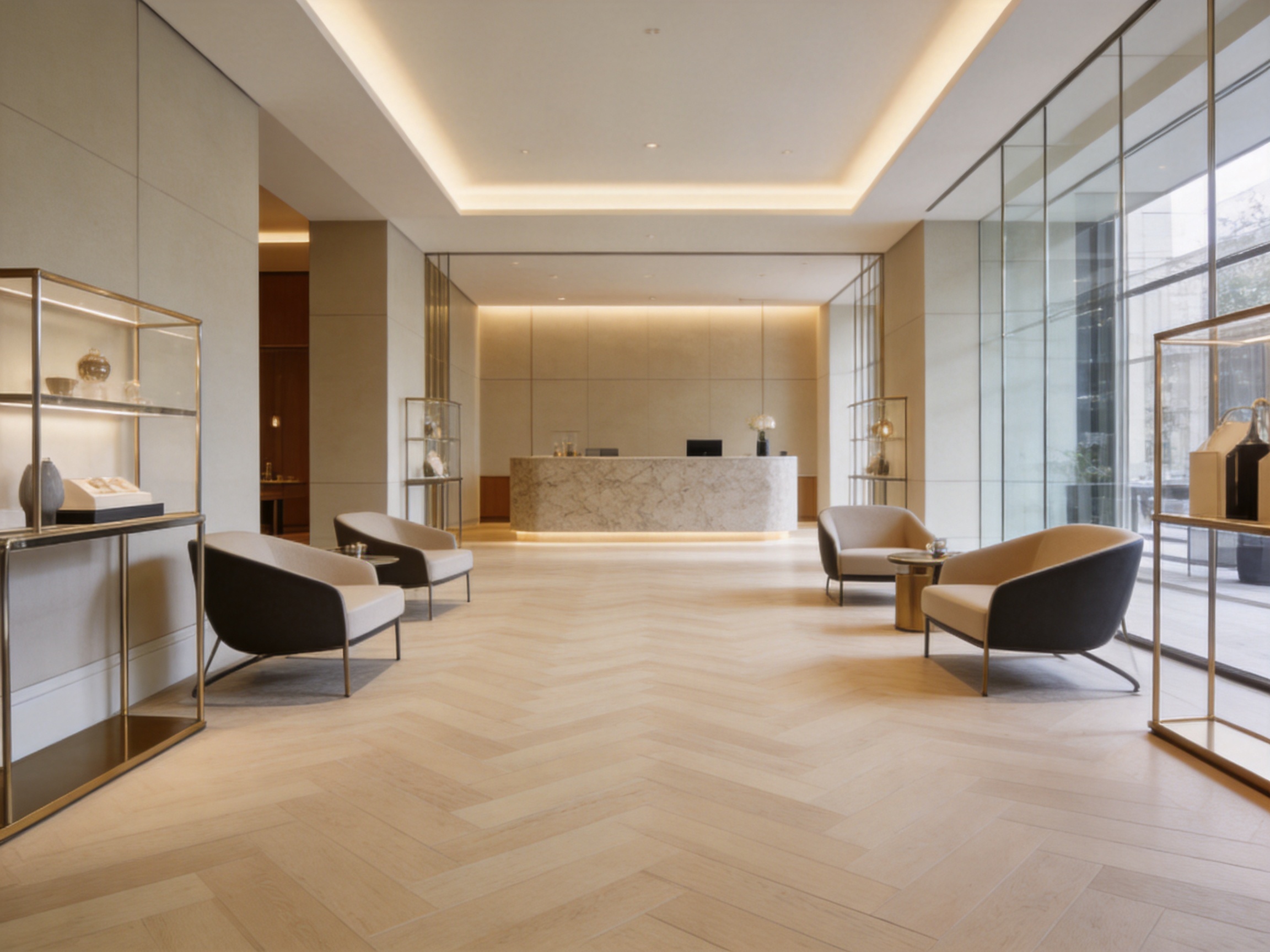
In hotel lobbies, the product offers both warmth and sophistication. Stone floors can feel grand but cold. Carpet can feel comfortable but may lack architectural clarity. Wood parquet provides a welcoming and upscale middle ground. The light beige color helps brighten large public interiors, while the herringbone geometry creates a sense of luxury associated with traditional European interiors and modern boutique hospitality design.
For commercial showrooms, the floor has the advantage of being attractive without competing too strongly with displayed products. Dark or heavily patterned floors can distract from merchandise. A soft beige oak floor supports visual merchandising by offering a refined, neutral base. The matte finish also reduces glare from showroom lighting, allowing products and interior displays to be seen more clearly.
For premium office interiors, the product can create a more human and natural working environment. Wood surfaces are often associated with comfort, warmth, and biophilic design. When paired with glass partitions, acoustic panels, neutral walls, and contemporary furniture, light beige herringbone flooring can soften the workplace while maintaining professionalism.
The product supports UV lacquer, UV oil, and wood wax oil finish options. Each finish offers different visual and practical characteristics. UV lacquer is often selected for durability, efficiency, and consistent factory-controlled protection. It can provide a strong surface layer suitable for busy interiors. UV oil enhances a more natural appearance and can offer a softer, penetrating finish effect. Wood wax oil is valued for its tactile quality and natural look, often preferred in projects that emphasize authenticity and material richness.
Surface texture options include wire brushed, handscraped, and smooth sanded. Wire brushing removes softer grain portions slightly, emphasizing the natural texture of the oak. It can help disguise small marks and increase tactile depth. Handscraped surfaces create a more artisanal and character-rich appearance, suitable for interiors that want warmth and uniqueness. Smooth sanding produces a clean and contemporary surface, ideal for minimalist designs.
The ability to combine finish and texture options gives designers significant control. For example, a Scandinavian apartment may use smooth sanded matte UV oil in light beige. A boutique hotel may choose wire brushed matte lacquer for durability and texture. A villa project may use wood wax oil to achieve a softer and more natural appearance. This level of specification flexibility helps the product serve multiple market segments.
Engineered flooring configurations may use eucalyptus or birch plywood core construction. This layered structure is designed to improve dimensional stability compared with some traditional solid wood formats. Wood naturally expands and contracts with changes in humidity and temperature. A well-made engineered core helps control movement by balancing the structure, making it more suitable for modern interior environments and international markets with varying climates.
Birch plywood is often valued for strength, density, and stability. Eucalyptus plywood can provide a practical and efficient core option. The selection depends on project performance requirements, budget, supply conditions, and customer preferences. In both cases, manufacturing precision is essential. The bonding process, moisture control, layer quality, and machining accuracy all influence the final flooring performance.
The product information also emphasizes natural solid wood base material and fine grain, reflecting the importance of real wood character. For clients comparing this product against imitation flooring, the key difference is authenticity. Printed surfaces may reproduce wood visually, but they cannot fully replicate the grain depth, variation, and tactile feel of real wood. Real wood flooring carries natural individuality. Each plank contributes to a more organic and premium interior.
The click-lock system on four sides is designed to make installation more precise and efficient. In parquet layouts, this is particularly valuable because accuracy determines the final visual result. A weak locking system can lead to uneven joints, misalignment, or installation delays. A well-machined click profile helps installers join planks securely and maintain pattern consistency.
Floating installation can be advantageous in certain projects because it may reduce the need for full-surface adhesive and can speed up installation when site conditions are appropriate. However, proper preparation remains essential. The subfloor should be clean, dry, level, and structurally sound. Suitable underlayment should be selected according to acoustic, moisture, and comfort requirements. Expansion gaps must be respected to allow natural movement. Professional installation is strongly recommended for herringbone or parquet patterns.
Packaging also supports installation planning. With 32 pieces per carton, approximately 1.665 square meters or 17.92 square feet per carton, and left and right planks supplied in separate boxes where applicable, installers can organize layout work more efficiently. For herringbone and chevron-style parquet, correct identification of plank orientation is crucial. Organized packaging helps reduce confusion and waste on site.
Sustainability is increasingly important in flooring procurement. The product supports FSC-certified sustainable material, which indicates attention to responsible forest management and supply chain accountability. For architects, developers, and commercial buyers, certification can be an important part of project compliance and environmental responsibility.
DEIF’s broader product system also supports global compliance standards such as CE, CARB P2, and ISO 9001. These standards matter because international buyers need more than attractive product samples. They need documentation, consistency, and confidence that products can meet regulatory expectations in target markets. CARB P2 compliance is especially relevant for emissions control in composite wood products, while ISO 9001 reflects quality management system discipline.
Responsible manufacturing also includes efficient material use, stable production planning, and long-term product durability. A floor that lasts longer is inherently more sustainable than one that must be replaced quickly. By combining durable white oak surfaces, stable construction options, and careful finishing, this parquet flooring supports long-term use when maintained properly.
Suzhou Dicosbo Wood Co., Ltd. has developed as a comprehensive wood solutions manufacturer covering wood flooring, wooden doors, and custom cabinets. This multi-category expertise gives the company a broader understanding of interior wood applications. Instead of treating flooring as an isolated product, the company can consider how wood surfaces interact throughout a project, including floors, doors, cabinetry, wall finishes, and interior architectural details.
The company’s production base covers approximately 20,000 square meters and is supported by German imported production lines and automated quality control systems. This production infrastructure is important for international customers who need stable supply and repeatable quality. Parquet flooring requires accurate milling and consistent profiling. Automated systems help maintain tolerances, while experienced technicians supervise production details that require judgment and craftsmanship.
Annual production capacity reaches approximately 2,400,000 square meters of flooring and 5,000 sets of doors. This scale enables the company to support distributors and project contractors with both regular supply and large project orders. Capacity is especially important when clients require consistent color, grade, and finish across multiple batches. A manufacturer with insufficient capacity may struggle to maintain continuity in large projects.
The company also provides OEM and ODM customization. This is a major advantage for global partners who want private-label products, market-specific specifications, or exclusive collections. OEM support helps distributors build their own product lines. ODM capability supports clients who need design development, technical adaptation, and product engineering assistance. The company’s 72-hour rapid prototyping service further strengthens project responsiveness, allowing clients to evaluate samples and accelerate decision-making.
The strict three-step quality inspection process is another competitive strength. Quality inspection should not be limited to the final stage. It should include raw material inspection, in-process control, and finished product verification. This layered approach helps identify issues early, reduce waste, and protect customer satisfaction. For parquet flooring, quality checks may include dimensions, moisture content, surface finish, color consistency, locking profile accuracy, packaging, and documentation.
Architects often need flooring that can align with a design concept rather than force the design to adapt to a fixed catalog product. This parquet flooring supports customization in size, color, surface texture, finish, veneer species, veneer grade, and wear layer thickness. These variables allow designers to create interiors with a clear material identity.
Contractors value products that install predictably and arrive with consistent quality. Customization is useful only if manufacturing control is strong enough to deliver what was specified. DEIF’s production systems and quality inspection process help bridge the gap between design intention and site execution. For large projects, this can reduce rework, installation delays, and client disputes.
Distributors need products that are marketable, differentiated, and reliable. Light beige white oak herringbone parquet has strong visual appeal in many international markets. Its design is premium but not overly niche. Its color is easy to match with common interior trends. Its customization options allow distributors to build collections for different customer segments, from entry-level character grades to high-end clean-grade boutique products.
Proper maintenance helps preserve the beauty and longevity of the floor. Daily cleaning should be simple and consistent. Dry mopping is recommended to remove dust, grit, and loose particles. Grit can act like sandpaper under shoes or furniture, so regular cleaning is one of the easiest ways to protect the surface.
For gaps between planks, a soft brush can be used to remove dust and debris. Harsh tools should be avoided because they may scratch the surface or damage joints. Vacuum cleaners may be used if they have a wood-floor-safe setting and soft brush attachment.
Water accumulation should be avoided. Wood flooring is not designed for prolonged standing water. Spills should be wiped promptly with a soft cloth. Damp cleaning may be used according to finish recommendations, but excessive water should never be applied. In commercial settings, cleaning staff should be trained to use appropriate wood floor maintenance procedures rather than generic wet mopping methods.
Furniture pads are recommended under chair legs, tables, and movable furniture. Entrance mats can reduce sand and dirt in high-traffic areas. Indoor humidity should be kept within a suitable range to minimize wood movement. These standard care practices help maintain the floor’s appearance and performance over time.
Flooring is one of the most permanent visual elements in an interior. Furniture can be changed, wall colors can be repainted, and decorative objects can be replaced, but flooring usually remains for many years. Therefore, selecting a floor should involve more than short-term price comparison. It should consider design longevity, material authenticity, installation quality, maintenance requirements, and supplier reliability.
This white oak herringbone parquet flooring offers long-term value because it combines timeless patterning with a highly adaptable color. Herringbone has remained desirable across centuries of interior design. Light beige oak is not a temporary fashion color; it is a natural tone that supports many styles. Matte finishes are also aligned with enduring preferences for understated elegance and tactile authenticity.
Compared with cheaper imitation floors, real wood parquet creates a stronger sense of luxury and material depth. Compared with less flexible suppliers, DEIF provides customization, prototyping, compliance support, and production capacity. Compared with more traditional parquet formats, the click system and engineered construction options can support improved installation efficiency and dimensional stability. These advantages make the product suitable for clients who want both beauty and practical project performance.
Several major interior design trends support the relevance of this product. The first is warm minimalism. Many designers are moving away from cold, gray interiors toward warmer neutral spaces. Light beige white oak fits this movement perfectly because it keeps interiors bright while adding natural warmth.
The second trend is biophilic design. Natural materials are increasingly used to create healthier and more emotionally comfortable interiors. Wood flooring contributes to this effect by introducing organic grain, natural color variation, and tactile warmth. White oak herringbone flooring supports biophilic design while still feeling polished and architectural.
The third trend is quiet luxury. Instead of excessive decoration, quiet luxury emphasizes quality materials, subtle craftsmanship, and refined details. A matte herringbone oak floor embodies this idea. It does not need high gloss or dramatic color to communicate value. Its precision, pattern, and natural beauty create a premium impression in a restrained way.
The fourth trend is flexible commercial design. Retail and hospitality spaces increasingly need interiors that can adapt over time. A neutral premium floor allows brands to update furniture, lighting, and displays without replacing the architectural base. Light beige herringbone parquet provides this flexibility while still giving the space a distinctive identity.
Project buyers should evaluate flooring based on several criteria. First, they should confirm the desired pattern, whether herringbone, chevron, or another parquet configuration. Pattern affects installation method, waste calculation, visual direction, and plank orientation. Second, they should select the appropriate color tone and surface finish based on lighting conditions and design intent.
Third, buyers should review construction options, wear layer thickness, and core material. A thicker wear layer may be preferred for long-term performance and future refinishing potential, depending on product configuration. Fourth, the installation environment should be assessed, including subfloor flatness, moisture conditions, underlayment requirements, and expansion planning.
Fifth, buyers should request samples and confirm color under actual project lighting. Wood is a natural material, and its appearance can vary under warm, cool, direct, or indirect light. Sample approval is an important step before bulk production. DEIF’s rapid prototyping capability can support this process by helping clients review customized specifications efficiently.
Finally, buyers should consider supplier reliability. A good flooring product is not only a material; it is part of a supply chain. Manufacturing capacity, export experience, quality inspection, certification support, packaging, communication, and after-sales coordination all influence project success. With more than 10 years of export experience and partnerships across Europe, North America, and Southeast Asia, DEIF is positioned to support international procurement needs.
The main difference is the herringbone parquet pattern. Standard straight plank flooring creates a linear appearance, while herringbone adds movement, rhythm, and architectural detail. This makes the floor feel more designed and premium, especially in living rooms, hotel lobbies, showrooms, and boutique interiors.
Yes. Light beige white oak is highly versatile. It works well in Scandinavian interiors, light French-style spaces, modern apartments, luxury residences, and commercial showrooms. It brightens interiors while maintaining warmth and natural character.
A matte finish provides a more natural and elegant appearance. It reduces glare, highlights the wood grain softly, and is generally more forgiving in daily use than high-gloss flooring. It also aligns well with current design trends that favor understated luxury and authentic materials.
Yes. Customization options include sizes, colors, veneer species, veneer grades, wear layer thicknesses, surface finishes, and surface textures. This makes the product suitable for residential projects, commercial spaces, distributor collections, and architectural specifications.
The flooring uses a click system on four sides with a V-bevel profile. This supports precise joining and efficient installation. Floating installation is available, provided that the subfloor and site conditions are properly prepared.
Herringbone requires more planning and precision than standard plank flooring because the pattern must align correctly. However, the click-lock system helps improve installation efficiency. Professional installation is recommended to achieve the best visual and technical result.
It is suitable for living rooms, bedrooms, leisure areas, luxury residences, commercial showrooms, boutique stores, hotel lobbies, premium offices, and design-focused interiors. It is especially effective in spaces that require warmth, elegance, and visual movement.
Dry mop regularly, clean plank gaps with a soft brush, avoid standing water, wipe spills promptly, use furniture pads, and place entrance mats in high-traffic areas. Proper maintenance helps protect the surface and extend the service life of the floor.
The product and manufacturing system can support certifications and compliance such as FSC, CE, CARB P2, and ISO 9001, depending on project requirements and documentation. These standards help international buyers evaluate sustainability, quality management, and regulatory suitability.
The manufacturer has more than 20 years of wood product experience, 20,000 square meters of production facilities, German imported production lines, automated quality control systems, OEM and ODM customization, 72-hour rapid prototyping, a strict three-step inspection process, and more than 10 years of export experience. These strengths support stable supply and project-based customization.
White Oak Herringbone Light Beige Matte Parquet Flooring is a premium flooring solution for interiors that require elegance, natural warmth, design flexibility, and reliable manufacturing quality. Its herringbone geometry creates dynamic visual movement, while the light beige white oak tone keeps spaces bright, soft, and welcoming. The matte surface enhances the natural texture of the wood and supports contemporary preferences for understated luxury.
The product stands out from many competitors because it combines real wood character, parquet craftsmanship, customizable specifications, click-lock installation, sustainable material support, and international manufacturing discipline. It is suitable for high-end residences, commercial showrooms, hotel lobbies, boutique interiors, bedrooms, living spaces, and leisure environments. Its design is distinctive enough to elevate a room yet neutral enough to remain timeless.
Behind the product is a manufacturer with strong production capacity, advanced equipment, export experience, quality inspection systems, and OEM/ODM customization capability. For architects, contractors, distributors, and project owners, this combination of product beauty and manufacturing reliability is essential. A successful floor must look refined on the first day and continue to support the interior for years. This light beige white oak herringbone parquet flooring is designed to do exactly that.
Forest Stewardship Council. Principles and Criteria for Responsible Forest Management.
International Organization for Standardization. ISO 9001 Quality Management Systems: Requirements.
California Air Resources Board. Airborne Toxic Control Measure for Composite Wood Products.
European Committee for Standardization. Wood Flooring and Parquet Product Standards.
Architectural Woodwork Institute. Guidelines for Wood Material Selection and Interior Wood Applications.
National Wood Flooring Association. Wood Flooring Installation and Maintenance Technical Guidelines.

We provide customers with sustainable and eco-friendly
engineered wood solutions and services.
Choose DEIF for the perfect blend of
performance and aesthetics.
