


 English
 Español
 عربى
عربى

Get Social
Choose DEIF for the perfect blend of
performance and aesthetics.
 Get Free Sample

Content
Flooring is one of the most influential architectural elements in an interior. It establishes the visual rhythm of a room, affects how light is reflected, contributes to acoustic comfort, and provides the foundation for furniture, fixtures, and decorative finishes. For residential and commercial projects seeking a distinctive yet timeless surface, White Oak Herringbone Dark Brown Retro Matte Parquet Flooring offers a compelling combination of natural material character, handcrafted appearance, configurable construction, and dependable manufacturing support.
Product code DF-Y1816, this parquet flooring is designed around the enduring appeal of white oak and the visual energy of a herringbone arrangement. Its dark brown retro matte appearance introduces warmth, depth, and a gently aged character without making a space appear overly formal or excessively glossy. The distressed surface is intended to resemble a naturally matured wood floor, giving new construction the atmosphere of an established interior.
The product is suitable for luxury residences, boutique hotels, commercial showrooms, cafes, guesthouses, leisure areas, and other spaces where flooring must contribute strongly to the overall design concept. It can complement retro, industrial, rustic, transitional, and contemporary interiors. Its pattern is decorative enough to function as a focal point, while its natural oak foundation allows it to coordinate with a wide range of furniture and architectural materials.
Beyond appearance, the flooring is supported by a customizable specification platform. Buyers can request different wood species, veneer grades, wear-layer thicknesses, surface finishes, textures, dimensions, and colors according to project requirements. This flexibility helps architects, interior designers, developers, distributors, and contractors create coordinated flooring programs rather than relying only on fixed, off-the-shelf options.
Its manufacturing background also adds value for professional buyers. Suzhou Dicosbo Wood Co., Ltd., operating under the DEIF wood solutions business, combines solid wood expertise, engineered wood production, OEM and ODM services, quality inspections, export experience, and project-oriented customization. This allows the product to be evaluated not simply as a decorative flooring design, but as part of a broader supply solution for interior woodwork and architectural flooring.
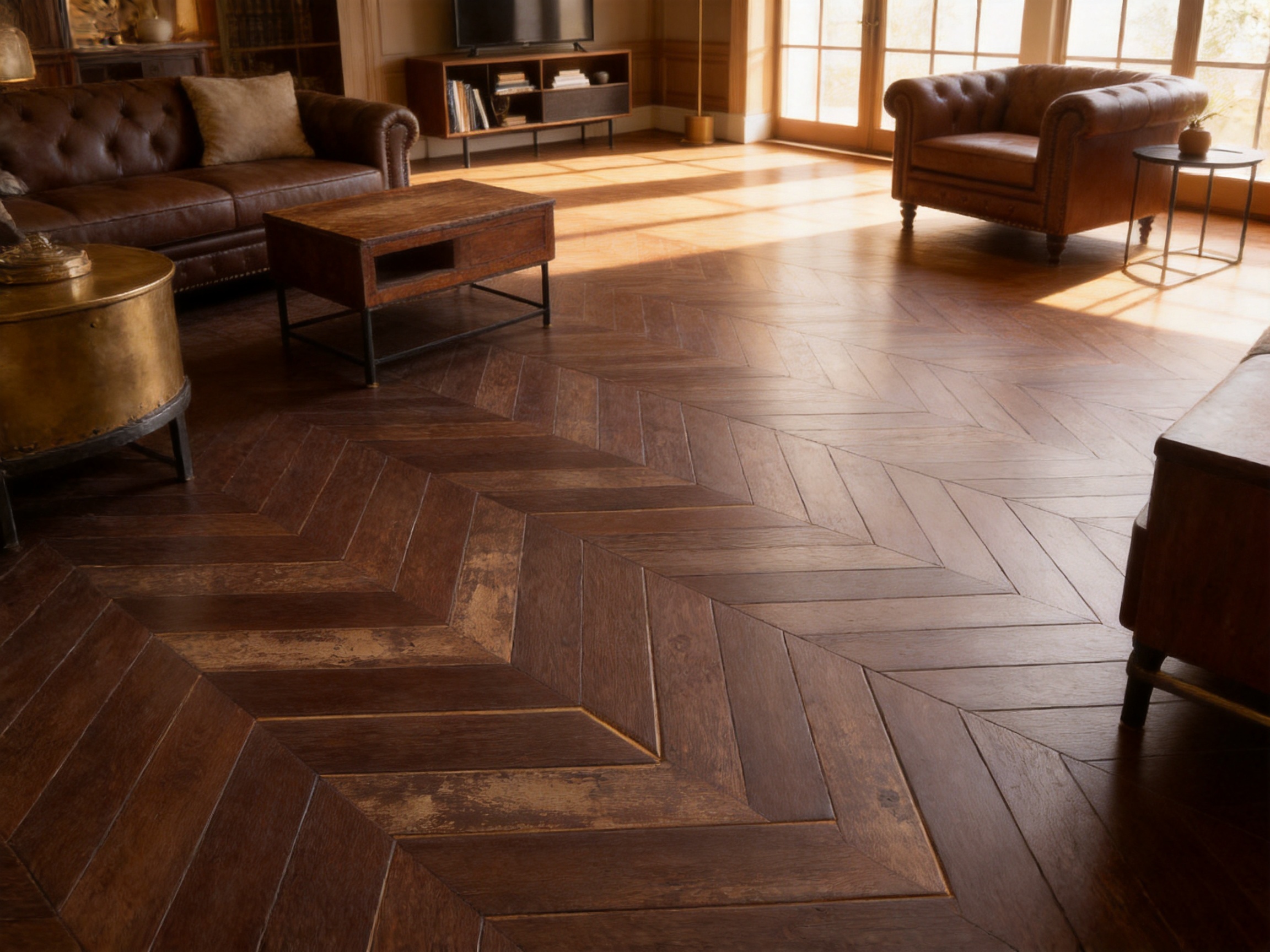
White Oak Herringbone Dark Brown Retro Matte Parquet Flooring
White Oak Herringbone Dark Brown Retro Matte Parquet Flooring is built around a balance of natural irregularity and controlled geometry. White oak provides the visual foundation, while the herringbone layout creates a directional pattern that can make a room feel more structured and dynamic. The dark brown tone deepens the grain and emphasizes the alternating movement of the individual parquet pieces.
Unlike a completely uniform contemporary floor, the retro matte concept intentionally avoids a highly reflective surface. The low-sheen appearance reduces glare and allows the texture of the wood to remain visible under different lighting conditions. This is especially valuable in rooms with large windows, decorative lighting, or polished furniture, where a glossy floor could create unwanted reflections.
The distressed visual treatment adds subtle variation to the surface. Rather than presenting every plank as identical, the finish is designed to suggest the marks, tonal changes, and softened character associated with aged timber. This does not mean that the flooring is structurally weak or artificially worn. The vintage effect is created as part of the controlled finishing process, allowing the floor to deliver an established appearance while retaining the performance expectations of a newly manufactured product.
The herringbone pattern is also highly adaptable from a design perspective. In a living room, it can define the central floor field and frame furniture groupings. In a hotel lobby, it can support a welcoming, heritage-inspired atmosphere. In a boutique retail space, it can create a handcrafted background for product displays. In a restaurant or cafe, it can reinforce a warm, tactile brand identity.
Although the supplied product title identifies the design as herringbone, the technical information also references Chevron Parquet Flooring and selectable Chevron angles of 45 or 60 degrees. This reflects the product family’s ability to support related geometric configurations. Project buyers should confirm whether they require a traditional herringbone arrangement, a pointed Chevron arrangement, or a particular angle before production. This confirmation is important because the visual effect and installation planning differ between these patterns.
White oak is widely valued in flooring because it combines an attractive grain structure with practical durability. Its grain can appear linear, cathedral-like, or gently varied depending on the cut and board position. In a dark brown finish, these natural lines become more pronounced, producing a rich surface that remains visually connected to real wood.
The natural solid wood base described for this product contributes to a more authentic material impression than printed synthetic surfaces. Each piece can display differences in grain direction, mineral character, and tone. These variations are not necessarily defects; they are part of the identity of natural timber. When arranged within a herringbone pattern, they provide a handcrafted visual quality that would be difficult to reproduce with a completely repetitive decorative print.
White oak is also appropriate for interiors that require a balance between design expression and everyday usability. Its recognized wear resistance supports use in residential environments and in commercial spaces with moderate to high foot traffic, provided that the floor is installed and maintained according to the project’s conditions. The precise performance of a finished floor depends on the complete construction, including the wear layer, core, finish, subfloor, installation method, moisture control, and maintenance schedule.
The product platform allows the face veneer to be customized in oak, walnut, ash, or teak. White oak remains the defining material for DF-Y1816, but this broader selection is beneficial for project programs requiring several coordinated finishes. A designer may specify white oak for public areas, walnut for executive rooms, ash for lighter spaces, or teak for a warmer tropical-inspired palette.
The dark brown color provides visual weight and warmth. It can make a large room feel more grounded and can help connect the floor with leather, bronze, black metal, aged brass, natural stone, exposed brick, and woven textiles. It also works effectively with cotton-linen fabrics, distressed furniture, and materials that have a visible handmade quality.
A matte finish is particularly useful where the design objective is understated luxury. Instead of relying on shine to attract attention, the surface encourages people to notice grain, texture, pattern, and color variation. This can produce a more relaxed atmosphere than a high-gloss floor, especially in hospitality spaces intended to feel comfortable and residential.
The finish can be specified according to project preference. Available options include UV lacquer, UV oil, and wood wax oil. These finishes create different tactile and visual results. UV lacquer generally provides a protective film and can be selected where consistent surface protection and efficient cleaning are priorities. UV oil can emphasize the natural appearance of the timber while offering a refined low-sheen effect. Wood wax oil is often chosen when a more natural, tactile, and traditionally inspired finish is desired.
Because finish selection influences color, maintenance, repairability, and surface feel, it should be evaluated with physical samples. Lighting conditions, room orientation, surrounding materials, and expected traffic can change how a dark brown floor is perceived. A sample review also helps confirm the relationship between the distressed effect, matte level, grain visibility, and final color.
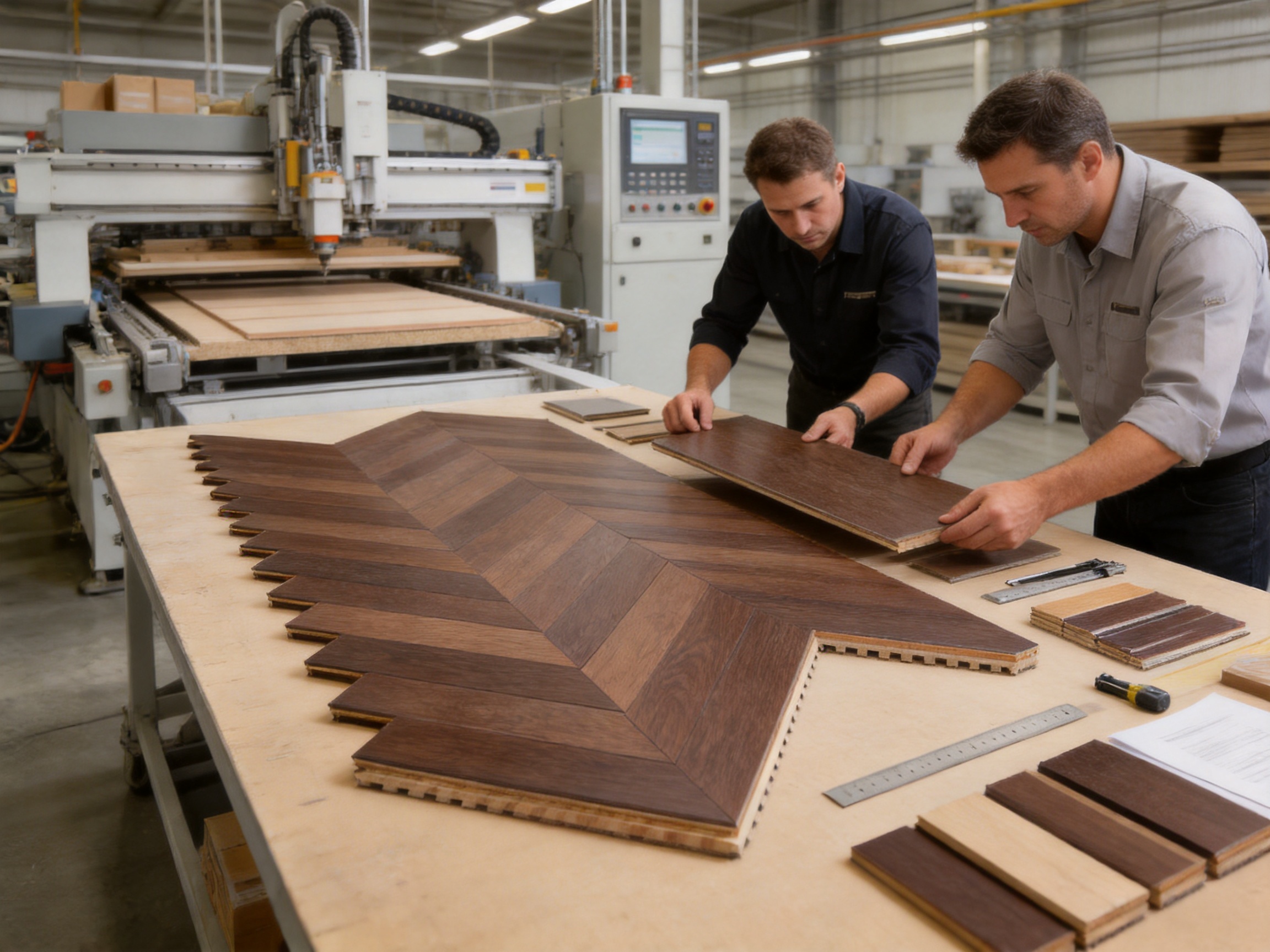
One of the product’s stated advantages is handcrafted splicing technology. Parquet flooring requires more than simply cutting wood into short pieces. The components must be dimensionally controlled, correctly oriented, and assembled so that the pattern remains visually consistent and the joints remain tight.
Handcrafted assembly can add a distinctive level of attention to the arrangement of individual elements. Skilled workers can review grain direction, color transitions, and pattern alignment during the assembly process. This is especially valuable for a dark distressed floor, where subtle differences between pieces contribute to the desired vintage character but excessive inconsistency could reduce visual harmony.
The technical description also refers to tight joints and high flatness. These qualities are important for both appearance and installation. Open or uneven joints can interrupt the continuous rhythm of a herringbone floor. Poor flatness can create visible lipping, uneven wear, movement, or installation difficulties. Controlled manufacturing and careful inspection help reduce these risks before the product reaches the job site.
The product is described with a click system on four sides and a V-bevel profile. A four-sided click connection can support accurate engagement between components when the subfloor and installation conditions are properly prepared. The V-bevel helps define the boundary of each piece, making the parquet geometry more visible after installation. It can also contribute to the crafted appearance by emphasizing the individual plank modules within the larger pattern.
At the same time, a click system does not remove the need for professional installation. The subfloor must be suitable, clean, dry, flat, and structurally stable. Expansion requirements, room geometry, transition details, moisture conditions, and the selected installation method should be reviewed before work begins. The supplied information identifies floating installation as an available method, but the final method should be confirmed with the technical team for the specific construction and site conditions.
A major advantage of this flooring platform over narrowly specified competitors is the breadth of available customization. Rather than limiting the buyer to one fixed combination of species, grade, wear layer, texture, and finish, the product can be adjusted for different aesthetic and performance targets.
Available wear-layer thicknesses include 2 mm, 3 mm, 4 mm, and 6 mm. A thinner wear layer may be appropriate for certain budget-conscious or light-use applications, while a thicker wear layer can provide additional material depth for projects that prioritize longevity and potential future maintenance. The correct choice depends on the expected traffic, maintenance strategy, project life cycle, and whether refinishing may be required in the future.
Veneer grades can be customized as AB, ABC, ABCD, or CD. These grades generally represent different levels of natural variation, including knot content, color variation, and visual uniformity. A higher uniformity grade may be preferred for a refined residential interior or a premium showroom. A more character-rich grade may better suit rustic, industrial, hospitality, or heritage-inspired projects. Buyers should request the supplier’s specific grading definitions and approve reference samples before placing a production order.
The core construction can use eucalyptus or birch plywood. Both options can support engineered flooring construction, but the appropriate selection may depend on availability, project specifications, dimensional requirements, and target performance. A stable multi-layer construction helps balance the natural movement of wood and can be advantageous compared with a single-piece solid plank in environments where seasonal humidity changes are significant.
Surface textures include wire brushed, hand scraped, and smooth sanded. Wire brushing can open and emphasize the softer portions of the grain, creating a tactile linear texture. Hand scraping can introduce a more visibly artisanal character with subtle irregularity. Smooth sanding offers a cleaner surface while allowing the color and grain to remain the main visual features. For the retro matte version, wire-brushed or hand-scraped options may reinforce the aged appearance, although the final selection should follow the project’s cleaning and usage requirements.
Dimensions can also be customized. The referenced imperial dimensions are approximately 20.1 inches by 4.0 inches by 19/32 inch. In metric terms, this is approximately 510 millimeters by 102 millimeters by 15 millimeters, subject to manufacturing tolerances and final confirmation. Because parquet patterns depend on precise module relationships, dimensions must be coordinated with room scale, border details, furniture layout, and installation drawings.
Straight-plank flooring offers a familiar and efficient installation format, but it may not provide the same visual movement as parquet. The herringbone layout creates a more decorative surface and can visually guide movement through a room. It can also help distinguish premium project areas without relying on additional rugs, inlays, or complex decorative elements.
The modular pattern allows designers to create a strong floor identity while retaining the warmth of real wood. In hospitality and retail environments, this identity can help create a memorable first impression. In residences, it can add architectural character to otherwise simple rooms.
High-gloss flooring can appear formal and reflective, but it may show dust, footprints, fine scratches, and lighting glare more readily. The retro matte finish offers a softer visual effect and can conceal minor day-to-day variation more effectively than a mirror-like surface. Its lower reflectivity also supports a calm, heritage-inspired atmosphere.
Matte finishes do not eliminate maintenance requirements, and they should not be considered scratch-proof. However, their visual character is often more forgiving in active interiors where the floor is expected to develop a natural patina over time.
Printed imitation wood can reproduce color and grain efficiently, but it may lack the depth, tactile variation, and material authenticity of a real wood surface. White oak parquet provides genuine timber grain and the possibility of selecting different grades, cuts, textures, and finishing systems.
Real wood also offers a different long-term design relationship. As the interior ages, natural wood can remain visually relevant because its variations become part of the space rather than appearing like a fixed decorative image. The distressed matte treatment further supports this relationship by making age and character part of the original design intent.
Some parquet suppliers offer only one standard size, one species, one finish, and one core. This can simplify purchasing but may create challenges when the design concept requires a particular tone, grade, texture, or wear-layer depth. The DF-Y1816 product platform provides a broader route to specification, supporting OEM and ODM projects that require coordinated customization.
This flexibility is particularly useful for developers and hospitality groups managing multiple properties. A standard design language can be maintained while dimensions, color, texture, and construction are adjusted for different locations or performance needs.
Suzhou Dicosbo Wood Co., Ltd. has more than two decades of wood product experience, with the business founded in 1999. The company operates production facilities covering approximately 20,000 square meters and has more than ten years of export experience. Its product scope includes wood flooring, wooden doors, and custom cabinet solutions, allowing it to support broader interior woodwork packages.
The stated annual production capacity includes approximately 2,400,000 square meters of flooring and 5,000 sets of doors. Capacity at this level can be important for distributors, contractors, and project developers that need consistent supply across multiple orders. Capacity alone does not guarantee quality, but when paired with documented processes and inspection systems, it can support more dependable production planning.
The company uses German imported production lines and automated quality control systems. Advanced equipment can improve repeatability in cutting, profiling, sanding, finishing, and packaging. Automation is especially relevant to parquet flooring because small dimensional differences can become visible when many pieces are assembled into a repeating geometric pattern.
At the same time, automation is complemented by manual craftsmanship. The product description emphasizes handcrafted assembly, indicating that the manufacturing model combines machine consistency with human review. This hybrid approach is suitable for flooring that must meet dimensional requirements while retaining a natural, artisanal appearance.
DEIF describes a three-step quality inspection process. For a flooring product such as DF-Y1816, a comprehensive inspection program may include checks of raw material quality, moisture and dimensional stability, veneer appearance, machining accuracy, locking profiles, surface finish, packaging, and final product identification. The exact inspection criteria should be confirmed in project documentation, but a multi-stage approach is beneficial because it can identify issues at different points rather than relying only on a final visual check.
Rapid prototyping is another stated strength. The company offers a 72-hour rapid prototyping service, which can help professional buyers evaluate a new color, pattern, texture, or construction before committing to a larger production run. For architects and designers, a physical prototype is often more useful than a digital rendering because it reveals actual grain behavior, color depth, gloss level, edge detail, and tactile response.
The product information identifies the flooring as FSC certified. Forest Stewardship Council certification is relevant to buyers seeking responsibly sourced wood and documented supply-chain practices. Certification requirements and product claims should always be verified through current certificates and applicable chain-of-custody documentation for the specific order.
DEIF also identifies compliance with CE, FSC, CARB P2, and ISO 9001 standards across its product and manufacturing activities. These credentials can support project documentation, distributor requirements, and procurement reviews. However, the exact scope of each certificate may vary by product, factory, material, or production batch. Buyers should request current documentation and confirm that the selected DF-Y1816 configuration is covered.
Responsible manufacturing involves more than a certification label. It also includes material traceability, efficient production planning, durable construction, reduced replacement frequency, appropriate packaging, and clear maintenance guidance. A floor that remains attractive and functional for many years can help reduce the environmental impact associated with premature removal and replacement.
The company’s ability to provide flooring, doors, and cabinets may also support more coordinated sourcing. When related wood products are developed through one manufacturing partner, it can be easier to align species, stains, finishes, edge details, and quality expectations across a project. This is valuable in hotels, residences, offices, and commercial developments where flooring is only one part of a larger interior wood package.
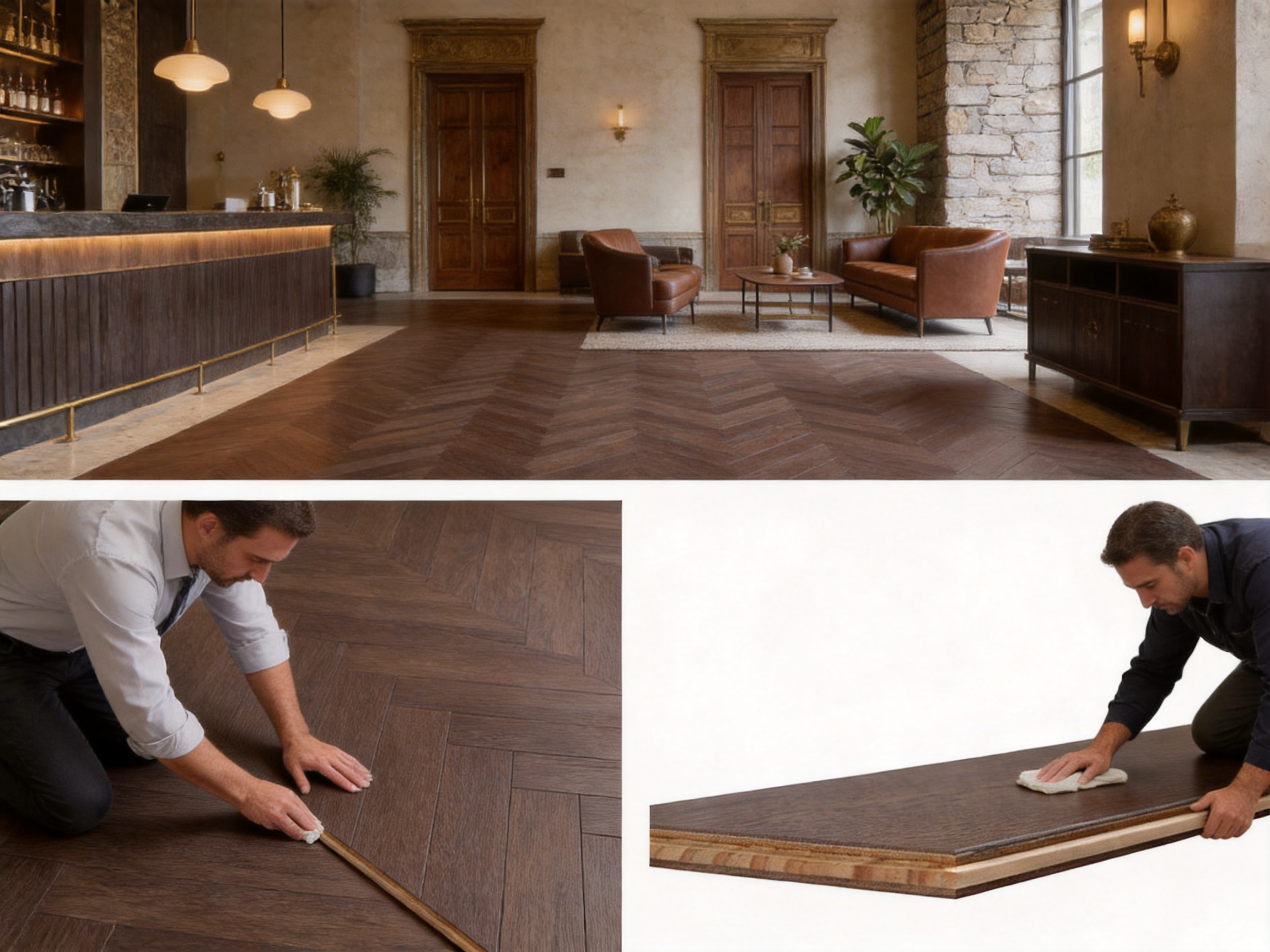
In luxury residences, the floor can serve as a central design feature. The dark brown herringbone arrangement is especially appropriate for living rooms, dining rooms, studies, bedrooms, corridors, and guest suites that require warmth and visual distinction. It can be paired with neutral walls, plaster finishes, upholstered furniture, vintage pieces, or contemporary lighting.
In a living room, the pattern can be oriented to emphasize the room’s longest axis or to frame a central furniture arrangement. Designers may use the flooring continuously between connected areas to create visual flow, or they may combine it with borders and transition strips to define separate zones.
In guesthouses and leisure residences, the distressed matte surface can help create an informal, welcoming atmosphere. It works well with linen curtains, woven rugs, natural stone, aged timber furniture, ceramics, and leather. The floor’s retro character can make a new property feel more established without requiring extensive decorative detailing.
In bedrooms, the dark tone can provide a calm and enveloping background. Because the surface is matte rather than highly reflective, it can feel softer under artificial lighting. Area rugs may be added for additional comfort, but the parquet pattern remains visible around the perimeter and beneath open furniture arrangements.
Boutique hotels can use this flooring to establish a recognizable design language in lobbies, lounges, corridors, suites, and private dining areas. The herringbone pattern communicates craftsmanship and tradition, while the configurable construction allows the hotel operator to select a finish appropriate for the anticipated traffic and maintenance program.
Commercial showrooms can benefit from the floor’s ability to create a premium setting for furniture, lighting, fashion, home accessories, or architectural materials. The dark brown background can make lighter display products stand out, while the natural grain adds texture without competing with every product category.
Cafes and restaurants often require interiors that feel distinctive but comfortable. The retro matte finish can coordinate with timber tables, metal details, exposed masonry, leather seating, and warm pendant lighting. The product is described as suitable for moderate to high foot traffic commercial environments, but project teams should evaluate local regulations, traffic intensity, cleaning chemicals, moisture exposure, and the selected finish before approval.
In offices and executive hospitality areas, parquet can communicate quality and permanence. It can be used in reception areas, meeting rooms, private offices, and client lounges. For larger commercial installations, consistent batch control and pre-production approval are important to ensure that color and texture remain within the accepted project range.
Because parquet installation requires more planning than simple linear planks, commercial projects should coordinate floor direction, expansion joints, thresholds, elevator entrances, service routes, and furniture layouts at the design stage. Early coordination helps reduce waste and protects the intended visual symmetry.
The product information lists floating installation as an available method and identifies a click locking system. Floating installation can offer practical advantages where the floor must be installed efficiently or where adhesive use is restricted. It may also support future access in certain project conditions, although the actual removability and suitability depend on the installation design.
Before installation, the subfloor should be assessed for flatness, cleanliness, structural stability, and moisture. Irregularities may telegraph through the finished parquet and affect the engagement of the click joints. Moisture control is especially important for wood flooring because excessive moisture can contribute to swelling, cupping, gapping, or finish failure.
Acclimatization requirements should be confirmed with the supplier and followed according to the site’s temperature, humidity, packaging, and construction schedule. The building should generally be enclosed, weather-tight, and sufficiently conditioned before wood flooring is installed. Wet trades should be completed or controlled so that the flooring is not exposed to unnecessary moisture.
Pattern installation should begin from carefully established reference lines. Herringbone and Chevron layouts are highly sensitive to alignment. A small deviation at the beginning can become increasingly visible as the pattern extends across the room. Professional installers should verify the direction of the pattern, the relationship to walls and doorways, and the location of borders or transition details before proceeding.
The left and right plank packaging configuration should also be considered. The technical information states that left and right planks are supplied in separate boxes. This arrangement supports the directional requirements of patterned installation, but installers must ensure that the correct quantities are ordered and that the boxes are distributed logically across the work area.
Packaging information identifies 32 pieces per carton, approximately 1.665 square meters per carton, or 17.92 square feet per carton, with an approximate carton weight of 18 kilograms. These details are useful for logistics, storage planning, labor scheduling, and project quantity calculations. Final quantities should include an allowance for cutting, layout selection, room irregularity, and future repairs.
Regular cleaning helps preserve the appearance of a matte wood floor. The recommended basic practice is to wipe the surface with a dry cloth. A soft broom or suitable vacuum attachment may also be used to remove loose dirt and grit. Abrasive particles can act like sandpaper under footwear and furniture, so entrance mats and routine cleaning are particularly valuable in active areas.
Liquid spills should be addressed promptly. Wood flooring should not be saturated with water, and wet cleaning should follow the finish manufacturer’s instructions. Excess moisture can affect joints, edges, and the underlying construction. Cleaning products should be tested or approved for the specific surface finish rather than selected solely because they are marketed for generic wood floors.
The supplied care guidance recommends applying vintage wood oil once a month to preserve texture and sheen. The appropriate frequency may vary according to the selected finish, traffic level, climate, and maintenance system. UV lacquer, UV oil, and wood wax oil do not necessarily require identical care procedures. The project owner should obtain a written maintenance schedule for the actual specification.
Sharp objects, dragging furniture, and unprotected chair legs can scratch the surface. Felt pads should be placed under furniture, and heavy items should be lifted rather than dragged. High-impact areas may benefit from protective runners or rugs, provided that they do not trap moisture or prevent the floor from being inspected.
The distressed appearance offers a practical visual advantage because minor changes can blend into the intended character of the surface. Nevertheless, deliberate distressing should not be confused with unlimited resistance. Proper cleaning, humidity management, furniture protection, and periodic professional review remain important for preserving the floor.
| Product Code | DF-Y1816 |
| Product Design | White oak herringbone parquet with dark brown retro matte appearance |
| Related Pattern Family | Herringbone and Chevron parquet configurations |
| Reference Dimensions | 20.1 inches × 4.0 inches × 19/32 inch |
| Approximate Metric Dimensions | 510 mm × 102 mm × 15 mm |
| Pattern Angle Options | Chevron 45° or 60°, subject to project confirmation |
| Face Veneer Options | Oak, walnut, ash, or teak |
| Veneer Grade Options | AB, ABC, ABCD, or CD |
| Wear-Layer Options | 2 mm, 3 mm, 4 mm, or 6 mm |
| Core Construction | Eucalyptus or birch plywood |
| Veneer Cut | Sliced veneer |
| Surface Finish Options | UV lacquer, UV oil, or wood wax oil |
| Surface Texture Options | Wire brushed, hand scraped, or smooth sanded |
| Profile | Four-sided click system with V-bevel |
| Installation Reference | Floating installation |
| Carton Contents | 32 pieces |
| Coverage per Carton | Approximately 1.665 square meters or 17.92 square feet |
| Approximate Carton Weight | 18 kilograms |
| Certification Reference | FSC-certified material; additional compliance documentation available subject to product configuration |
The table provides a practical starting point for specification, but it should not replace a project-specific technical data sheet. Pattern, dimensions, finish, grade, core, wear layer, packaging, and certification scope should be confirmed in writing before production.
For distributors and project purchasers, the value of a flooring product includes more than its appearance. Reliable lead times, repeatable quality, responsive communication, packaging control, documentation, and after-sales support all influence project success.
DEIF’s OEM and ODM capabilities allow buyers to develop products around a particular brand identity, architectural concept, or market position. A distributor may request a private-label color collection. A hotel developer may require flooring to coordinate with custom doors and cabinets. An architect may need a specific pattern scale, wear-layer thickness, or surface texture. A manufacturer with integrated wood product capabilities can provide a more direct route from concept to production.
The stated 72-hour rapid prototyping service is useful during the early design phase. Color and texture decisions are often made under time pressure, and a rapid prototype can help a project team compare alternatives before approving a full batch. It can also reveal whether a dark brown tone appears too warm, too cool, too uniform, or too heavily distressed when viewed under the actual lighting concept.
Global export experience can further support international projects. DEIF serves partners in Europe, North America, and Southeast Asia, giving the company experience with different procurement practices, documentation requirements, shipping arrangements, and project communication expectations. Buyers should still confirm applicable local regulations and installation standards for each destination.
The company’s product range, including flooring, wooden doors, and custom cabinets, offers opportunities for package purchasing. Coordinating these products can reduce the number of separate suppliers involved in a project and may simplify color matching. It also creates a stronger opportunity to develop a unified material story throughout an interior.
Dark brown parquet should be considered in relation to the amount of natural light in the room. In a bright room with large windows, the color can create contrast and visual grounding. In a smaller or darker room, lighter walls, reflective accessories, and carefully positioned lighting can prevent the interior from feeling visually heavy.
Furniture scale is another consideration. The strong directionality of a herringbone pattern can support large furniture pieces, but excessive visual competition may occur if the room also contains highly patterned upholstery, elaborate rugs, or multiple decorative surfaces. A balanced scheme often combines the active floor pattern with quieter walls and carefully selected accent materials.
Door and cabinet coordination can make the floor feel intentional. White oak flooring may be paired with painted doors, walnut cabinetry, dark-stained shelving, or natural stone countertops. If wooden doors and cabinets are sourced through the same manufacturing partner, designers can request coordinated samples to manage differences in undertone, sheen, and grain.
For commercial projects, the flooring should be integrated into the brand experience. A retro hospitality concept may use aged brass and leather. An industrial showroom may combine the parquet with black steel and exposed concrete. A refined residence may use the floor with soft plaster, stone, wool, and understated lighting. The product’s value lies partly in this ability to support multiple visual narratives.
Before approving a production order, buyers should evaluate a representative sample or mock-up. Important review points include color consistency, grain scale, distressing intensity, gloss level, texture, edge profile, click engagement, dimensions, and the appearance of assembled modules.
It is advisable to inspect several pieces rather than a single plank. Natural wood is inherently variable, and a group of samples provides a better understanding of the expected range. For large projects, a full-size mock-up can reveal how the floor behaves as a pattern and how it interacts with lighting and adjacent finishes.
Buyers should also confirm the accepted tolerance for natural variation. A premium natural wood floor is not expected to be perfectly identical from piece to piece, but the project team should agree on the desired balance between uniformity and character. This is particularly important when selecting AB, ABC, ABCD, or CD grades.
Technical documentation should identify the approved construction, finish, installation method, maintenance products, packaging arrangement, and certification references. Clear documentation reduces misunderstandings between the manufacturer, distributor, installer, designer, and owner.
The dark brown retro matte parquet is suitable for retro, industrial, rustic, transitional, boutique hospitality, and warm contemporary interiors. It can be used in luxury residences, guesthouses, showrooms, cafes, hotels, lounges, and other spaces where natural wood character and geometric pattern are desired.
The product title identifies it as herringbone, while the technical material also references a Chevron parquet collection with 45-degree and 60-degree options. Herringbone and Chevron are related but different patterns. Buyers should confirm the exact pattern, angle, plank orientation, and drawings before production.
Yes. The product information identifies customizable colors and finishes. The dark brown retro matte appearance is the featured design, but project-specific colors can be developed subject to sample approval, material availability, and production confirmation.
The available face veneer options include oak, walnut, ash, and teak. White oak is the primary material associated with DF-Y1816, while the other species support broader OEM and ODM programs.
The listed options are 2 mm, 3 mm, 4 mm, and 6 mm. The appropriate thickness depends on use, maintenance expectations, project life cycle, and the possibility of future refinishing. It should be selected with technical guidance.
Available surface finishes include UV lacquer, UV oil, and wood wax oil. Each finish creates a different combination of protection, sheen, tactile quality, and maintenance requirements. Physical samples and finish-specific care instructions should be reviewed before approval.
The product platform supports wire-brushed, hand-scraped, and smooth-sanded textures. Wire brushing and hand scraping can strengthen a vintage or handcrafted visual effect, while smooth sanding provides a cleaner and more refined surface.
Floating installation is listed among the installation methods, and the product includes a click system. Site conditions still need to be evaluated, including subfloor flatness, moisture, expansion requirements, room geometry, and local installation standards.
It is described as suitable for commercial showrooms, hotel lobbies, boutique hotels, cafes, and other moderate- to high-traffic environments. The final specification should be matched to the expected traffic, cleaning practices, moisture exposure, and regulatory requirements of the site.
Regular dry cleaning with a soft cloth, broom, or suitable vacuum attachment is recommended to remove dust and grit. Spills should be cleaned promptly, and liquid use should be controlled. Cleaning products must be compatible with the selected finish.
The supplied guidance recommends applying vintage wood oil once a month. The exact schedule may vary by finish type, traffic, climate, and manufacturer instructions. A project-specific maintenance plan should be confirmed for the selected specification.
The product information identifies FSC certification, while the company also references CE, CARB P2, and ISO 9001 compliance within its product and manufacturing capabilities. Buyers should request current certificates and confirm the scope applicable to the exact product configuration.
Yes. The manufacturer specializes in wood flooring, wooden doors, and custom cabinets. This can support coordinated material selection, colors, finishes, and wood species across a complete interior project.
Buyers should confirm the exact pattern, dimensions, wood species, grade, wear layer, core, surface texture, finish, color, packaging arrangement, quantity, installation method, certification scope, lead time, and maintenance requirements. A pre-production sample or mock-up is strongly recommended.
White Oak Herringbone Dark Brown Retro Matte Parquet Flooring provides a distinctive solution for interiors that require more than a basic wood surface. Its natural white oak foundation, dark brown distressed appearance, matte finish, geometric pattern, and handcrafted assembly create a floor with warmth, depth, and architectural presence.
Its advantages extend beyond design. Customizable dimensions, species, grades, wear layers, cores, surface textures, and finishing systems allow the product to respond to different project budgets, performance targets, and aesthetic directions. The four-sided click system, V-bevel profile, and floating installation reference can support efficient project planning when combined with proper site preparation and professional installation.
The manufacturing capabilities of Suzhou Dicosbo Wood Co., Ltd. strengthen the product proposition for professional buyers. More than 20 years of wood industry experience, a 20,000-square-meter production base, export experience, German imported production lines, automated quality control, three-step inspection, rapid prototyping, OEM and ODM services, and broad interior wood product capabilities provide a foundation for dependable project cooperation.
For residential designers, the flooring offers a way to add character and warmth. For commercial and hospitality developers, it creates a memorable material identity. For distributors and contractors, its configurable specification and manufacturing support can provide a broader product offering than fixed-format parquet alternatives. When properly specified, installed, and maintained, DF-Y1816 can help create interiors that feel established, refined, tactile, and enduring.
1. Product specification materials for White Oak Herringbone Dark Brown Retro Matte Parquet Flooring, product code DF-Y1816.
2. Manufacturer-provided information regarding wood flooring construction, customization, finishing options, packaging, and installation.
3. Manufacturer-provided company profile covering production capacity, OEM and ODM services, export experience, quality inspection, and facility capabilities.
4. Forest Stewardship Council, guidance on responsible forest management and certified wood supply chains.
5. ISO 9001, Quality management systems—Requirements.
6. CARB Phase 2, formaldehyde emission requirements for composite wood products.
7. General professional principles for engineered wood flooring installation, moisture control, subfloor preparation, and maintenance.

We provide customers with sustainable and eco-friendly
engineered wood solutions and services.
Choose DEIF for the perfect blend of
performance and aesthetics.
