


 English
 Español
 عربى


Get Social
Choose DEIF for the perfect blend of
performance and aesthetics.
 Get Free Sample

Content
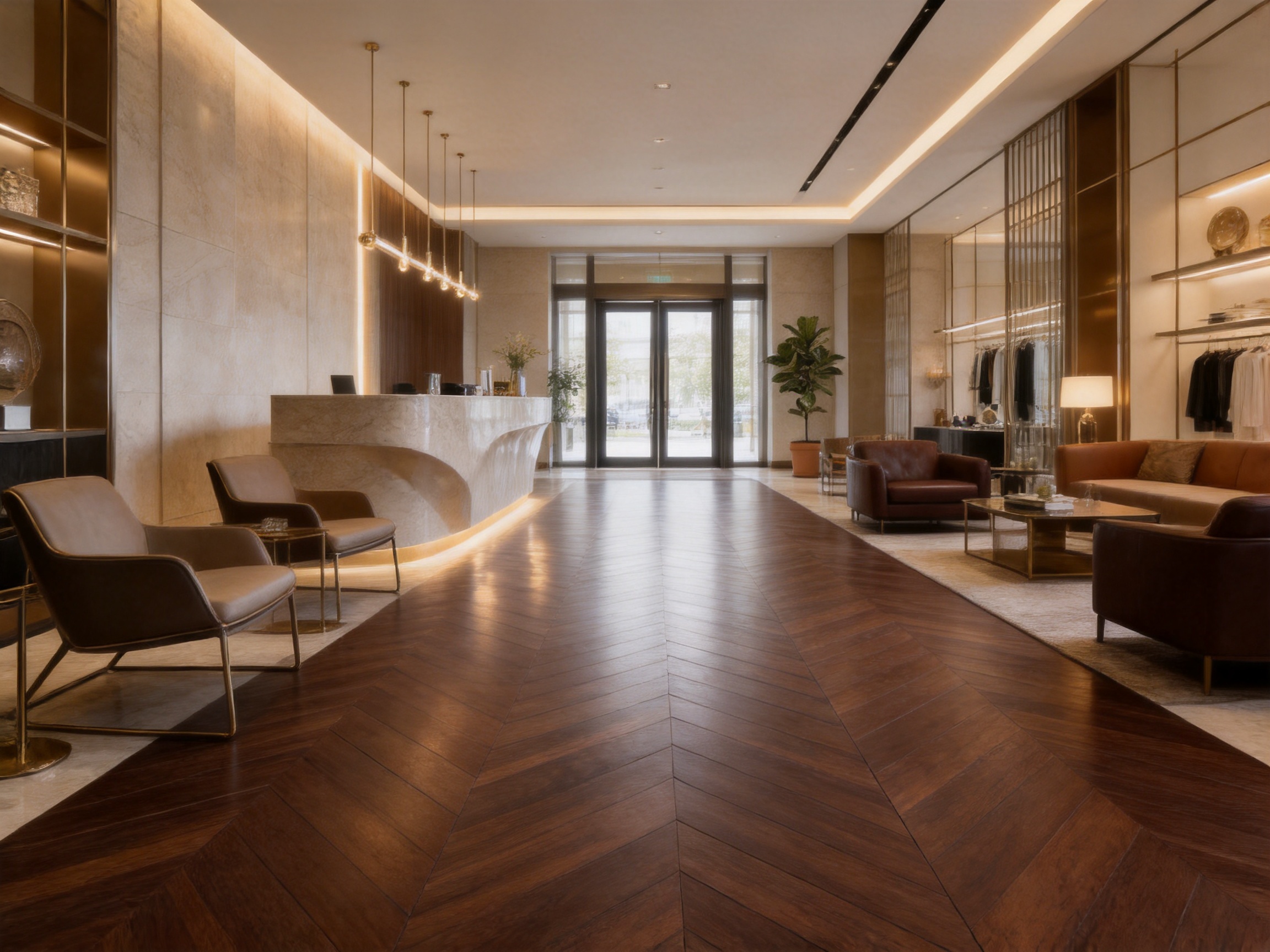
Walnut Herringbone Dark Brown Matte Parquet Flooring is designed for projects that require more than a practical walking surface. It combines the natural character of solid wood, the visual rhythm of a herringbone arrangement, a deep walnut-inspired color, and a low-reflective matte finish. Together, these elements create a floor with warmth, structure, and understated luxury.
Identified as model DF-Y1156, this flooring solution is intended for high-end residences, commercial showrooms, hotel lobbies, study rooms, living areas, boutique offices, and other interior spaces where material quality and visual identity are important. Its interlocking pattern introduces movement without becoming visually chaotic, while the dark brown tone provides a strong foundation for classic, modern, industrial, and vintage-inspired interiors.
The product is also supported by customizable sizes, colors, surface treatments, wood species, veneer grades, wear-layer options, and finish systems. This flexibility allows architects, designers, distributors, contractors, and property developers to adapt the flooring to project-specific requirements rather than relying on a single fixed appearance.
Herringbone flooring is recognized for its repeated zigzag arrangement, created by placing rectangular wood elements at opposing angles. Unlike ordinary straight-plank flooring, the pattern creates a strong directional effect that can make a room appear more carefully designed and architecturally considered. In the DF-Y1156 design, the rich walnut color reinforces this pattern by emphasizing the contrast between the direction of each plank and the natural variation of the wood grain.
The standard plank reference associated with this product is approximately 510 × 102 × 15 millimeters. The construction uses a click-lock installation system, helping installers achieve consistent connections while reducing the complexity commonly associated with traditional parquet installation. The product information also identifies a four-sided click profile and V-bevel detailing, which can create a subtle definition between adjacent pieces after installation.
The product is presented with a dark brown matte appearance. This surface character is particularly suitable for interiors that require warmth without excessive gloss. A matte surface can reduce the visibility of fingerprints and strong reflections, helping the floor maintain a calm and natural appearance under residential lighting, showroom spotlights, or hotel lobby illumination.
Depending on the project configuration, the flooring can be supplied with a UV lacquer, UV oil, or wood wax oil finish. Surface texture options may include wire brushing, hand scraping, or smooth sanding. This range allows the same design concept to be adapted for different visual targets, from refined contemporary interiors to more tactile heritage-style environments.
| Product Attribute | Reference Specification or Option | Project Value |
|---|---|---|
| Product model | DF-Y1156 | Provides a clear reference for quotation, sampling, and production communication |
| Pattern | Herringbone parquet | Creates visual rhythm and a distinctive architectural floor layout |
| Color direction | Dark walnut brown | Adds warmth, depth, and a premium vintage character |
| Surface appearance | Matte | Reduces glare and supports a soft, natural visual effect |
| Reference plank size | 510 × 102 × 15 mm | Balances pattern definition with practical handling and installation |
| Profile | Four-sided click system with V-bevel | Supports efficient assembly and clear plank definition |
| Finish options | UV lacquer, UV oil, or wood wax oil | Allows adaptation to aesthetic and performance requirements |
| Texture options | Wire brushed, hand scraped, or smooth sanded | Provides different tactile and visual expressions |
| Core options | Eucalyptus or birch plywood | Supports dimensional stability and engineered construction |
| Installation method | Floating installation | Can simplify project installation and reduce site disruption |
| Packaging reference | 32 pieces per carton; approximately 1.665 square meters per carton | Supports project quantity planning and logistics |
Walnut is widely valued for its expressive grain, naturally deep color, and ability to create a sophisticated interior atmosphere. In this flooring design, the walnut appearance is not used simply as a dark color. It is combined with the directionality of the herringbone pattern so that the floor becomes an active part of the room’s composition.
The dark brown palette is versatile. It can complement cream-colored walls, natural stone, brushed metal, leather, smoked glass, dark timber furniture, and neutral textiles. In a residential setting, it can make a living room feel grounded and intimate. In a hotel lobby, it can communicate warmth and permanence. In a commercial showroom, it can provide a rich background that allows furniture, lighting, and product displays to remain visually prominent.
The matte finish contributes to the product’s restrained character. High-gloss floors can create dramatic reflections, but they may also emphasize fingerprints, light hotspots, and minor surface marks. A matte floor generally offers a softer reflection and a more natural visual impression. This is especially useful in spaces with large windows or strong artificial lighting, where excessive glare can affect both comfort and photography.
The herringbone pattern also contributes to the perception of space. Depending on the direction in which the pattern is laid, it can lead the eye toward a doorway, emphasize the length of a corridor, frame a central furniture arrangement, or visually connect different zones within an open-plan interior. Designers can use the pattern direction as part of the overall space-planning strategy.
Because the product has a relatively strong visual identity, it can serve as a focal surface without requiring excessive decorative elements elsewhere. A carefully selected wall color, restrained furniture palette, and well-positioned lighting may be sufficient to create a complete interior scheme. This can help achieve a luxury appearance while avoiding visual overload.

Walnut Herringbone Dark Brown Matte Parquet Flooring
One of the principal advantages of this flooring solution is its wood-based construction and natural surface character. The product information describes a solid wood base material and also identifies engineered core options such as eucalyptus or birch plywood for configurable constructions. These details should be confirmed for each project specification, because the final structure may vary according to the selected product configuration.
Natural wood provides qualities that printed imitation surfaces cannot fully reproduce. Grain variation, tonal depth, tactile response, and the way the surface changes under different lighting conditions all contribute to a more authentic interior experience. Each piece can display subtle differences, ensuring that the completed floor does not appear mechanically repetitive.
At the same time, engineered wood construction can provide advantages over a single-piece solid plank in terms of dimensional control. Wood naturally responds to changes in temperature and humidity. A properly designed multi-layer construction can help reduce the impact of these movements and support a more stable installed surface when the product is correctly acclimatized and installed.
The inclusion of eucalyptus or birch plywood as possible core materials reflects an approach that combines a premium wood surface with a structurally controlled base. Birch plywood is known for its layered construction and balanced strength, while eucalyptus-based materials can provide a practical engineered support structure. The appropriate core depends on the required dimensions, market standards, performance targets, and production configuration.
Compared with many low-cost flooring products that depend primarily on decorative printing, this flooring provides a more substantial material experience. The grain is part of the wood surface rather than only a visual image. This distinction matters in high-end projects, where clients and designers often evaluate the floor through both sight and touch.
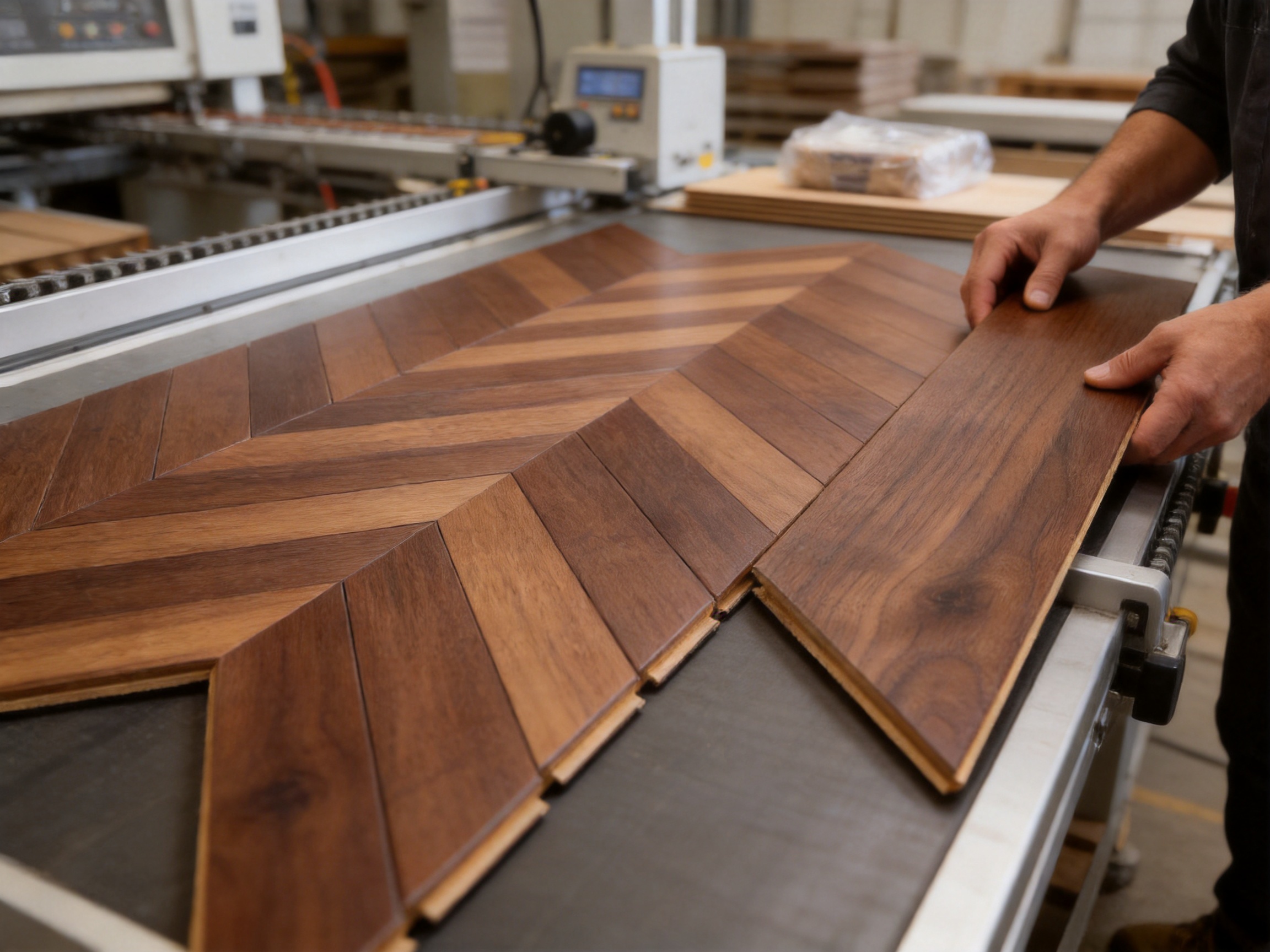
The product description emphasizes handcrafted splicing technology. Handcrafted assembly does not mean that the product is made without modern equipment. In a well-managed manufacturing environment, skilled workers and precision machinery complement one another. Automated cutting and profiling help establish dimensional accuracy, while experienced technicians inspect grain direction, piece alignment, surface quality, and joint consistency.
Parquet products require careful attention because the final visual result depends on the relationship between many individual pieces. A small inconsistency in length, angle, edge preparation, or color selection can become noticeable when repeated across a large floor. Handcrafted assembly helps identify and correct these issues before the product reaches the installation site.
Tight joints are another important quality feature. Properly prepared joints help reduce visible gaps and contribute to a flatter, more continuous appearance. The supplied information describes handcrafted assembly with tight joints and high flatness. These characteristics are especially valuable in herringbone flooring, where irregular joints can interrupt the pattern and reduce the sense of precision.
Modern production lines also support repeatability for larger orders. This is important for hospitality developments, multi-unit residential projects, retail programs, and commercial rollouts that require the same appearance across multiple rooms or locations. The combination of digital production control, automated quality systems, and skilled inspection can help maintain consistency from one batch to the next.
The manufacturer associated with this product operates production facilities covering approximately 20,000 square meters and has more than two decades of experience in wood solutions. Its reported annual production capacity includes approximately 2,400,000 square meters of flooring and 5,000 sets of doors. These capabilities are relevant to buyers that require both product quality and dependable production volume.
A three-step quality inspection process is used as part of the company’s stated manufacturing approach. Although the precise internal checkpoints may vary by product line, a structured inspection program generally addresses raw material selection, in-process machining and assembly, and final product verification. This approach helps reduce the risk of defects being discovered only after delivery.
The DF-Y1156 reference includes a click-lock DIY installation system and a four-sided click profile. A click system allows adjoining pieces to connect through a designed locking geometry rather than relying entirely on site-applied adhesives or complex traditional fastening methods. For qualified installers, this can support a more organized workflow and reduce installation time.
Herringbone installation still requires care. The pattern depends on accurate starting lines, correct left and right plank placement, controlled expansion allowances, and consistent alignment. A click profile does not remove the need for professional preparation. Instead, it can make the assembly process more predictable when the subfloor, moisture conditions, room layout, and product acclimatization are properly managed.
The packaging reference identifies separate left and right planks. This is useful because herringbone layouts require opposing pieces to form the repeated zigzag. Clear separation and labeling can help installers reduce sorting time and avoid incorrect placement during large installations.
Floating installation can offer additional practical benefits. It may reduce reliance on permanent adhesive bonding, simplify repair or replacement of selected boards, and support faster project turnover. It can also be advantageous in renovation work where the installation team needs to minimize noise, odor, or wet trades. However, the final installation method must always follow the technical instructions supplied for the selected construction and local building requirements.
Before installation, the subfloor should be clean, dry, structurally sound, and sufficiently level. Excessive moisture, unevenness, contamination, or movement in the substrate can affect the performance of any wood flooring system. The product should be stored in suitable conditions and acclimatized according to the supplier’s technical guidance.
Expansion gaps around walls, columns, door frames, and fixed furniture are essential because wood products require room for natural movement. These gaps are typically concealed with skirting, trims, or transition profiles. Correct planning at the beginning of the project helps preserve both performance and appearance.
A major advantage of this flooring solution is the range of available customization options. The stated options include different wood species such as oak, walnut, ash, and teak; veneer grades such as AB, ABC, ABCD, and CD; wear-layer thicknesses from 2 to 6 millimeters; several surface finishes; and multiple texture treatments.
Customization allows the same basic product platform to serve different market segments. A residential developer may request a warm walnut appearance with a smooth matte finish. A boutique hotel may select a hand-scraped surface with a more historic character. A retail showroom may prefer a wire-brushed texture that adds tactile depth under strong lighting. A distributor may request several standardized colorways for different regional customer preferences.
Wear-layer selection should be considered in relation to the project’s expected traffic, maintenance program, refinishing objectives, and budget. A thicker wear layer may provide greater future refinishing potential, while a thinner option may be appropriate for certain applications or cost targets. The correct specification should be selected in consultation with the manufacturer and project professionals.
Veneer grade affects the visual consistency and natural variation of the finished floor. More selective grades may offer a calmer appearance with fewer prominent knots or variations, while character grades can create a more expressive and rustic result. Neither approach is universally better; the best choice depends on the design concept and the client’s expectations.
Surface texture can significantly change how a dark floor is perceived. Smooth sanding creates a clean, refined effect. Wire brushing emphasizes the grain and adds tactile definition. Hand scraping introduces irregularity and a crafted appearance. In each case, the texture should be coordinated with the lighting plan, furniture style, and expected maintenance conditions.
Color customization is also valuable for projects that require coordination with doors, cabinetry, wall paneling, stair components, or custom furniture. Since the manufacturer also specializes in wooden doors and custom cabinet solutions, buyers may be able to coordinate multiple wood products through one supply partner. This can simplify color approval, sample management, and project communication.
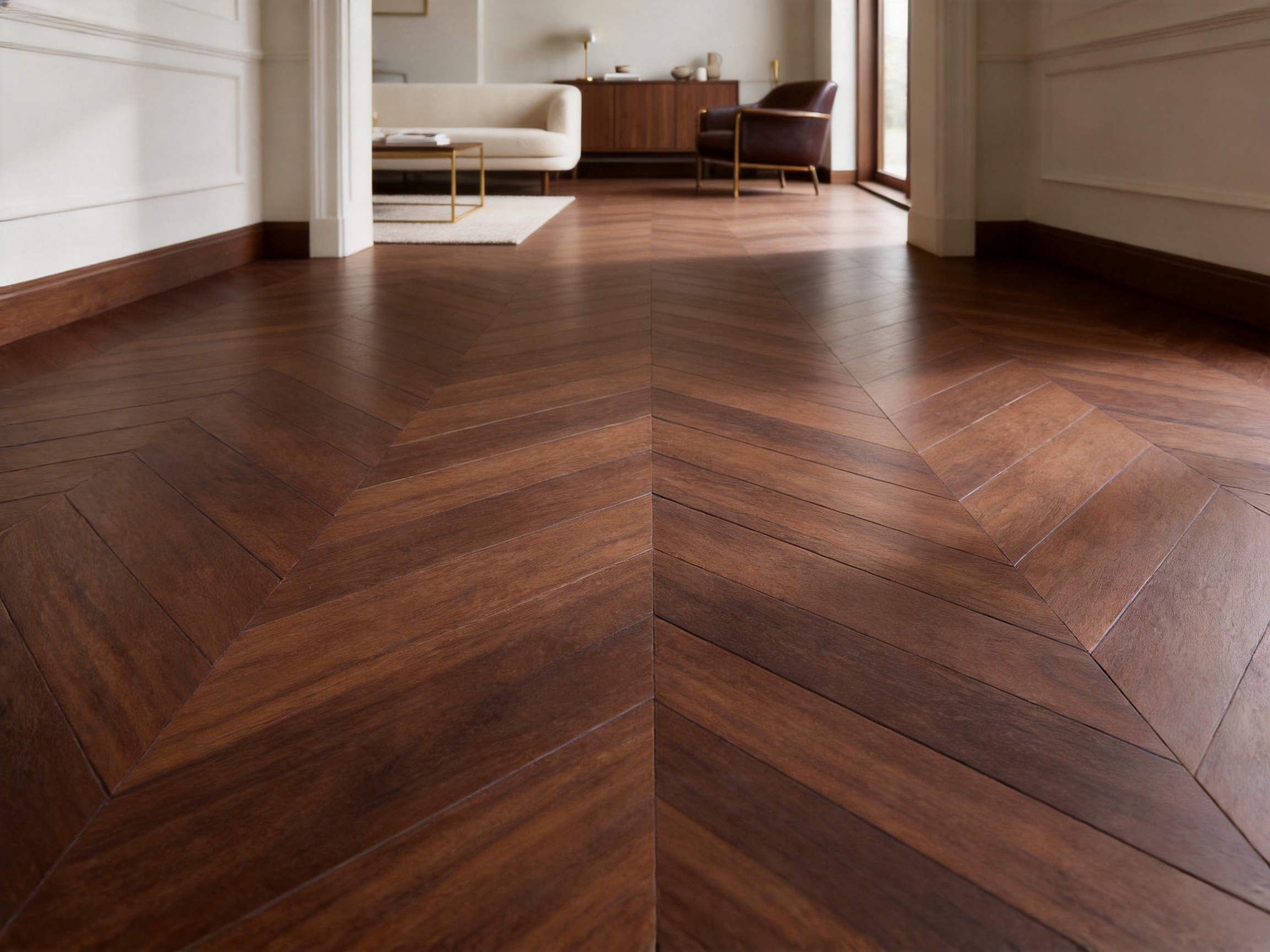
Many entry-level flooring products use printed decorative layers to imitate timber. These products can be economical and visually consistent, but they may not provide the depth, tactile response, or natural variation expected in premium interiors. Walnut herringbone parquet uses real wood characteristics to create a richer and more authentic surface impression.
Straight-plank floors offer a familiar appearance, while herringbone flooring adds a more deliberate architectural rhythm. The repeated angled arrangement can define zones, lengthen visual sightlines, and add character to otherwise simple rooms. This makes the product especially suitable for projects where the floor itself is part of the design statement.
Compared with highly glossy surfaces, the matte finish offers a calmer visual effect with less intense reflection. It can be easier to coordinate with natural fabrics, textured walls, brushed metals, and low-sheen furniture. The matte surface also supports the vintage and understated luxury positioning of the product.
Generic ready-made floors often offer limited options for grade, core construction, finish, and texture. This product platform provides more opportunities to adapt the flooring to project demands. Buyers can discuss wood species, wear-layer thickness, grade, finish, texture, and color rather than accepting a single fixed specification.
For large projects, flooring rarely exists in isolation. It must coordinate with doors, cabinets, wall details, stairs, and furniture. A manufacturer that can support several interior wood categories may provide a more coherent procurement strategy than multiple unrelated suppliers. This can reduce color mismatch and simplify production planning.
Architects and interior designers often need samples, mock-ups, technical clarification, and controlled revisions. The manufacturer’s stated ability to provide rapid prototyping within approximately 72 hours can support faster design development, although actual timing depends on project complexity, sample availability, and shipping arrangements.
In living rooms, dark walnut herringbone flooring can create a stable visual base for sofas, occasional tables, area rugs, and statement lighting. The pattern can be aligned with the principal sightline or oriented to connect the living room with an adjacent dining or circulation zone. A matte finish helps prevent the floor from competing with reflective decorative objects.
In a study or library, the dark brown tone works naturally with bookshelves, leather seating, aged brass hardware, and darker timber furniture. The floor can support a quiet, concentrated atmosphere while adding enough texture to prevent the room from feeling flat.
In bedrooms, the herringbone pattern can be paired with soft textiles, upholstered headboards, neutral curtains, and warm lighting. Designers may choose a more restrained grade or smoother surface texture if the desired result is calm and elegant rather than rustic or highly expressive.
In dining rooms, the pattern can help frame the table and define the dining zone within an open-plan home. The floor’s natural wood character can complement stone tabletops, solid timber dining furniture, and woven accessories. Appropriate protective pads and routine care remain important in areas where chairs and table legs move frequently.
Entry halls and corridors can benefit from the directional quality of herringbone flooring. The pattern can lead visitors toward the main living space and create a strong first impression. Because entrances may receive more dirt and moisture, designers should specify suitable protective measures, entrance mats, and cleaning procedures.
Hotel lobbies require materials that communicate quality immediately while remaining compatible with frequent use and continuous visual exposure. Walnut herringbone flooring can help establish a welcoming and sophisticated arrival experience. Its pattern provides a memorable design feature, while the dark tone can support a broad range of furniture and branding palettes.
In boutique hotels, the flooring can reinforce a heritage, residential, or European-inspired design direction. Combined with wall molding, decorative lighting, tailored furniture, and textured fabrics, it can create a setting that feels personal rather than standardized.
Commercial showrooms can use the flooring as a backdrop for displayed products. Furniture, lighting, fashion, automobiles, materials, and lifestyle goods may all benefit from a floor that looks premium but does not dominate the display. The matte finish can also reduce distracting reflections in photographs and under directional lighting.
In offices, the product may be suitable for executive rooms, meeting suites, reception zones, and hospitality lounges. It can soften the institutional character of commercial interiors and create a more welcoming environment for visitors and staff. For higher-traffic areas, the project team should carefully assess the selected wear layer, finish, maintenance plan, and expected use intensity.
Restaurants and private clubs may use dark herringbone flooring to create an intimate atmosphere. However, these environments require close attention to moisture, spills, chair movement, cleaning chemicals, and local fire or safety requirements. The product specification should be reviewed in relation to the full operational environment before approval.
The product information identifies FSC certification, reflecting a commitment to responsible forestry and traceable wood sourcing. Certification can be important for projects seeking green building recognition, environmental procurement documentation, or responsible material policies.
FSC certification should be reviewed through the applicable certification documents and product chain-of-custody information for the specific order. Buyers may need to confirm whether the certification applies to the complete flooring assembly, selected wood components, or a particular production batch.
The company also reports compliance or product support associated with CE, CARB P2, and ISO 9001 standards. These certifications and declarations address different areas, including product conformity, emissions requirements, and quality management. Project teams should request current documentation and verify that it applies to the exact product configuration and destination market.
Responsible material selection should be considered together with product longevity. A durable floor that can be maintained, repaired, or refinished may reduce the need for frequent replacement. The potential service life of the flooring depends on the wear layer, installation quality, environmental conditions, cleaning program, and traffic level.
Wood flooring can also contribute to a warmer and more tactile interior environment. Its natural appearance may reduce the need for additional decorative finishes, while its ability to coordinate with multiple design styles can support long-term adaptability when furniture or wall colors change.
Quality begins with raw material selection. Wood should be assessed for species identity, grain characteristics, moisture condition, dimensional quality, and visible defects appropriate to the selected grade. For a dark walnut appearance, color consistency and grain direction are important because irregular combinations can become more visible across a herringbone layout.
During machining, plank dimensions and edge profiles must remain within controlled tolerances. The click-lock geometry should be formed accurately so that pieces engage correctly without excessive force or looseness. V-bevel details should be consistent to maintain a uniform visual rhythm.
During assembly, left and right components must be correctly organized. The production team should inspect joint tightness, alignment, surface flatness, and color distribution. Any damaged, incorrectly profiled, or visually unsuitable piece should be removed before packaging.
Surface finishing requires control of coating coverage, curing, sheen, color, and texture. UV lacquer, UV oil, and wood wax oil each create different performance and visual characteristics. The selected system should be applied consistently across the order, and sample approval should be used to establish the expected appearance.
Final inspection may include dimensional checks, visual inspection, packaging review, labeling verification, and quantity confirmation. Proper packaging protects the surface during handling and transportation. Carton information should identify the product model, batch, quantity, and installation orientation where applicable.
The manufacturer’s use of imported German production lines and automated quality control systems indicates an investment in modern manufacturing infrastructure. Advanced equipment can improve repeatability, while human inspection remains essential for evaluating natural wood variation and the visual requirements of decorative parquet products.
The supplied packaging reference lists 32 pieces per carton, approximately 1.665 square meters per carton, approximately 17.92 square feet per carton, and an approximate carton weight of 18 kilograms. These figures are useful for preliminary quantity planning, warehouse organization, shipping calculations, and installation scheduling.
Actual project quantities should include an allowance for cutting, layout adjustment, damaged pieces, and future repairs. Herringbone flooring may require a higher allowance than simple straight-plank flooring because the installation pattern involves more cuts and more precise edge management. The correct allowance depends on room geometry and installer experience.
Large projects should coordinate production batches and delivery schedules carefully. If flooring is installed across multiple buildings or phases, it is preferable to maintain clear batch records and reserve material for future repairs. Color and grain can naturally vary between production periods, even when the same specification is used.
Cartons should be transported and stored in dry, protected conditions. They should not be placed directly on damp floors or exposed to uncontrolled weather. Pallets and cartons should be handled according to the supplier’s instructions to avoid corner damage, surface abrasion, or deformation before installation.
The installation area should be inspected before the flooring arrives. The subfloor should meet the required flatness and moisture criteria, and the building should be sufficiently enclosed to protect the product from rain and excessive humidity. Wet construction activities should be completed or appropriately isolated.
Acclimatization is a critical step. Wood flooring should be allowed to adjust to the indoor environment according to the supplier’s instructions. The recommended time and conditions may vary depending on the construction type, local climate, and packaging. Installing flooring before proper acclimatization can increase the risk of gaps, cupping, or dimensional movement.
Installers should establish a precise reference line before laying the first pieces. In a herringbone pattern, an inaccurate starting point can cause the entire layout to drift. The central axis, room geometry, door transitions, and furniture arrangement should be considered before work begins.
Left and right planks should be kept organized. Mixing the two types without a clear installation sequence can interrupt the pattern. A dry layout or partial test assembly can help verify the pattern, color distribution, and relationship with thresholds and adjacent materials.
The click system should be engaged according to the product instructions. Excessive force, hammering in the wrong location, or forcing an incorrectly aligned piece may damage the locking profile. Approved tools and tapping blocks should be used where necessary.
Expansion gaps should be maintained at the room perimeter and around fixed obstructions. Transition details should be planned at doorways and where the flooring meets tile, stone, carpet, or other materials. These details influence both long-term performance and the finished appearance.
After installation, the floor should be protected from subsequent construction activity. Heavy equipment, abrasive dust, paint, and moisture can damage a new surface. Breathable protective coverings may be used when compatible with the finish and installation conditions.
Daily care for the walnut herringbone floor is straightforward when appropriate products and methods are used. Dry dust removal with a soft broom, microfiber mop, or dry cloth helps prevent abrasive particles from remaining on the surface. Fine grit can act like sandpaper when repeatedly walked across the floor.
Spills should be removed promptly with a clean, slightly damp cloth. Excess water should not be allowed to remain on the surface or enter open joints. Wood flooring should not be saturated during cleaning, and harsh chemicals or abrasive pads should be avoided unless specifically approved for the selected finish.
Entry mats can reduce the amount of sand, dirt, and moisture brought into the room. Mats should be appropriate for wood flooring and should not have backing materials that trap moisture or discolor the finish. Furniture legs should be fitted with protective pads, and heavy items should be lifted rather than dragged.
The supplied care recommendation includes applying walnut oil monthly to enhance appearance and longevity. This recommendation should be followed only when compatible with the selected surface finish. UV lacquer, UV oil, and wood wax oil have different maintenance requirements, so the manufacturer’s specific maintenance instructions should take priority.
Sharp objects, pet claws, high heels, and unprotected furniture can scratch the finish. Minor marks may sometimes be addressed through approved maintenance products, while deeper damage may require professional repair. Keeping spare boards from the original production batch can simplify future localized replacement.
Indoor environmental control also supports long-term performance. Extremely dry or excessively humid conditions can affect wood flooring. Maintaining a stable indoor climate, using suitable ventilation, and addressing leaks promptly can help preserve the floor’s appearance and dimensional stability.
Suzhou Dicosbo Wood Co., Ltd. has been active in wood manufacturing since 1999 and reports more than 20 years of experience. Its product categories include wood flooring, wooden doors, and custom cabinet solutions. This broader capability is valuable for projects that require a coordinated interior wood package rather than one isolated product.
The company reports more than 10 years of export experience and serves partners across Europe, North America, Southeast Asia, and other international markets. Export experience can support familiarity with international packaging, documentation, communication, product customization, and shipment coordination.
OEM and ODM services allow buyers to develop products under their own market identity or to modify existing designs for specific projects. For distributors, this may support differentiated product collections. For architects and developers, it can provide a path toward project-specific flooring rather than a standard catalog selection.
The reported 72-hour rapid prototyping capability can be useful during the early design stage. Samples and mock-ups help project teams review color, grain, sheen, texture, plank proportion, and pattern behavior under actual lighting. Prototype timing should be confirmed for each request, especially where custom species, finishes, or complex assemblies are required.
Production capacity is another important strength. With a stated annual flooring capacity of approximately 2,400,000 square meters, the company is positioned to support both smaller bespoke orders and larger commercial programs. Capacity alone does not replace quality control, but it can reduce the risk of supply shortages when production planning is handled properly.
The company also reports automated quality control systems and German imported production lines. These systems can help improve repeatability in cutting, profiling, finishing, and packaging. For decorative flooring, the most effective approach combines this equipment with skilled workers who understand natural wood variation and visual grading.
Global compliance support, FSC certification, CE-related conformity, CARB P2 considerations, and ISO 9001 quality management provide a foundation for international project discussions. Buyers should always request the latest certificates, test reports, technical data sheets, and declarations for the exact product configuration being purchased.
Designers should decide whether the flooring is intended to act as a quiet background or a central visual feature. If the floor is the focal point, furniture and wall finishes can remain relatively restrained. If the room already contains strong patterns, a more selective wood grade and smoother surface may help maintain balance.
Pattern direction should be studied in relation to the room’s longest dimension. A consistent directional strategy can make circulation feel more intentional. In irregular rooms, the designer may use thresholds, borders, or changes in pattern direction to transition between zones.
Lighting has a strong effect on dark wood. Warm lighting can emphasize the walnut character, while cooler lighting may reveal gray or neutral undertones. Sample boards should be observed under the actual project lighting where possible, including daylight, decorative lighting, and evening conditions.
Color coordination is also important. Walnut herringbone flooring can work with pale plaster, warm white paint, olive green, navy, charcoal, terracotta, tan leather, and natural stone. The correct combination depends on the selected wood grade and finish, as a heavily varied floor will interact differently with surrounding colors than a more uniform floor.
Designers should also consider the scale of the room. The reference plank size provides a recognizable herringbone rhythm, but larger spaces may support stronger pattern repetition, while smaller rooms may require careful alignment to avoid excessive visual fragmentation. Custom dimensions can help adjust the scale for a particular project.
Before approving the product, the project team should confirm the intended application, traffic level, subfloor condition, indoor climate, installation method, finish type, wood species, grade, wear-layer thickness, texture, color, and packaging configuration.
A physical sample should be reviewed rather than relying only on digital images. Natural wood color can vary according to photography, screen settings, lighting, and batch. The sample should be viewed beside the intended furniture, wall finish, stone, metal, and textiles.
The team should confirm whether the order will use the standard DF-Y1156 configuration or a customized version. The product information includes both herringbone references and configurable chevron options. Because herringbone and chevron patterns use different geometry and visual alignment, the final pattern, angle, plank type, and packing arrangement should be clearly documented in the quotation and approval drawings.
Technical documents should identify the core construction, surface finish, surface texture, wear layer, dimensions, installation method, carton coverage, and applicable certifications. Clear documentation reduces the risk of assumptions during procurement and installation.
For commercial projects, the maintenance department or facility manager should be included in the product review. A floor that looks attractive at handover must also be manageable within the building’s long-term cleaning and repair procedures.
The flooring is suitable for vintage, transitional, classic, contemporary, industrial, and luxury residential interiors. It works particularly well with dark solid wood furniture, leather sofas, metal accents, neutral textiles, stone, and warm architectural lighting.
Yes. The product is intended for applications such as commercial showrooms, hotel lobbies, boutique offices, reception areas, executive rooms, and other design-led spaces. The wear layer, finish, installation method, and maintenance plan should be selected according to the expected traffic.
The product description identifies a solid wood base material and natural wood grain. Configurable constructions may use wood veneer with eucalyptus or birch plywood core options. The exact structure should be confirmed in the project specification before ordering.
The product information identifies a reference size of approximately 510 × 102 × 15 millimeters. Other dimensions may be available through customization, and the final approved size should be stated in the quotation and technical documents.
Available options include UV lacquer, UV oil, and wood wax oil. The correct finish depends on the desired appearance, maintenance program, project conditions, and performance expectations.
Yes. The listed texture options include wire brushed, hand scraped, and smooth sanded surfaces. These treatments create different tactile and visual effects.
Customization is available for wood species and colors. Listed species options include oak, walnut, ash, and teak. Custom color matching should be confirmed through physical samples and an approved color standard.
The four-sided click system and floating installation method can simplify assembly for qualified installers. However, herringbone flooring still requires accurate layout, correct left and right plank placement, proper subfloor preparation, acclimatization, and expansion allowances.
The matte finish is designed to reduce strong reflections and make fingerprints less visually prominent than on a high-gloss surface. It is not completely mark-proof, so regular care and prompt spill removal remain necessary.
Routine care includes dry dust removal and wiping spills with a clean, slightly damp cloth. Excessive water, abrasive tools, and unsuitable chemical cleaners should be avoided. Maintenance oil should be used only when compatible with the selected finish.
The product information identifies FSC-certified sustainable material. Buyers should request current certification and chain-of-custody documentation for the specific order. The company also reports support for several international compliance and quality standards.
Yes. The manufacturer also provides wooden doors and custom cabinet solutions. Coordinating these products through one supplier may help achieve closer color, grain, and finish consistency across the interior.
Buyers should confirm the pattern, dimensions, wood species, grade, core construction, wear layer, finish, texture, color, installation method, packaging coverage, certifications, lead time, and approved sample. For commercial applications, traffic and maintenance requirements should also be documented.
The manufacturer reports OEM and ODM capabilities. This may allow distributors, developers, and design firms to request customized products, packaging, colors, or specifications, subject to minimum order quantities and technical feasibility.
Walnut Herringbone Dark Brown Matte Parquet Flooring offers a combination of natural material character, distinctive pattern design, practical click-lock construction, and broad customization potential. Its dark walnut appearance brings depth and warmth to interiors, while the matte surface supports an understated luxury aesthetic that is suitable for both residential and commercial applications.
The product’s advantages over generic flooring alternatives include a more authentic wood experience, stronger visual identity, configurable construction, handcrafted assembly, flexible surface treatments, and compatibility with coordinated interior wood programs. Its herringbone layout can help define space, guide movement, and create a memorable foundation for furniture and architectural finishes.
Behind the product is a manufacturing platform with more than two decades of experience, substantial production capacity, export expertise, OEM and ODM capabilities, rapid prototyping support, modern production lines, and structured quality inspection. These strengths are particularly valuable for professional buyers who require both design flexibility and dependable supply.
Successful results depend on correct specification, sample approval, appropriate installation, stable indoor conditions, and regular maintenance. When these factors are managed carefully, DF-Y1156 can provide a durable and visually distinctive wood surface for luxury homes, showrooms, hospitality environments, and other design-focused interiors.
1. Product specification and technical information for DF-Y1156 Walnut Herringbone Dark Brown Matte Parquet Flooring.
2. Manufacturer-provided information regarding wood flooring construction, surface finishes, click-lock profiles, packaging, and installation methods.
3. Forest Stewardship Council, principles and criteria for responsible forest management and chain-of-custody certification.
4. ISO 9001, Quality Management Systems: Requirements.
5. CARB Phase 2 requirements concerning formaldehyde emissions from composite wood products.
6. General professional guidance for engineered wood flooring installation, acclimatization, moisture control, expansion planning, and maintenance.
7. Manufacturer information concerning OEM and ODM customization, rapid prototyping, production capacity, international export experience, and quality inspection procedures.

We provide customers with sustainable and eco-friendly
engineered wood solutions and services.
Choose DEIF for the perfect blend of
performance and aesthetics.
