


 English
 Español
 عربى


Get Social
Choose DEIF for the perfect blend of
performance and aesthetics.
 Get Free Sample

Content
Interior doors have evolved from basic functional elements into important architectural features. In contemporary homes, hospitality environments, offices, and commercial developments, a door contributes to the visual identity, acoustic comfort, durability, and perceived quality of an interior. The Pure White Maple Veneer Door is designed for projects that require a clean appearance, natural material character, reliable construction, and flexible customization.
Combining natural maple veneer with a soft white finish and geometric V-shaped groove detailing, this door offers a carefully balanced alternative to both ordinary painted doors and expensive solid wood products. Its design is bright and minimalist, while its engineered construction is developed to address common concerns associated with solid wood, including cracking, dimensional movement, and warping.
The product is identified as DFD-NV-06 and belongs to the Natural Veneer Doors category. It is suitable for modern minimalist residences, high-end apartments, villas, boutique hotels, offices, showrooms, reception areas, art studios, and premium commercial interiors. Because the structure, finish, dimensions, hardware preparation, and opening direction can be customized, it is also suitable for large-scale architectural projects requiring consistent quality across multiple room types.
Manufactured by Suzhou Dicosbo Wood Co., Ltd., the door benefits from an established production system focused on wood flooring, wooden doors, and custom cabinet solutions. The company combines natural material selection, engineered core technology, automated manufacturing, export experience, and structured quality control to provide a dependable product for distributors, contractors, architects, and developers.
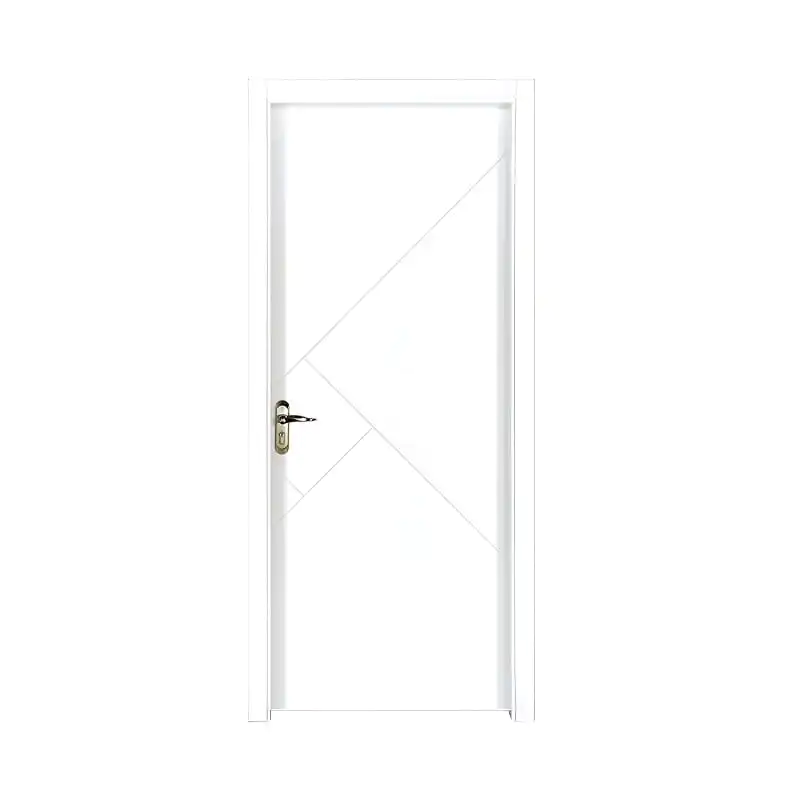
Pure White Maple Veneer Door
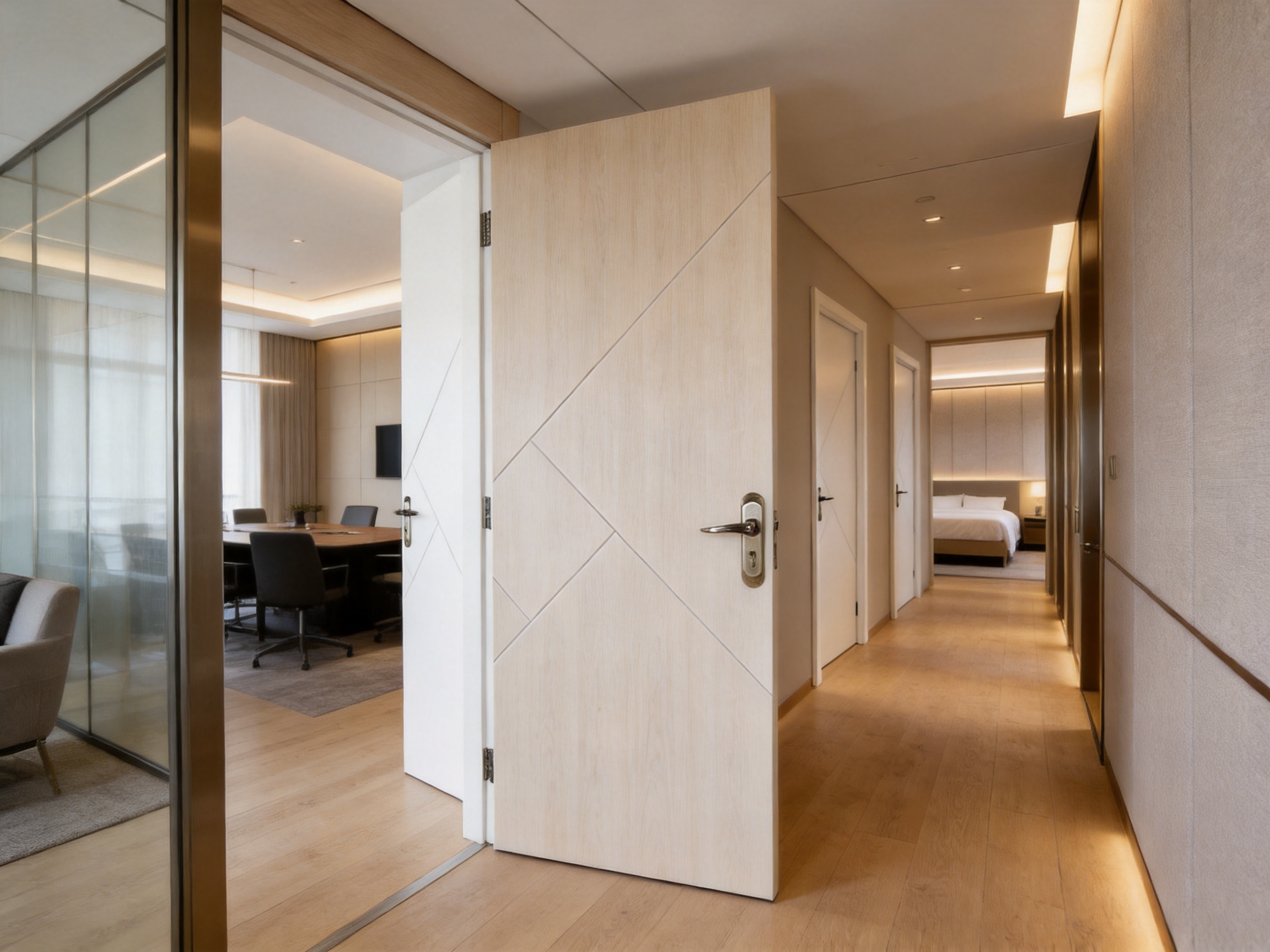
The Pure White Maple Veneer Door is a contemporary interior door featuring a natural maple veneer surface, a clean white finish, and a geometric V-groove pattern. The design preserves the subtle visual movement of real wood while creating a bright, orderly, and highly adaptable appearance. Unlike a completely flat painted door, the veneer surface provides tactile depth and authentic grain variation. Unlike a heavily patterned timber door, the white tone and restrained geometry maintain a calm and sophisticated look.
The basic product description includes 100% pure natural wood veneer, a high-strength composite solid wood core, FSC and CE certification, multiple finish and species options, non-standard size customization, pre-cut hardware holes, and strong project cost-effectiveness. These features are intended to meet the practical and aesthetic requirements of modern interior construction.
A standard door slab size is listed as 2100 × 900 × 45 millimeters, while customized sizes are available. The wall thickness range is approximately 100 to 300 millimeters, depending on the project configuration. Frames can be supplied in MDF or plywood, and the delivery form is a knock-down frame with door slab. This format can simplify transportation, storage, and installation management, particularly for projects involving many openings.
The door can be configured for left- or right-hand operation and inward- or outward-opening applications. Hinge and lock positions can be pre-drilled before shipment, reducing the amount of site work required. The product is also available with PUR or laser edge banding, optional acoustic performance, and selected environmental grades.
The primary features of the Pure White Maple Veneer Door include:
• Natural maple veneer selected for fine, even grain and an authentic wood appearance.
• A soft white surface treatment that improves brightness and complements a wide range of interior palettes.
• Geometric V-shaped grooves that introduce structured relief and visual depth.
• A high-strength composite solid wood core engineered for improved stability.
• MDF, HDF, or plywood base-board options according to project requirements.
• Honeycomb paper, solid wood, or plywood core structures available for different performance and budget targets.
• Primed or painted finished surfaces, with color customization available.
• Custom production for extra-wide, extra-high, and irregular openings.
• Pre-drilled hinge and lock holes for more efficient installation.
• Rw 28–32 dB acoustic performance as a standard range, with further customization available.
• E0 and E1 environmental grades available.
• Knock-down frame and slab delivery for practical project logistics.
• PE film, foam, and carton packaging to support protection during transportation.
Maple is widely appreciated for its light color, subtle grain, and refined visual consistency. When used as a natural veneer, maple creates a surface that feels warmer and more authentic than a synthetic wood-look film. The natural grain is visible without becoming visually dominant, making it appropriate for interiors where the door should contribute to the design without overwhelming surrounding materials.
The pure white finish gives the maple veneer a contemporary character. Rather than concealing the material completely, the finish works with the natural grain to create a soft and clean appearance. Depending on lighting conditions, the surface can appear bright and crisp while still retaining the texture associated with real wood. This combination is especially effective in spaces using stone, glass, metal, neutral textiles, light oak, or monochromatic furnishings.
White interior doors can help create a perception of greater openness. They reflect more available light than darker finishes and can visually connect multiple rooms. In apartments and compact commercial spaces, this effect can make circulation areas appear less enclosed. In larger properties, a white veneer door can function as a quiet background element that allows furniture, artwork, lighting, and architectural finishes to remain visually prominent.
The V-shaped groove pattern is one of the most distinctive elements of the design. Precision grooves create linear shadows across the door surface, adding rhythm and depth to an otherwise restrained composition. The pattern gives the slab a crafted architectural quality while maintaining the simplicity expected in minimalist interiors.
Geometric detailing can also support design continuity. The clean lines may echo wall paneling, ceiling joints, cabinetry, flooring arrangements, or architectural metalwork. When coordinated with other linear elements, the door becomes part of a unified interior language rather than an isolated functional component.
The pattern is suitable for both residential and commercial environments because it is decorative without being overly ornamental. In a modern villa, it can complement custom cabinetry and natural flooring. In a boutique hotel, it can create a consistent identity across guest rooms and corridors. In an office or showroom, it can provide a subtle premium detail that distinguishes the space from standard commercial interiors.
Natural veneer offers a useful middle ground between the individuality of solid wood and the uniformity of industrial decorative surfaces. Every natural veneer panel contains genuine wood characteristics, yet professional selection and production can provide a controlled overall appearance across a project. This is important when multiple doors must appear coordinated while still retaining the authenticity of natural material.
The maple surface may be specified as part of a broader customization program. Although the featured design is presented in pure white maple, the product range also supports alternatives such as red oak, black walnut, and white ash. This allows designers and project managers to maintain the same construction approach while adapting the visible species to different interior concepts.
One of the major advantages of the Pure White Maple Veneer Door is its engineered construction. Solid wood has a natural beauty that is difficult to replicate, but it also responds to variations in temperature and humidity. If a solid wood component is not properly dried, balanced, or assembled, it may develop dimensional changes, cracking, twisting, or warping over time.
The composite solid wood core is designed to address these risks. Through a scientifically planned layered structure, the door distributes internal stresses more effectively than a single-piece solid wood slab. The use of engineered materials allows the manufacturer to control density, balance, and dimensional behavior while preserving the visual character of natural veneer on the surface.
Available core structures include honeycomb paper, solid wood, and plywood. These options allow the product to be matched to different project objectives. A honeycomb structure can support weight reduction and efficient handling. A solid wood or plywood structure may be selected where a more substantial feel, improved screw-holding capacity, or specific performance requirements are desired.
The base-board can be specified as MDF, HDF, or plywood. MDF and HDF offer smooth, uniform substrates that are well suited to veneering and painted finishes. Plywood can be selected for applications requiring a layered panel structure and additional project-specific performance. The final choice depends on the intended use, door size, hardware requirements, acoustic targets, moisture conditions, and budget.
A stable door is not determined by the face veneer alone. The veneer, substrate, core, edge treatment, frame, adhesive system, and finishing process must work together. If one layer is significantly more affected by environmental changes than another, internal stress may accumulate. The composite design of this product aims to create a more balanced door assembly.
Moisture content is listed at approximately 8% to 10%, with a tolerance of plus or minus 2%. Proper moisture management is essential in wood manufacturing because it helps the material reach a condition suitable for the climate in which the product will be used. Although all wood products should be stored and installed under appropriate conditions, controlled moisture content can reduce the risk of avoidable movement.
Edge treatment is another important factor. PUR and laser edge banding are available, giving projects options for clean appearance and durable edge protection. A properly finished edge helps limit vulnerability at exposed panel boundaries and supports a more refined visual result after installation.
Ordinary painted MDF or composite doors can provide a low-cost and consistent finish, but they may lack the visual depth and tactile quality of natural wood. The Pure White Maple Veneer Door retains real wood grain beneath the white finish, creating a more premium appearance. The result is especially valuable in projects where doors are located in prominent circulation paths, bedrooms, reception areas, meeting rooms, or hospitality spaces.
The veneer also responds differently to light than a completely flat synthetic coating. Subtle grain variations and the V-groove pattern generate changing highlights and shadows throughout the day. This can make the door surface appear more refined and dimensional without requiring excessive ornamentation.
Another advantage is the ability to specify different surface treatments. Open-pore and closed-pore finishes can be customized, allowing designers to choose between a more tactile natural appearance and a smoother, more uniform surface. This range is useful when coordinating doors with flooring, wall panels, cabinetry, or furniture from different material families.
The door is also more flexible in terms of project configuration. Standard painted doors are often offered in limited dimensions and with basic hardware preparation. This product supports non-standard sizes, custom wall thicknesses, different opening directions, multiple frame materials, and pre-drilled hardware. Such flexibility can reduce the need for site modifications and help maintain design consistency in architecturally complex projects.
Solid wood doors remain desirable for their weight, authenticity, and material richness. However, a solid wood door may require careful species selection, extended seasoning, precise moisture control, and ongoing attention to environmental conditions. It can also involve higher material costs and greater weight, creating logistical and installation challenges.
The Pure White Maple Veneer Door is designed to deliver a comparable high-end visual impression within a more controllable project budget. Its real veneer surface provides natural wood authenticity, while the engineered core helps improve dimensional stability. This approach can make the product more suitable for large developments where dozens or hundreds of doors must be coordinated.
Because the core can be adjusted according to performance requirements, the door can be optimized rather than over-specified. A project may choose a lighter structure for efficient handling, a stronger plywood configuration for demanding hardware applications, or a solid wood core where a more substantial construction is preferred. This flexibility can improve the relationship between performance and cost.
Pre-cut hardware holes provide another practical advantage. Solid wood doors often require careful site preparation to prevent chipping, incorrect positioning, or unnecessary labor. Factory drilling based on approved hardware schedules can produce more consistent results and improve installation efficiency. The product information indicates that pre-cut preparation can improve on-site installation efficiency by approximately 50%, depending on project conditions and installation practices.
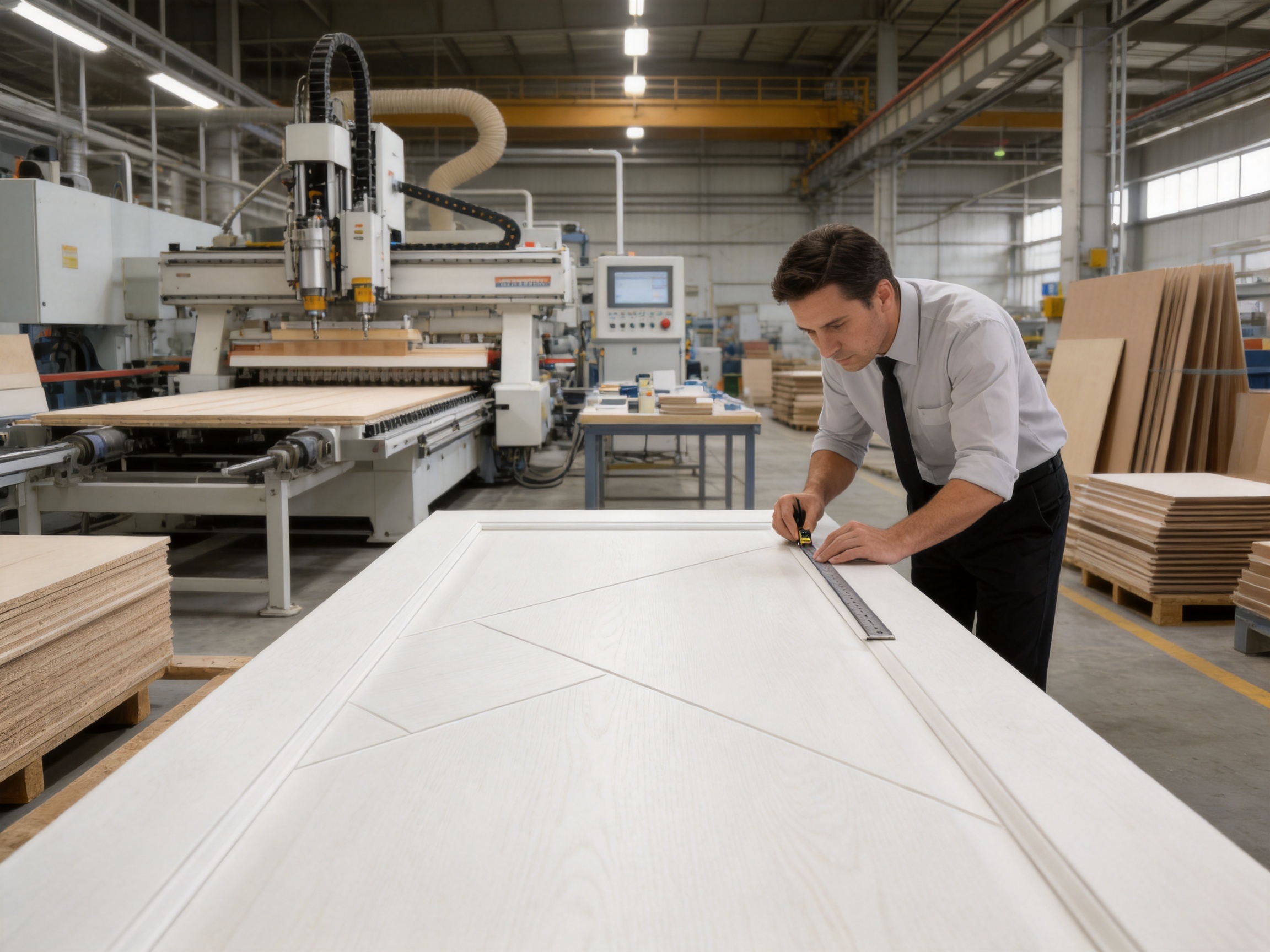
The quality of a veneer door depends on the complete manufacturing process rather than a single material feature. Suzhou Dicosbo Wood Co., Ltd. operates production facilities covering approximately 20,000 square meters and uses German-imported production lines together with automated quality control systems. These resources support repeatable processing, stable supply, and the ability to produce customized orders at commercial scale.
The first stage is the selection of suitable wood materials. Veneer quality affects grain appearance, color, surface integrity, and the final visual consistency of the door. Logs and veneer sheets are assessed for characteristics that influence slicing, matching, bonding, and finishing. For a white maple door, the objective is to achieve a clean, even foundation that allows the natural grain to remain visible beneath the selected finish.
Other materials, including MDF, HDF, plywood, solid wood components, and edge-banding materials, must also meet the requirements of the intended construction. The selection process considers not only appearance but also moisture content, structural suitability, machining behavior, and compatibility with adhesives and coatings.
Natural veneer is prepared to create a stable and visually coordinated surface. The veneer may be arranged to support continuity across the door face, depending on the design and project specification. Careful preparation helps prevent visible irregularities from distracting from the intended geometry of the V-groove pattern.
At this stage, the manufacturer must also consider how the veneer will react to later machining and finishing. Groove locations, edge conditions, hardware areas, and panel dimensions are coordinated so that the decorative design remains balanced after the door has been assembled.
The selected core structure is assembled with the base-board and related components. Pressing and bonding must be carefully controlled to achieve even adhesion and minimize the potential for delamination or internal stress. The purpose of the engineered assembly is to create a rigid but balanced panel that can support the veneer and tolerate normal interior use.
For larger or non-standard door sizes, production planning becomes especially important. Extra-wide and extra-high slabs can place greater demands on structural stability, pressing equipment, handling, and storage. A professional manufacturing system can review the opening dimensions and recommend a suitable core and frame configuration before production begins.
Computer-controlled and automated machining equipment can be used to process door edges, grooves, hardware recesses, hinge positions, and lock preparations. Precision machining supports consistency from one door to the next, which is particularly important in hospitality and commercial projects where visual repetition is part of the design.
The V-shaped grooves require accurate positioning and consistent depth. Irregular machining may cause uneven shadows or misalignment between adjacent design elements. Automated production helps control these variables while allowing the same design to be reproduced across different sizes.
After machining and preparation, the door receives its selected surface treatment. The Pure White Maple Veneer Door is characterized by a soft white finish that enhances brightness while retaining visible wood texture. Depending on the specification, the surface may use an open-pore or closed-pore finish.
Open-pore finishing allows more of the natural texture to remain perceptible. It can be suitable for interiors seeking a tactile, organic character. Closed-pore finishing creates a smoother appearance and may be selected where a more refined or uniform surface is preferred. Primed or fully painted finishes can also be specified according to the project’s design and installation requirements.
DEIF describes a three-step quality inspection process intended to maintain consistency throughout production. Inspection can include incoming material evaluation, in-process checks, and final product review. Relevant checkpoints may include veneer appearance, panel dimensions, groove alignment, edge quality, surface finish, hardware preparation, moisture condition, packaging, and overall assembly.
A structured inspection system is especially important for customized doors. When every opening has different dimensions or hardware requirements, quality control must verify the relationship between drawings, production data, and the finished product. This reduces the risk of receiving doors that require costly rework at the installation site.
Modern architectural projects rarely use only one standard door size. Apartments may contain compact bedrooms, wide living-room openings, utility areas, and double-door entrances. Hotels may require guest-room doors, connecting doors, service doors, corridor openings, and feature doors. Commercial interiors may include meeting rooms, offices, back-of-house areas, and display zones.
The Pure White Maple Veneer Door is designed to respond to this variety. Non-standard sizes can be customized, including extra-wide and extra-high openings. Irregular shapes may also be considered depending on technical review and production feasibility. This makes the product more suitable for design-led projects than a limited catalog door with fixed dimensions.
Although the featured product uses pure white maple veneer, the available species list includes red oak, black walnut, and white ash. These alternatives allow a project team to maintain a consistent door platform while changing the visible species according to the interior concept.
Red oak can provide a warmer and more expressive grain. Black walnut offers a deeper, more luxurious appearance. White ash can deliver a light and linear visual effect. Maple remains particularly effective when the project requires a clean, bright, and understated door surface.
Frames are available in MDF or plywood, and the stated wall thickness range is approximately 100 to 300 millimeters. This range can support different partition systems and wall constructions. The frame finish and door finish can be coordinated to create a unified appearance, or they can be specified differently to emphasize the slab as a design element.
The knock-down frame and slab delivery form can provide logistical benefits. Components can be transported more efficiently, stored in a more organized manner, and assembled in accordance with the installation schedule. For projects with restricted access, elevators, narrow corridors, or phased construction, this format may simplify movement from storage areas to final openings.
Hinge and lock pre-drilling is available. Hardware preparation should be based on approved drawings and hardware specifications. When correctly coordinated, factory preparation can reduce drilling, chiseling, measuring, and correction work at the job site.
This feature is particularly valuable for projects with repetitive room layouts. A hotel, student residence, serviced apartment development, or office complex may contain hundreds of similar openings. Consistent factory preparation can help installers work more quickly and can reduce variation between doors.
The listed acoustic performance is Rw 28–32 dB, with further customization available. Actual acoustic results depend on the complete door assembly, including the slab, frame, seals, thresholds, surrounding wall, installation quality, and hardware. Even so, the availability of an acoustic option makes the product relevant to rooms where privacy and sound management are important.
Potential applications include hotel bedrooms, executive offices, consultation rooms, meeting rooms, residential bedrooms, and studio spaces. Project teams should define the target performance early so the appropriate core, seals, frame, and hardware can be selected together.
E0 and E1 environmental grades are available. These classifications are relevant to projects that place emphasis on indoor air quality and controlled formaldehyde emissions from wood-based panels and adhesives. The correct grade should be confirmed in the technical documentation for the selected configuration.
FSC certification supports responsible forest sourcing, while CE certification indicates compliance with applicable European product and safety requirements for the relevant product configuration. These certifications can help distributors, architects, and contractors address procurement standards and documentation requirements in international projects.
The product is also associated with broader compliance capabilities including CARB P2 and ISO 9001 within the company’s manufacturing and quality framework. Certification scope should always be confirmed for the specific material, component, and order, but the presence of these systems demonstrates an understanding of international project expectations.
In modern minimalist homes, the Pure White Maple Veneer Door can create a calm transition between rooms. Its white tone supports open, light-filled interiors, while the natural veneer prevents the space from feeling overly sterile. The V-groove pattern adds enough detail to distinguish the door from a plain wall without introducing visual clutter.
In high-end apartments, the door can be coordinated with white walls, pale stone, brushed metal, and light-colored flooring. It is also suitable for contrast-based interiors in which a white door stands against dark flooring, walnut furniture, or charcoal wall surfaces.
Villas and larger residences may use the product throughout bedrooms, dressing rooms, studies, service areas, and secondary living spaces. Custom dimensions make it possible to coordinate doors with tall ceilings and generous architectural openings. The availability of different veneer species can also support separate design zones within the same property.
For bedrooms, acoustic customization may help improve privacy. For utility or storage areas, a durable and easy-to-maintain surface can reduce the need for frequent refinishing. For home offices and libraries, the natural veneer appearance contributes to a more sophisticated atmosphere.
Boutique hotels require interior products that are visually distinctive, durable, and easy to reproduce across multiple rooms. The Pure White Maple Veneer Door can support a refined hospitality identity through its natural material, white finish, and geometric detailing.
Guest rooms can use the door as part of a bright, contemporary palette. Corridors can benefit from a repeated pattern of clean lines and consistent finishes. Meeting rooms and executive areas can use the door with acoustic specifications where privacy is important. Because the product can be customized in size and hardware preparation, it can be adapted to different room categories while maintaining a common design language.
In offices, the door can complement glass partitions, wood ceilings, carpet tiles, stone reception counters, and modular furniture. The white surface helps maintain a professional and spacious impression, while the veneer adds warmth. In showrooms and reception areas, the geometric surface can reinforce a premium brand environment without competing with displayed products.
Art studios, galleries, and creative workplaces may also benefit from the neutral background provided by the pure white finish. The door can blend into a gallery-like setting or act as a subtle architectural feature, depending on the surrounding materials and lighting.
Cost-effectiveness should be evaluated across the complete project rather than through the purchase price alone. A door that appears inexpensive at the quotation stage may create additional costs through site modifications, inconsistent dimensions, damaged surfaces, delayed deliveries, or excessive installation labor.
The Pure White Maple Veneer Door is designed to provide a premium visual effect while maintaining a controllable budget. Natural veneer delivers a high-end appearance without requiring every component to be made from a single solid timber block. Engineered construction can also make material use more efficient and provide greater flexibility in sizing.
Pre-drilled hardware holes may reduce installation time. Knock-down delivery may improve shipping and handling efficiency. Customized production can reduce the need for on-site alterations. Multiple core and substrate options allow a project to select an appropriate specification instead of paying for unnecessary performance.
The listed weight is approximately 45 kilograms per set, including door panels and frames, although actual weight may vary with dimensions and material configuration. Packaging consists of PE film, foam, and carton, and approximately 25 sets are listed per pallet. These logistics details can help project teams plan storage, handling equipment, container loading, and installation sequencing.
For distributors, the product offers an opportunity to serve both residential and project-based customers using a single customizable door platform. For contractors, it can help standardize procurement and installation. For architects, it provides freedom to specify a consistent design across different openings and applications.
DEIF was founded in 1999 and has more than two decades of experience in wood product manufacturing. The company reports more than ten years of export experience and serves partners across Europe, North America, Southeast Asia, and other international markets.
The company’s production facilities cover approximately 20,000 square meters. Annual capacity is stated at approximately 2,400,000 square meters of flooring and 5,000 sets of doors. Although capacity alone does not guarantee product quality, it indicates that the manufacturer has experience with organized production, material procurement, scheduling, packaging, and international order management.
OEM and ODM services are available. These services are valuable when a project requires a specific finish, unusual dimensions, custom groove patterns, private labeling, or coordinated flooring and door solutions. Rapid prototyping is also offered, with a stated 72-hour prototyping capability. A prototype can help design teams review color, veneer character, groove proportions, edge details, and hardware locations before approving a larger production run.
Stable supply is supported by German-imported production lines, automated quality control, and a structured inspection process. For project customers, the benefit is not only access to equipment but also improved repeatability. A repeatable process is essential when doors are delivered in phases or when the same design must be reproduced across several buildings.
The company’s broader product focus includes wood flooring, wooden doors, and custom cabinet solutions. This creates opportunities for coordinated interior procurement. A project may specify pure white maple veneer doors together with natural flooring and built-in cabinetry, allowing the materials to be reviewed as part of one overall design concept.
Coordination does not necessarily mean using identical wood species everywhere. In many contemporary interiors, successful design depends on controlled contrast. A white maple door can work with warm oak flooring, dark walnut cabinetry, painted millwork, or neutral stone. The key is to coordinate undertones, sheen levels, grain direction, and visual scale.
When one manufacturer manages multiple wood product categories, technical coordination may become more efficient. Door finishes, flooring transitions, cabinet colors, and installation requirements can be reviewed together. This may reduce communication gaps between separate suppliers and support a more consistent final result.
Successful installation begins with accurate site measurement. Openings should be checked for width, height, plumb, level, wall thickness, finished-floor height, and the location of adjacent walls or fixtures. Hardware specifications and opening directions should be approved before pre-drilling begins.
Because the product is supplied as a knock-down frame and slab, installers should follow the assembly instructions for the selected configuration. The frame must be positioned accurately, securely fixed, and checked before the slab is hung. Clearances should be reviewed according to the flooring, threshold, seal, and hardware requirements.
Doors should be stored in a dry, protected, and ventilated area before installation. They should remain flat or be supported in a manner that prevents bending. Packaging should be removed only when appropriate for the construction schedule, and surfaces should be protected from plaster, paint, water, abrasive dust, and impact.
Pre-drilled hardware preparation can improve efficiency, but it does not replace verification. Installers should confirm that the supplied hinges, locks, handles, closers, seals, and accessories match the approved schedule. Small differences in hardware models can affect hole positions, backsets, recess depths, and edge preparations.
Routine maintenance is straightforward. Dust should be removed regularly with a soft, dry cloth or a slightly damp cloth. Excess water should not be left on the surface. Cleaning should be gentle, particularly around grooves, edges, and hardware areas.
Strong acidic, alkaline, or abrasive cleaning agents should be avoided. These products may damage the finish, alter the surface sheen, or affect the appearance of the veneer. Harsh scouring pads and rough brushes should also be avoided.
Indoor spaces should be kept reasonably ventilated. Prolonged exposure to high humidity can affect wood-based products, even when the door has been properly manufactured. Stable interior conditions help preserve dimensional performance and finish quality.
Sharp objects should be kept away from the surface to prevent scratches. When furniture or equipment is moved through a doorway, the door should be protected from impact. Long-term direct sunlight should also be minimized because ultraviolet exposure can gradually influence color stability and surface appearance.
If the door is installed in a demanding environment, maintenance intervals should be adjusted to the level of use. Hospitality, healthcare, retail, and high-traffic commercial doors may require more frequent inspection of hinges, handles, closers, seals, and edges than doors in private residential areas.
| Evaluation Area | Pure White Maple Veneer Door | Basic Painted Composite Door | Traditional Solid Wood Door |
| Surface Appearance | Natural maple veneer with white finish and V-groove geometry | Uniform painted surface with limited natural material depth | Authentic solid timber appearance with species-dependent grain |
| Design Flexibility | Custom finishes, species, sizes, grooves, frames, and hardware preparation | Usually limited to standard sizes and catalog finishes | Customizable, but often with higher material and processing costs |
| Dimensional Stability | Engineered composite construction designed to reduce cracking and warping risks | Generally stable, depending on substrate and environmental conditions | Can be more sensitive to humidity and temperature changes |
| Project Cost | Premium appearance within a controllable engineered-product budget | Often lower initial cost but less natural visual value | Often higher due to material, weight, and processing requirements |
| Hardware Preparation | Hinge and lock pre-drilling available | May be available but often less project-specific | Possible, but requires careful machining and material coordination |
| Acoustic Options | Rw 28–32 dB listed, with customization available | Varies widely by construction | Can be strong, depending on density and assembly |
| Environmental Options | FSC, CE, and E0/E1 options available according to specification | Depends on board, coating, and supplier documentation | Depends on timber sourcing, adhesives, and finishing materials |
| Logistics | Knock-down frame and slab delivery, PE film, foam, and carton packaging | Typically easy to transport | Can be heavier and more difficult to handle |
A successful order should begin with a clear project brief. The brief should identify the number of doors, opening dimensions, wall thicknesses, room functions, finish requirements, species preferences, hardware schedule, acoustic goals, fire requirements, and environmental documentation needs.
Designers should request veneer and finish samples before approving the final specification. Natural wood varies from panel to panel, so a sample helps establish expectations regarding grain, color, pore visibility, sheen, and the appearance of the white finish under project lighting.
Technical drawings should identify the location and size of V-grooves, door edges, frame profiles, hinge positions, lock positions, handle heights, seals, and any additional hardware. For double doors, concealed doors, or irregular openings, detailed drawings are particularly important.
Where non-standard sizes are required, the manufacturer should review the opening schedule before production. Extra-wide and extra-high doors may require specific core structures, frame details, handling procedures, or installation methods. Early technical review reduces the risk of late-stage changes.
Prototype approval is recommended for high-value or design-sensitive projects. A prototype allows the project team to evaluate the actual relationship between the maple veneer, white finish, groove geometry, edge treatment, frame, and hardware. Once approved, the prototype can serve as a reference for subsequent production batches.
The door uses natural maple veneer on the visible surface and an engineered composite construction. Depending on the project specification, MDF, HDF, or plywood may be used as the base-board, while honeycomb paper, solid wood, or plywood core structures are available.
Yes. The product is described as using 100% pure natural wood veneer. The featured version uses maple veneer, allowing genuine wood grain and texture to remain visible beneath the white finish.
Yes. The product supports customized colors, finishes, and wood species. Options include open-pore and closed-pore finishes, as well as red oak, black walnut, and white ash. The final color and surface treatment should be confirmed through project samples.
Yes. Custom production is available for extra-wide, extra-high, and various irregular openings, subject to technical review. The listed standard slab size is 2100 × 900 × 45 millimeters, but customized dimensions can be considered.
Yes. Hinge and lock pre-drilling is available. The hardware schedule and technical drawings should be approved before production to ensure that all positions and dimensions are correct.
Frames can be manufactured from MDF or plywood. The appropriate material depends on the wall construction, finish requirements, door weight, hardware, and overall project specification.
Yes. The door is suitable for boutique hotel rooms, corridors, meeting rooms, offices, showrooms, reception areas, and other commercial interiors. Its custom sizes, finish options, pre-drilling service, and acoustic customization make it appropriate for project applications.
The listed acoustic performance is Rw 28–32 dB, with customization available. Actual performance depends on the complete assembly, including the slab, frame, seals, wall, threshold, and installation quality.
The product information identifies FSC and CE certification. E0 and E1 environmental grades are also available. The exact certification and documentation should be confirmed for the selected materials and configuration.
Use a soft, dry cloth or a slightly damp cloth. Avoid strong acidic, alkaline, and abrasive cleaners. Do not use rough tools that may scratch the finish, and remove moisture promptly after cleaning.
Store the door in a dry, ventilated, protected interior area. Keep it away from prolonged humidity, direct sunlight, water, construction dust, and impact. The door should be supported properly to reduce the possibility of bending or damage.
The product combines an authentic natural veneer surface with an engineered core. This approach can provide a high-end appearance and improved dimensional control while reducing some of the material, weight, and processing costs associated with a fully solid wood construction. Custom core options and factory hardware preparation can further improve project efficiency.
Yes. The manufacturer specializes in wood flooring, wooden doors, and custom cabinet solutions. Coordinating these categories through one supplier may help projects align colors, materials, production schedules, and technical requirements.
The Pure White Maple Veneer Door combines several qualities that are often difficult to achieve in one product. It provides the authenticity of natural wood, the brightness of a white finish, the visual structure of geometric grooves, the stability of engineered construction, and the flexibility required for customized architectural openings.
Its advantages are not limited to appearance. The product is supported by factory-based machining, multiple substrate options, pre-drilled hardware preparation, acoustic customization, environmental grades, and international certification capabilities. These characteristics make it more than a decorative door slab; it is a coordinated interior component intended for professional project delivery.
The manufacturer’s experience, production capacity, export background, prototyping service, and three-step quality inspection process further support its use in demanding applications. Architects can specify a distinctive design. Contractors can benefit from factory preparation and repeatable dimensions. Distributors can offer a flexible natural veneer door platform to residential and commercial customers. Developers can obtain a premium visual result without committing every opening to a high-cost solid wood construction.
For modern interiors, the product provides a particularly strong balance between subtle luxury and practical performance. The soft white maple surface can brighten a room, the V-grooves can add architectural character, and the engineered core can improve reliability under normal interior conditions. With suitable specification, installation, and maintenance, the door can contribute to a durable and coherent interior environment.
The Pure White Maple Veneer Door is a refined solution for projects seeking a clean contemporary appearance with the authenticity of natural wood. Its maple veneer, white finish, and geometric V-shaped grooves create a surface that is elegant, adaptable, and visually distinctive without becoming excessive.
Its engineered composite construction is designed to address the dimensional challenges commonly associated with solid wood. Multiple core structures, base-board options, frame materials, finishes, species, dimensions, opening directions, and hardware preparations allow the product to be adapted to a wide range of project requirements.
Supported by established manufacturing facilities, imported production lines, automated quality control, international certification capabilities, rapid prototyping, and global supply experience, the product is well suited to professional architectural procurement. From modern residences and luxury villas to boutique hotels, offices, showrooms, and premium commercial interiors, it provides a practical way to achieve a coordinated, high-end door specification.
For project teams seeking a balance of natural beauty, customization, stability, installation efficiency, and cost control, the Pure White Maple Veneer Door represents a strong and versatile choice.
1. Product technical information for DFD-NV-06, Pure White Maple Veneer Door.
2. Manufacturer-provided material specifications for natural veneer doors, core structures, frames, finishes, and hardware preparation.
3. Manufacturer-provided information concerning production facilities, OEM/ODM services, prototyping, export experience, and quality inspection procedures.
4. Forest Stewardship Council, general principles for responsible forest sourcing and chain-of-custody certification.
5. General European conformity principles relating to CE-marked building and interior products.
6. General guidance on wood moisture content, storage, installation, and maintenance for interior wood products.
7. General architectural principles for acoustic doors, frame assemblies, seals, and room sound control.

We provide customers with sustainable and eco-friendly
engineered wood solutions and services.
Choose DEIF for the perfect blend of
performance and aesthetics.
