


 English
 Español
 عربى
عربى

Get Social
Choose DEIF for the perfect blend of
performance and aesthetics.
 Get Free Sample

Content
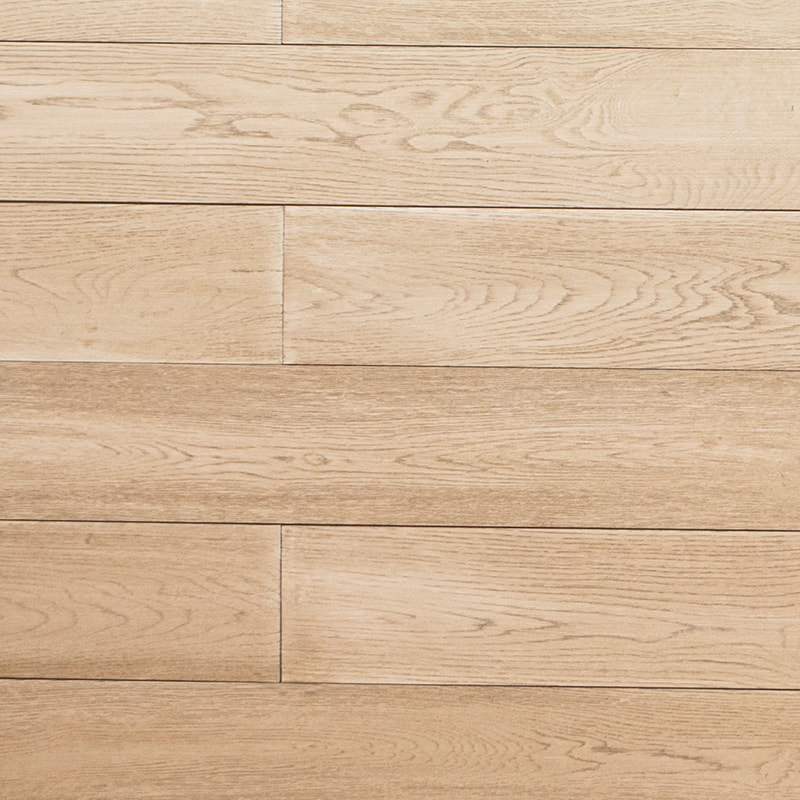
In contemporary interior design, flooring is more than a surface underfoot; it is the foundation of atmosphere, durability, comfort, and long-term value. The 3-Layer Oka Light Beige Hand-scraped Click Engineered Wood Flooring, model DF-L9908, is designed for residential and commercial interiors that require the warmth of real wood, the stability of engineered construction, and the visual softness of a refined light beige oak tone.
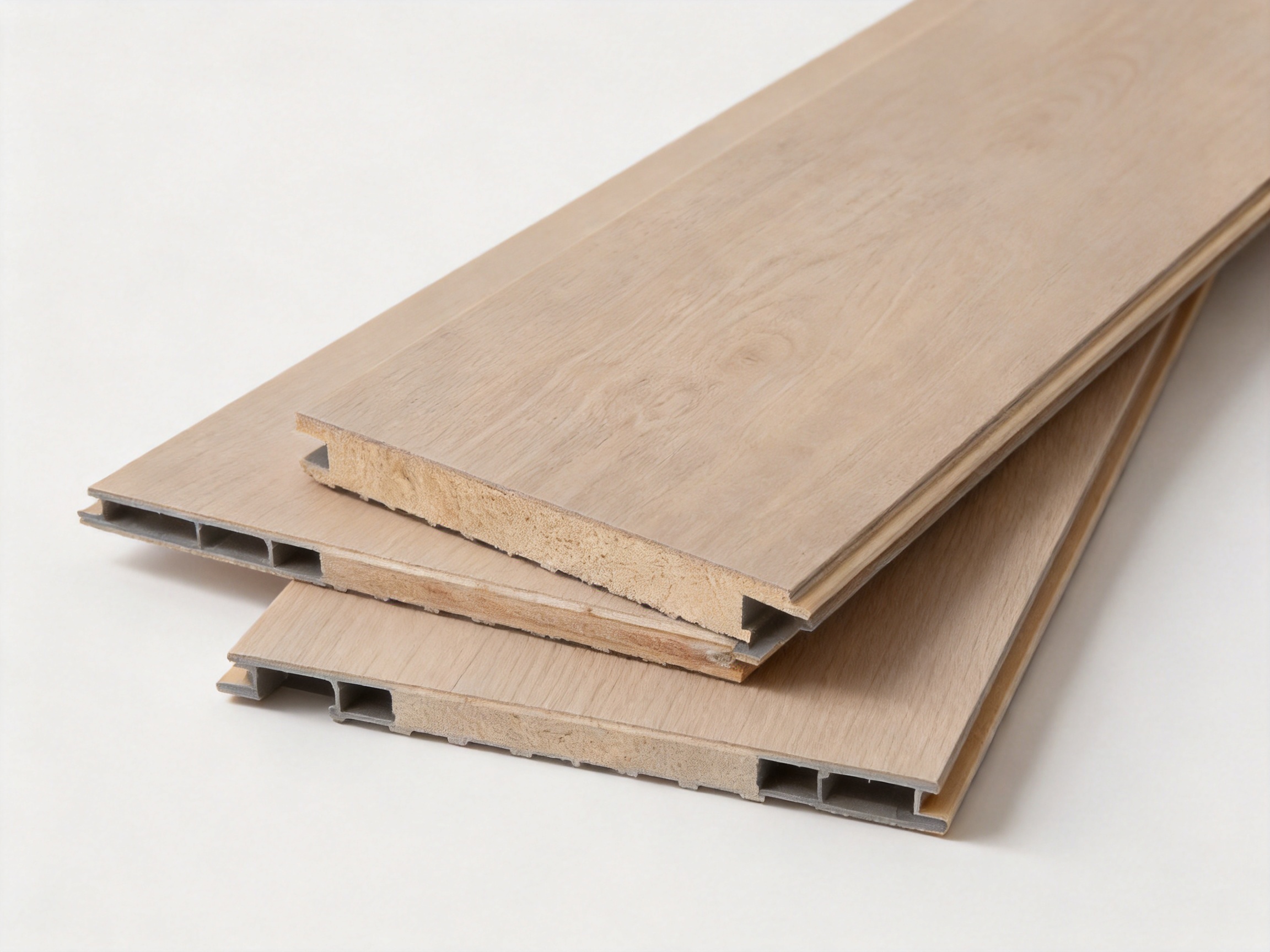
This flooring belongs to the 3-layer engineered flooring category and combines a natural wood veneer surface with a stable fir or pine core structure. Its hand-scraped texture creates a distinctive crafted appearance, while the click-lock profile supports faster and more secure installation. The result is a floor that feels natural, looks elegant, and performs reliably in demanding interior environments.
3-Layer Oka Light Beige Hand-scraped Click Engineered Wood Flooring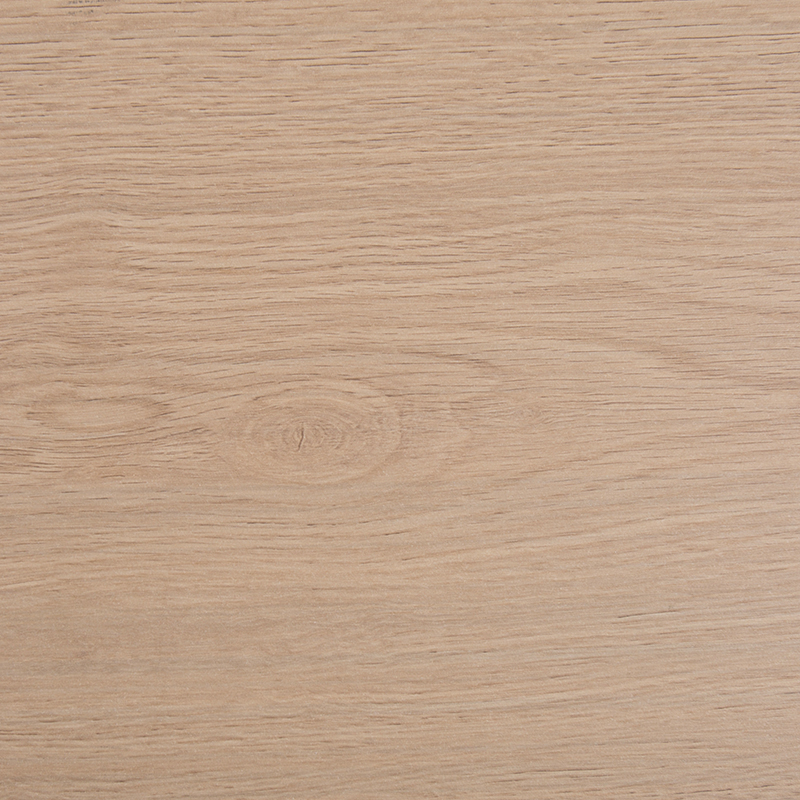
The DF-L9908 engineered wood flooring is built around a practical design concept: deliver the beauty of natural oak with enhanced dimensional stability and convenient installation. Unlike conventional solid wood flooring, which can be more vulnerable to expansion, contraction, warping, and cracking, this 3-layer engineered structure is designed to reduce movement caused by changes in temperature and humidity.
The light beige oak surface makes the product especially suitable for Nordic, cream-style, contemporary, and rustic interiors. It introduces warmth without making a room feel dark or visually heavy. In bedrooms, living rooms, guesthouses, boutique retail spaces, offices, and hospitality areas, this tone helps create a calm and balanced environment.
The hand-scraped surface gives each plank a tactile and visual character that resembles naturally aged timber. It is not overly rough, but it provides enough texture to add depth and authenticity. Combined with a micro-bevel on all four sides, the floor creates subtle shadow lines between planks, emphasizing the individual board layout while maintaining a clean overall appearance.
For projects that require flexibility, the product is customizable in veneer species, veneer thickness, grade, surface finish, and surface texture. Options include oak, walnut, ash, and teak veneer, with veneer thickness choices such as 2 mm, 3 mm, 4 mm, and 6 mm. Surface finish options include UV lacquer, UV oil, and hardwax oil, while textures can include wire brushed, hand-scraped, or smooth sanded finishes.
| Product Model | DF-L9908 |
| Product Category | 3-Layer Engineered Flooring |
| Nominal Dimensions | 48.6″ × 8.1″ × 9/16″ |
| Face Veneer | Customizable: Oak, Walnut, Ash, Teak |
| Veneer Thickness | Customizable: 2 mm, 3 mm, 4 mm, 6 mm |
| Core Construction | 3-Layer Engineered Wood |
| Core Layer | Spruce or Pine |
| Veneer Grade | Customizable: AB, ABC, ABCD, CD |
| Veneer Cut | Sliced Veneer |
| Surface Finish | UV Lacquer, UV Oil, Hardwax Oil |
| Surface Texture | Wire Brushed, Hand-Scraped, Smooth Sanded |
| Profile Detail | Micro-Bevel on All Four Sides |
| Locking System | Click System |
| Installation Methods | Floating, Glue-Down, Staple |
| Pieces Per Carton | 12 |
| Area Per Carton | 3.04 m² / 32.72 ft² |
| Weight Per Carton | 24 kg |
| Certifications | CE, FSC, CARB P2, ISO 9001 |
The first major advantage of this flooring is its natural wood veneer surface. Real wood veneer delivers an authentic grain pattern, a tactile sense of organic material, and natural color variation that synthetic surfaces often struggle to reproduce convincingly. Every plank carries its own grain movement, tone transition, and surface character, which helps create a living interior rather than a flat decorative layer.
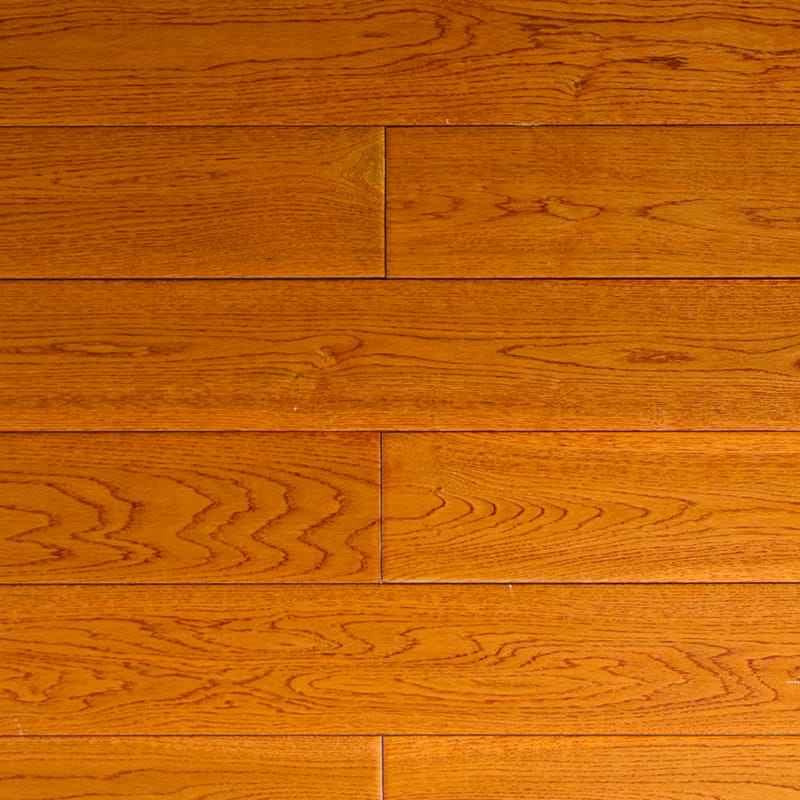
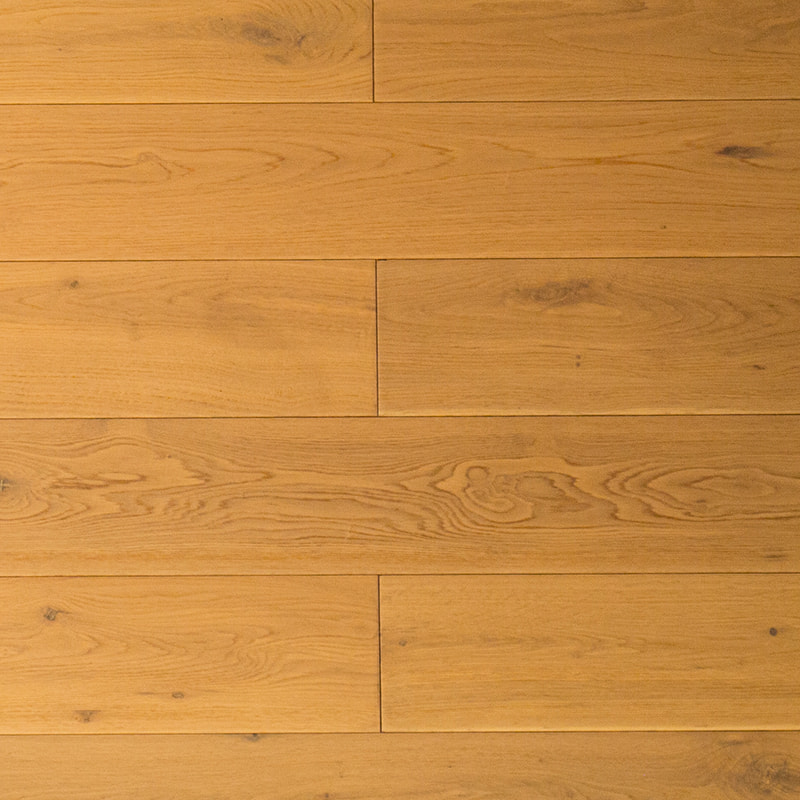
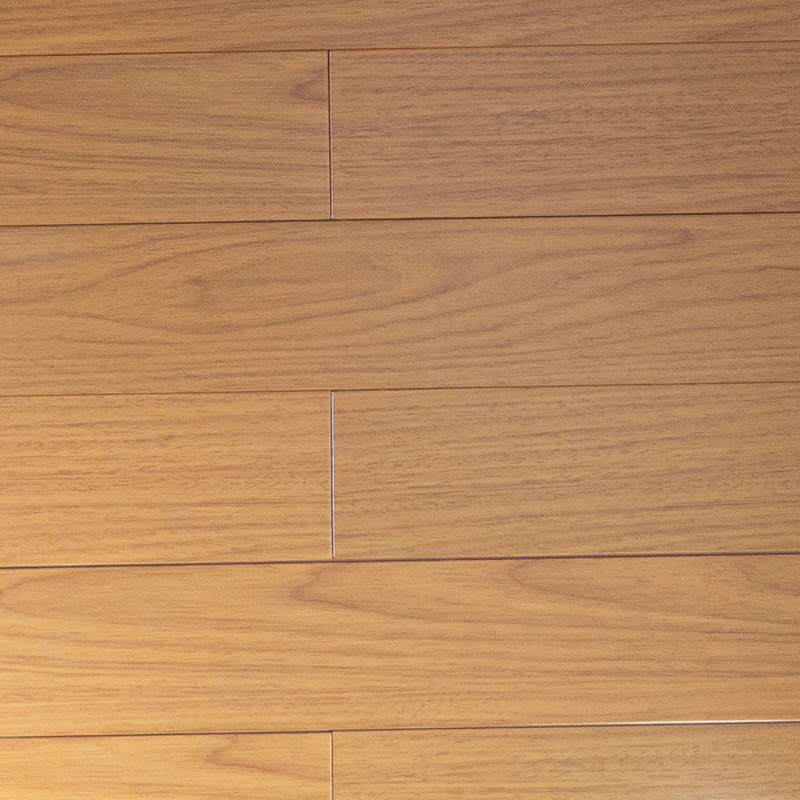
The veneer can be selected according to project requirements. Oak is highly popular for its balanced grain, durability, and design compatibility. Walnut provides a darker and richer effect, ash creates a brighter and more linear visual style, while teak offers a luxurious tone and strong decorative presence. This customization allows designers, distributors, contractors, and developers to align the floor with different market demands and architectural concepts.
The optional veneer thickness range from 0.6 mm to 6.0 mm in general use, and common project choices such as 2 mm, 3 mm, 4 mm, and 6 mm, provide flexibility for budget, expected service life, and refinishing potential. Compared with many low-cost flooring products that use extremely thin decorative layers, a thicker veneer option can improve the floor’s long-term value and allow stronger performance in higher-grade projects.
The core of the DF-L9908 product is its 3-layer engineered structure. A well-designed engineered floor uses multiple wood layers arranged to reduce natural movement. Wood expands and contracts with moisture changes, but layered construction can balance those forces and lower the risk of deformation. This makes engineered flooring a preferred solution for many modern interiors where stability is essential.
In this product, the 3-layer category uses a fir or pine base material, with spruce or pine listed as the core layer. These materials are selected for their favorable weight-to-strength ratio, workability, and stability when properly dried and processed. The top veneer provides the visible design surface, the core provides structural balance, and the backing layer helps control movement.
Compared with traditional solid wood flooring, 3-layer engineered flooring is generally less sensitive to seasonal humidity changes. Solid wood can cup, crown, gap, or crack if site conditions are not controlled. While all wood floors require proper installation and maintenance, engineered construction offers a more forgiving and stable platform, especially in spaces with heating, air conditioning, or moderate climate variation.
This advantage is particularly important for project buyers. A stable floor reduces after-sales issues, replacement costs, and maintenance complaints. For distributors and contractors, stability is not just a technical benefit; it directly affects customer satisfaction and brand reputation in the local market.
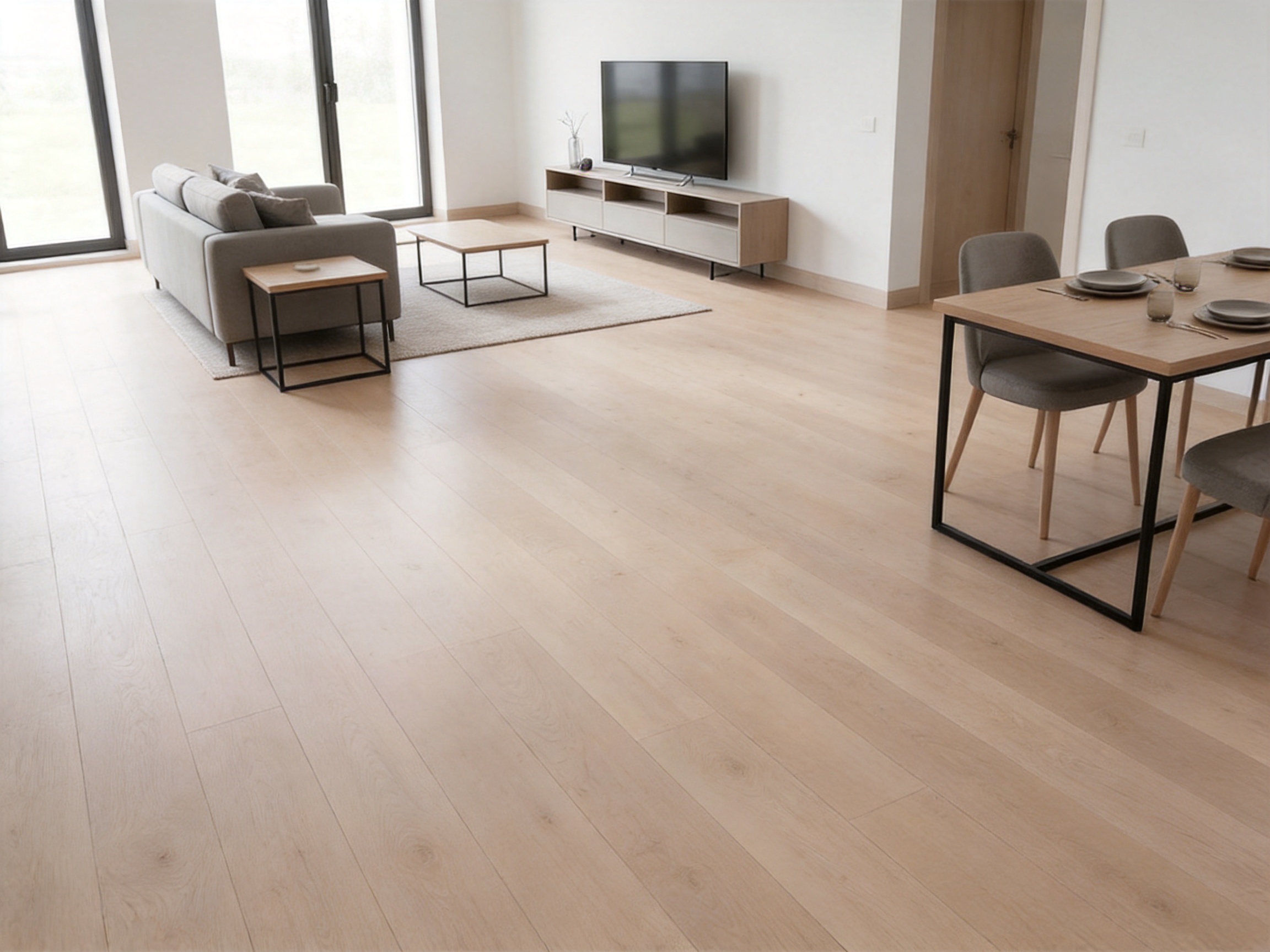
The light beige oak color of DF-L9908 is one of its strongest design features. This shade is soft, warm, and versatile. It reflects light well, which helps interiors feel more open and spacious. It also pairs easily with white walls, cream textiles, stone surfaces, light cabinets, natural linen, black metal details, and soft contemporary furniture.
In Nordic-style interiors, the color supports a clean and natural atmosphere. In cream-style homes, it reinforces warmth and comfort without becoming yellow or visually heavy. In rustic spaces, the hand-scraped texture gives the floor an aged and crafted identity. In contemporary interiors, the pale oak tone provides balance against minimal furniture and smooth architectural lines.
Many competing floors rely on either overly uniform colors or artificial printed surfaces. Those products may look acceptable in small samples but can appear repetitive across large rooms. Natural veneer gives DF-L9908 more authentic variation. The floor has visual movement, but the light beige tone keeps the overall effect calm and coordinated.
For designers and architects, this balance matters. A floor must be expressive enough to elevate the room, but not so dominant that it conflicts with furniture, wall panels, doors, cabinets, or lighting. The DF-L9908 color profile gives professionals a safe and elegant base for multiple interior styles.
The hand-scraped finish is both decorative and practical. Visually, it creates the impression of handcrafted woodwork, adding irregular depth and texture to the surface. This makes the floor feel more natural and less industrial. Instead of a perfectly flat surface, the floor carries subtle waves and marks that enhance the grain structure.
From a practical perspective, textured surfaces can help disguise minor signs of daily use better than ultra-smooth glossy floors. In active homes, hospitality spaces, guest rooms, or commercial areas, small scratches and scuffs are often less noticeable on a hand-scraped or wire-brushed surface. This does not mean the floor is damage-proof, but it does mean the design is more forgiving in real life.
Competitor products with flat, low-quality finishes may show wear more quickly, especially under angled light. DF-L9908’s combination of texture, coating, and natural veneer helps preserve a premium appearance over time. For buyers who want a lived-in, warm, and authentic feeling, the hand-scraped texture provides a valuable advantage.
The flooring is protected by a 7-layer UV coating system in general use. A quality UV coating improves wear resistance, scratch resistance, color protection, and surface durability. It also helps simplify daily cleaning by creating a sealed surface that resists dirt penetration better than untreated wood.
In residential spaces, this coating helps the floor withstand normal foot traffic, furniture movement with proper pads, and routine cleaning. In commercial environments, where traffic can be heavier, surface protection becomes even more important. The 7-layer UV system gives project buyers confidence that the floor is designed for both appearance and performance.
UV lacquer provides a clean and durable finish, UV oil can enhance natural texture and a softer sheen, and hardwax oil offers a more natural touch with repair-friendly characteristics. The availability of different finish systems allows the product to meet the expectations of different markets. Some customers prefer a smooth lacquered surface for easy maintenance, while others prefer an oil-style finish for a more natural and matte appearance.
Compared with competitor products using basic coatings or insufficient curing processes, a controlled multi-layer UV coating can deliver stronger consistency, better surface performance, and improved long-term satisfaction. The quality of the coating process is therefore a key differentiator, not merely a decorative detail.
The click system is another important advantage. A round-arc click-lock system allows planks to connect securely without requiring complex tools or adhesive in floating installations. This makes installation faster, cleaner, and more efficient. For contractors, faster installation can reduce labor time and project disruption. For residential users, it can make renovation more convenient.
The product supports multiple installation methods, including floating, glue-down, and staple installation. This flexibility is valuable because different sites have different subfloor conditions, acoustic requirements, moisture considerations, and performance expectations. A floating installation may be suitable for many residential renovations, while glue-down installation can provide a more solid underfoot feel in certain commercial or premium residential projects.
Competitor flooring products with poor locking accuracy may suffer from gaps, movement, squeaking, or installation difficulty. Precision profiling is essential. The click system on DF-L9908 is designed to support secure plank engagement and stable alignment. When combined with proper acclimation, subfloor preparation, and installation practice, it helps create a reliable finished floor.
The micro-bevel profile on all four sides improves the visual definition of each plank. Instead of creating a completely seamless sheet-like surface, the bevel highlights the plank format in a refined and controlled way. This is especially attractive for engineered wood flooring because it emphasizes authenticity and board individuality.
Micro-bevels also provide practical benefits. They can help reduce the visibility of minor height differences between planks and make the floor look more natural after installation. A square-edge floor can look very clean, but it requires extremely precise site conditions and installation. A micro-bevel offers a balanced solution for real projects.
For customers comparing this product against lower-grade flooring, the edge detail is an important sign of manufacturing precision. Poor bevel cutting can create irregular edges, weak coating coverage, or inconsistent appearance. A well-executed micro-bevel improves both aesthetics and perceived quality.
In homes, DF-L9908 performs especially well in living rooms, bedrooms, guest rooms, corridors, and family areas where comfort and visual warmth are priorities. The light beige color makes rooms feel relaxed and inviting, while the engineered structure provides better stability than traditional solid flooring under typical indoor climate changes.
For bedrooms, the soft tone supports restfulness and pairs well with neutral bedding, wood furniture, fabric wall panels, and gentle lighting. For living rooms, it creates a warm foundation for sofas, rugs, cabinets, coffee tables, and entertainment walls. In guesthouses and boutique accommodations, the hand-scraped surface gives rooms a memorable natural identity without appearing overly rustic.
Daily care is straightforward. The floor can be cleaned with a soft cloth or dry mop. Strong or corrosive cleaning agents should be avoided. Prolonged exposure to water or high humidity should also be avoided to preserve long-term stability. Periodic maintenance, such as waxing where appropriate for the selected finish system, can help maintain beauty and durability.
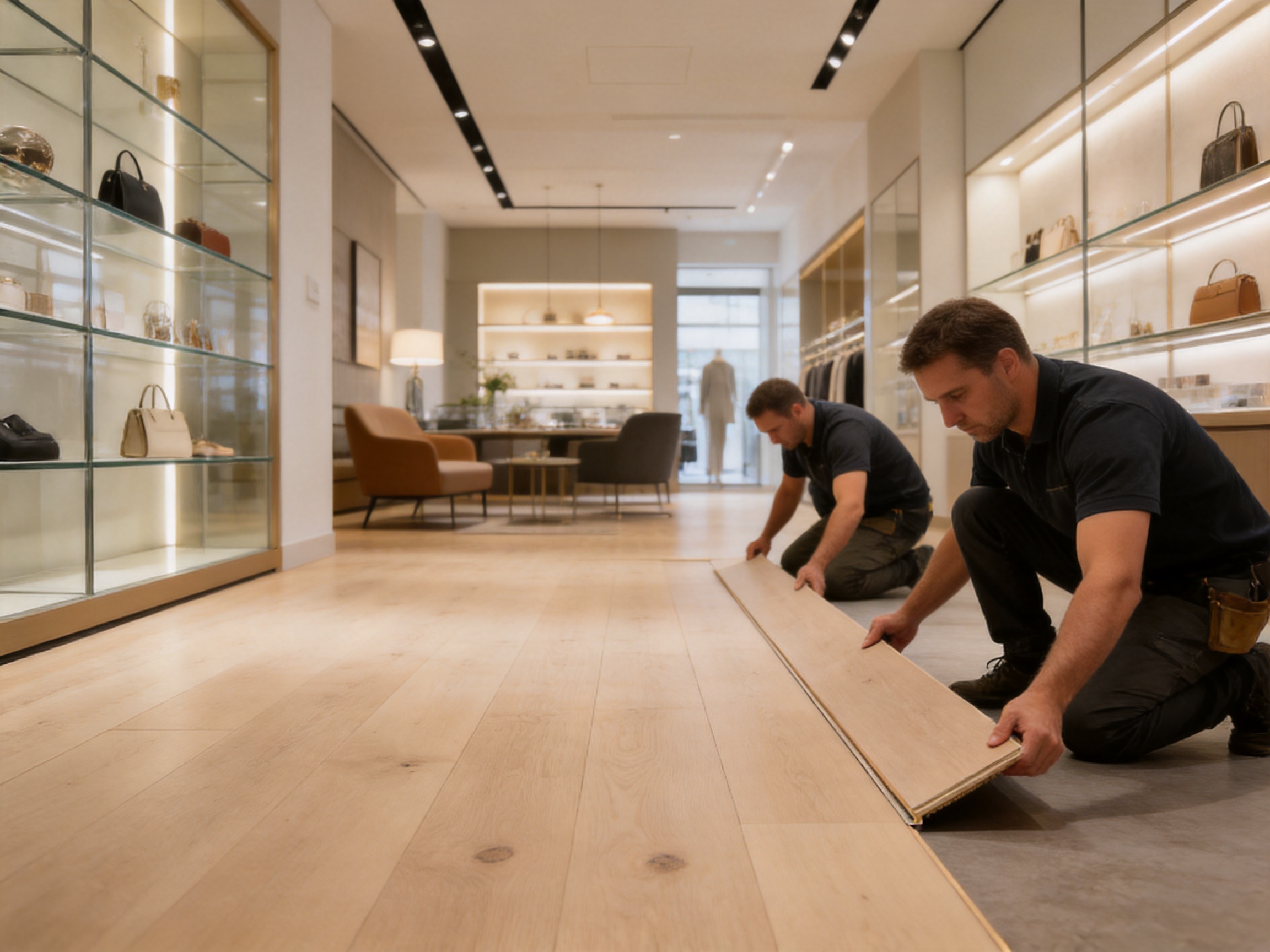
Commercial interiors need flooring that supports both design and durability. DF-L9908 is suitable for commercial spaces that require a stylish wood appearance and reliable performance, such as boutique shops, offices, showrooms, serviced apartments, hospitality rooms, design studios, and reception areas.
The natural oak veneer communicates quality, while the light beige color keeps the space bright and welcoming. The 7-layer UV coating supports wear resistance, and the engineered construction helps reduce dimensional instability. The click system can also support faster project completion, which is valuable in commercial renovations where downtime must be minimized.
Compared with laminate or low-grade vinyl alternatives, engineered wood offers a more authentic and premium material experience. Compared with solid wood, it offers improved structural stability and often greater installation flexibility. For commercial decision-makers, this combination creates a strong value proposition: real wood beauty, engineered performance, and project-friendly installation.
The strength of this flooring is not limited to its product structure. It is also supported by the manufacturing capabilities of Suzhou Dicosbo Wood Co., Ltd., a wood solutions manufacturer with a long history in flooring, wooden doors, and custom cabinet solutions. Founded in 1999, the company has accumulated more than 20 years of expertise in wood product manufacturing and more than 10 years of export experience.
The company operates approximately 20,000 square meters of production facilities and serves more than 100 global partners across Europe, North America, and Southeast Asia. This international experience is important because export markets often require strict product consistency, certification compliance, packaging reliability, and responsive communication. Flooring for global projects must meet not only aesthetic expectations but also technical standards and delivery schedules.
The annual production capacity of 2,400,000 square meters of flooring demonstrates the company’s ability to support both regular supply and large project orders. This capacity is especially valuable for distributors and contractors who need stable inventory, repeatable specifications, and reliable lead times. In addition, the company produces wooden doors and custom cabinets, enabling broader interior woodwork solutions for projects that require coordinated materials.
Advanced manufacturing begins with material selection. Wood veneer must be chosen according to species, grade, grain consistency, moisture condition, and appearance requirements. The slicing process helps produce a refined natural veneer surface, preserving the character of the wood while enabling efficient use of valuable timber resources.
Core materials such as spruce, pine, fir, eucalyptus, or birch in other categories must be properly dried and prepared before assembly. Moisture control is one of the most important factors in engineered flooring. If the core is too wet or unevenly dried, the finished product may develop deformation, bonding issues, or installation problems. Therefore, disciplined drying and conditioning are essential steps.
The company’s use of German imported production lines and automated quality control systems supports more accurate machining, better surface finishing, and improved consistency. In engineered flooring, precision matters at every stage: veneer pressing, core bonding, sanding, profiling, coating, curing, and packaging. Small errors can become visible after installation, so process control directly affects user satisfaction.
The multi-layer UV coating process requires careful application and curing. Each layer must be applied evenly and cured properly to achieve the desired wear resistance, adhesion, and surface appearance. Automated systems help reduce variation between batches, which is essential for distributors and project buyers who may order flooring in phases.
The company applies a strict 3-step quality inspection process. For engineered flooring, inspection typically includes raw material checks, in-process checks, and final product checks. Raw material inspection helps verify veneer grade, moisture content, core quality, and bonding materials. In-process inspection helps monitor dimensions, surface sanding, coating quality, and locking profile accuracy. Final inspection confirms appearance, packaging, labeling, and specification compliance.
This systematic approach gives DF-L9908 an advantage over competitors that rely on less controlled production environments. Flooring defects can be costly after installation. Problems such as uneven gloss, poor locking, weak bonding, dimensional inaccuracy, surface contamination, and color inconsistency can create customer complaints and project delays. A strong inspection system reduces these risks.
For export customers, quality control is also a business advantage. Consistency across cartons, pallets, and repeat orders helps distributors maintain market trust. Contractors can install with greater confidence, and architects can specify products knowing that technical and visual standards are supported by factory control.
DF-L9908 is supported by certifications and compliance standards including CE, FSC, CARB P2, and ISO 9001. These certifications are important for global buyers because they address safety, sustainability, formaldehyde emissions, and quality management.
CE certification supports access to European markets and indicates conformity with relevant regulatory requirements. FSC certification reflects responsible forestry sourcing and supports sustainability goals. CARB P2 compliance is especially important for markets concerned with formaldehyde emissions from composite wood products. ISO 9001 indicates that the manufacturer operates under a recognized quality management framework.
Compared with uncertified or poorly documented products, certified flooring provides stronger assurance for distributors, developers, and public or commercial projects. Many architects and contractors now require documentation before approving materials. Certification is not merely a label; it is part of risk management and responsible procurement.
One of the strongest competitive advantages behind this product is customization. The company provides OEM and ODM services, enabling buyers to adapt flooring specifications to their own market demands. Customization can include veneer species, color, size, texture, finish, veneer thickness, grade, and packaging requirements.
For a distributor, this means the ability to build a private-label collection with distinctive colors and specifications. For a contractor, it means project-specific matching with doors, wall panels, stairs, or cabinets. For an architect, it means greater control over design intent. For a developer, it means aligning product cost, performance, and appearance with the positioning of a residential or commercial property.
The company also offers 72-hour rapid prototyping. This is highly valuable during design development and project bidding. Sample confirmation often determines whether a material can move forward. Faster prototyping shortens decision cycles, supports timely presentation to clients, and helps accelerate procurement planning.
When compared with traditional solid wood flooring, DF-L9908 offers better resistance to deformation and cracking due to its engineered structure. Solid wood remains a premium material, but it can be more sensitive to humidity and site conditions. A 3-layer engineered floor retains the beauty of natural wood while improving dimensional stability.
When compared with laminate flooring, DF-L9908 provides a real wood veneer surface rather than a printed decorative image. Laminate can be economical and durable, but it does not offer the same natural grain depth, repair potential, or premium material value. For customers who want authentic wood, engineered flooring is a superior choice.
When compared with low-cost engineered flooring, DF-L9908 stands out through customizable veneer thickness, 7-layer UV coating, click system installation, micro-bevel detail, certification support, and controlled manufacturing. Many budget products reduce cost by using thin veneers, inconsistent cores, weak coatings, or imprecise profiles. These shortcuts may not be obvious in a small sample but become apparent after installation and use.
When compared with luxury vinyl tile, DF-L9908 offers the warmth and authenticity of real wood. Vinyl products can provide water resistance and design variety, but they remain synthetic materials. For premium interiors where natural materials matter, engineered wood communicates higher quality and a more organic atmosphere.
Proper installation is essential for achieving the best performance from any wood flooring. Before installation, cartons should be stored in a dry, protected environment and allowed to acclimate according to project conditions and professional guidance. The subfloor should be clean, dry, level, and structurally sound.
For floating installation, the click system allows planks to connect efficiently, and a suitable underlayment may be used depending on acoustic, moisture, and comfort requirements. For glue-down installation, the correct adhesive system should be selected according to subfloor type and site conditions. For staple installation, professional evaluation is needed to confirm compatibility.
Expansion gaps should be maintained around walls and fixed objects because wood flooring naturally responds to environmental changes. The room’s temperature and humidity should be kept within recommended ranges to support long-term stability. Although engineered flooring is more stable than solid wood, it is still a natural wood product and should be treated accordingly.
Daily maintenance is simple but important. Use a soft cloth, dry mop, or vacuum suitable for wood floors to remove dust and grit. Avoid strong, corrosive, or abrasive cleaning agents. Spills should be wiped promptly to prevent water marks or moisture penetration. Prolonged exposure to standing water or high humidity should be avoided.
Furniture pads are recommended under chair legs, tables, sofas, and movable furniture. Entrance mats can reduce dirt and sand brought indoors, helping protect the surface coating. When moving heavy objects, lifting is better than dragging. These simple steps can significantly extend the appearance and service life of the floor.
Long-term care depends on the selected finish. UV lacquered surfaces generally require routine cleaning and protection from severe abrasion. UV oil and hardwax oil finishes may benefit from periodic maintenance treatments according to the finish system. Periodic waxing may help maintain surface beauty where appropriate, but users should confirm compatibility with the chosen finish before applying any product.
Sustainability has become a central requirement in modern building materials. Engineered wood flooring can support responsible resource use by applying a valuable natural wood veneer over a stable core, rather than using a full-thickness solid hardwood plank. This approach makes more efficient use of premium hardwood species while preserving the desired surface appearance.
FSC certification further supports responsible sourcing. For developers, architects, and distributors working in markets with green building expectations, sustainability documentation can be an important selling point. Customers increasingly want materials that are beautiful, durable, and responsibly produced.
Durability is also part of sustainability. A floor that lasts longer, resists deformation, and maintains its appearance reduces replacement frequency and material waste. DF-L9908’s engineered construction, UV coating, and maintenance-friendly design contribute to longer-term value.
In residential apartments, the light beige oak floor can visually enlarge compact rooms and create a bright, comfortable atmosphere. It pairs well with white cabinetry, wooden doors, soft curtains, and minimalist furniture. For family homes, the hand-scraped surface adds warmth and helps create a relaxed environment.
In guesthouses and boutique hotels, the floor supports a natural and welcoming guest experience. Its color is neutral enough to work across multiple room types, while its texture adds a memorable design detail. In commercial offices, it can soften the workplace environment and bring a more human, residential feeling to meeting rooms and reception zones.
In retail showrooms, flooring influences how customers perceive product quality. A real wood surface can elevate the visual standard of the entire space. In design studios or architectural offices, the floor communicates material awareness and refined taste.
Project buyers typically evaluate flooring through several criteria: appearance, stability, installation efficiency, certification, customization, supply capacity, and after-sales reliability. DF-L9908 performs strongly in each of these areas. Its light beige oak appearance is commercially appealing, while its 3-layer construction supports stability. The click system improves installation efficiency, and the 7-layer UV coating enhances surface performance.
The manufacturer’s production scale and export experience strengthen supply reliability. With over 20 years of manufacturing expertise, 20,000 square meters of facilities, annual flooring capacity of 2,400,000 square meters, and partnerships across global regions, the company can support both standard procurement and customized project requirements.
This combination of product quality and manufacturing strength creates a clear advantage over suppliers that only compete on price. Flooring is a long-term building material. Choosing the lowest-cost option can lead to installation problems, complaints, replacement costs, and reputational risk. A stable, certified, customizable product from an experienced manufacturer offers stronger total value.
This product uses a 3-layer engineered structure, which improves dimensional stability and reduces the risk of warping and cracking. It still has a natural wood veneer surface, so it provides real wood beauty while offering better stability than many traditional solid wood options.
Yes. The floor uses a natural wood veneer surface. Oak is the featured style for DF-L9908, and other veneer choices such as walnut, ash, and teak can be customized depending on project requirements.
The light beige oak tone is suitable for Nordic, contemporary, cream-style, rustic, and natural modern interiors. It creates a warm, calm, and bright atmosphere without making the space feel heavy.
Yes. Customization options include veneer species, veneer thickness, veneer grade, color, surface finish, surface texture, dimensions, and packaging. OEM and ODM services are available for distributors, contractors, and project buyers.
The flooring can be installed by floating, glue-down, or staple methods. The click system supports fast and secure floating installation, while glue-down and staple methods may be selected according to site conditions and project requirements.
Yes. It is suitable for commercial spaces that require both style and durability, such as offices, showrooms, boutique retail spaces, serviced apartments, and hospitality interiors. Proper installation and maintenance are important for long-term performance.
Use a soft cloth, dry mop, or wood-floor-safe vacuum. Avoid strong corrosive cleaners, excessive water, and prolonged humidity exposure. Spills should be cleaned promptly.
The product is supported by certifications and compliance systems such as CE, FSC, CARB P2, and ISO 9001. These help demonstrate safety, responsible sourcing, emissions compliance, and quality management.
The 7-layer UV coating improves wear and scratch resistance, supports easier cleaning, and helps preserve the floor’s appearance. It is especially valuable for active residential spaces and suitable commercial environments.
Suzhou Dicosbo Wood Co., Ltd. has more than 20 years of manufacturing experience, 20,000 square meters of production facilities, German imported production lines, automated quality control systems, a strict 3-step inspection process, and strong export experience. These strengths support reliable quality, customization, and stable supply.
The 3-Layer Oka Light Beige Hand-scraped Click Engineered Wood Flooring, model DF-L9908, is a strong flooring solution for customers who want natural wood beauty, stable performance, flexible customization, and efficient installation. Its real wood veneer surface provides authentic grain and warmth, while the 3-layer engineered structure improves resistance to deformation and cracking.
The light beige oak tone is elegant, versatile, and highly compatible with modern interior trends. The hand-scraped texture adds character, the 7-layer UV coating supports durability, and the click system simplifies installation. These advantages make it suitable for both residential and commercial applications.
Beyond the product itself, the manufacturing strength behind it adds important value. With advanced production lines, automated quality control, international certifications, OEM and ODM customization, rapid prototyping, and large-scale supply capacity, Suzhou Dicosbo Wood Co., Ltd. provides the reliability required by distributors, contractors, architects, and project developers.
For buyers comparing flooring options, DF-L9908 offers a balanced combination of beauty, stability, certification, customization, and manufacturing confidence. It is not simply a decorative surface; it is a practical, durable, and design-driven wood flooring solution for modern interiors.
Forest Stewardship Council. Responsible Forest Management and Chain of Custody Certification Guidelines.
International Organization for Standardization. ISO 9001 Quality Management Systems Requirements.
California Air Resources Board. Composite Wood Products Airborne Toxic Control Measure and Phase 2 Emission Standards.
European Committee for Standardization. Wood Flooring Performance and Conformity Assessment Principles.
Wood Flooring Installation Guidelines. Best Practices for Engineered Wood Flooring Acclimation, Subfloor Preparation, and Maintenance.
Architectural Woodwork and Interior Materials Handbook. Technical Considerations for Natural Wood Veneer, Surface Finishing, and Dimensional Stability.

We provide customers with sustainable and eco-friendly
engineered wood solutions and services.
Choose DEIF for the perfect blend of
performance and aesthetics.
