


 English
 Español
 عربى


Get Social
Choose DEIF for the perfect blend of
performance and aesthetics.
 Get Free Sample

Content
Bathroom furniture has evolved from a purely practical storage solution into an important architectural element. In contemporary residential, hospitality, and commercial interiors, the vanity often establishes the visual character of the entire bathroom. It connects the basin, mirror, lighting, wall finishes, flooring, and storage system into one coordinated composition. The Splendor French decorative molding and curved door bathroom vanity is developed for projects that require more than standard cabinetry. It combines French neoclassical detailing, softly curved door fronts, moisture-resistant construction, customizable basin solutions, and project-oriented manufacturing support.
Identified as DFD-BV-04, this bathroom vanity collection is designed around a refined interpretation of French classicism. Decorative molding provides a clear sense of architectural order, while curved doors soften the profile and make the furniture more approachable. The result is a vanity that can become a focal point in a bathroom without overwhelming the surrounding interior. Its detailed façade, carefully controlled proportions, and multilayer lacquer finish create an atmosphere of elegance, while its internal structure is organized for practical everyday use.
The collection is particularly suitable for French-style villa bathrooms, vintage light-luxury residences, boutique homestays, design-led hotels, and neoclassical interiors that combine traditional references with modern functionality. It also supports customized dimensions, materials, colors, countertop configurations, hardware, lighting, and mirror cabinet preparation. This adaptability makes it useful for both individual high-end residences and larger architectural projects.
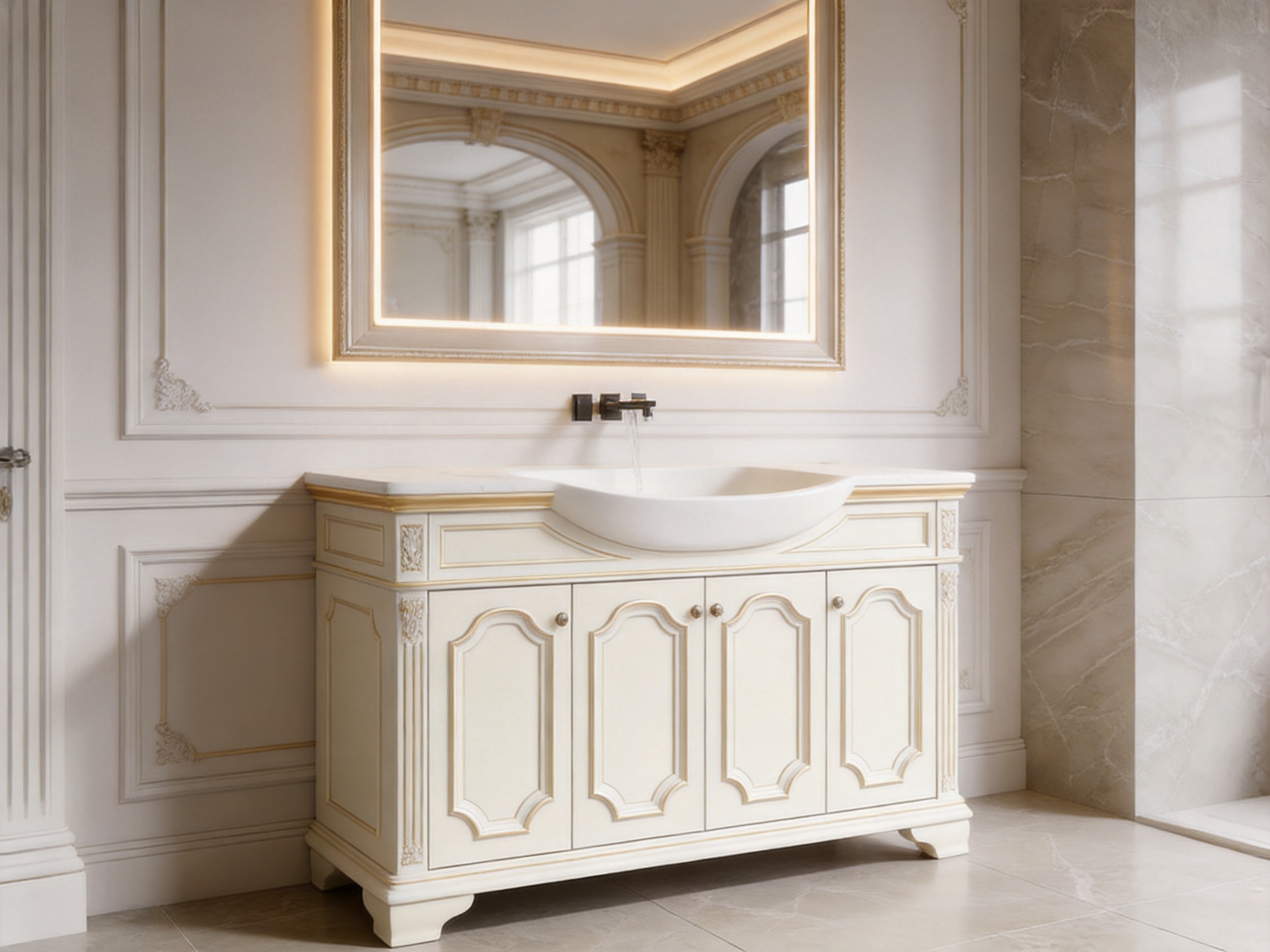
Splendor French Decorative Molding & Curved Door Bathroom Vanities
French neoclassical interiors are recognized for their balance, proportion, rhythm, and restrained decorative language. Instead of relying on excessive ornamentation, the style uses carefully arranged moldings, framed surfaces, symmetrical compositions, and refined finishes. The Splendor vanity translates these principles into a bathroom furniture system that feels decorative yet functional.
The most distinctive design feature is the relationship between the decorative molding and the curved door structure. Linear moldings establish visual order across the façade, while curved door panels introduce movement and soften the overall silhouette. This contrast creates a more nuanced appearance than a completely flat cabinet front or a heavily ornate traditional vanity.
Curved surfaces also affect how light interacts with the furniture. On a flat door, light tends to form a uniform reflection. On a curved door, the reflection gradually changes across the surface, creating subtle transitions between highlight and shadow. When combined with decorative lines, this effect gives the vanity greater depth and makes it visually responsive to natural and artificial lighting.
The design is therefore not decorative for its own sake. Every molding, curve, and proportion contributes to the perceived structure of the furniture. The vanity can be used as a central visual feature while still integrating with marble, sintered stone, ceramic tile, wood flooring, metal fixtures, and architectural wall treatments.
Bathroom cabinetry is often composed of rigid rectangles because rectangular forms are efficient to manufacture and easy to install. However, a completely rectilinear arrangement can make a compact bathroom feel hard or visually dense. The curved doors of DFD-BV-04 help interrupt this rigidity. Their softened profiles create a more fluid visual transition between the vanity, the wall, and the circulation zone in front of the cabinet.
This characteristic is especially valuable in master bathrooms and hospitality suites, where the furniture is viewed from multiple angles. A curved front can appear more welcoming than a sharp, box-like cabinet. It can also complement rounded mirrors, arched wall openings, curved lighting fixtures, and sculptural basins.
Decorative molding must be carefully scaled to avoid making a bathroom vanity look heavy or outdated. The collection uses linear decorative elements to strengthen the façade without covering the entire surface with unnecessary detail. This creates a layered appearance that remains compatible with modern materials and contemporary sanitaryware.
The molding can be coordinated with the chosen color and finish. Light shades such as pearl cream white and ivory gold can emphasize the elegance of the relief, while tobacco brown or vintage soft grey can create a more dramatic and mature interior. For project applications, the finish and decorative treatment may be adjusted to align with a broader interior design schedule.
The performance of a bathroom vanity depends on more than its visible finish. The furniture must withstand humidity, water splashes, cleaning routines, temperature changes, hardware use, and the pressure of daily storage. DFD-BV-04 addresses these demands through a combination of moisture-resistant materials, engineered construction, waterproof edge treatment, corrosion-resistant hardware, and customized installation planning.
Bathrooms are among the most demanding interior environments for wood-based furniture. Persistent humidity can cause swelling, edge separation, coating failure, mildew growth, and deformation when unsuitable materials are used. The vanity system is developed with moisture-resistant high-density eco-friendly plywood, solid wood plywood options, or high-density PVC material according to project requirements.
Selected board systems are combined with protective surface treatments and moisture-resistant finishes. The purpose is not simply to make the exterior look attractive, but to reduce the risk of water penetration through exposed surfaces, panel edges, and joints. This is especially important around the basin, where repeated splashing and cleaning can expose the cabinet to moisture every day.
The marine-grade waterproofing concept gives the product an advantage over ordinary residential cabinetry that may use standard boards or insufficient edge protection. While no cabinet should be subjected to standing water or continuous uncontrolled humidity, a properly specified moisture-resistant structure provides a significantly more reliable foundation for bathroom use.
Edges are vulnerable points in any cabinet. If the edge treatment is incomplete, water can enter the board core even when the main surface appears sealed. The product specification includes PUR eco-friendly waterproof edge banding and seamless laser edge banding options. These treatments help create a more continuous barrier around the exposed panel edges.
PUR edge banding is valued for its strong adhesive performance and resistance to moisture and heat. Laser edge banding can provide a highly integrated appearance with minimal visible adhesive lines. The appropriate solution can be selected based on the project’s visual standards, environmental conditions, production requirements, and budget.
The product materials and paint finishes are developed for bathroom applications and are described as having passed rigorous testing for waterproofing and anti-mold properties. This focus is important in spaces where warm, humid air and limited ventilation may encourage biological growth or accelerate surface deterioration.
Proper material specification helps reduce the risk of peeling, cracking, and surface degradation during long-term use. However, product performance also depends on installation quality, ventilation, cleaning methods, and the prevention of continuous water accumulation. The best results are achieved when the vanity is installed in a bathroom with sound waterproofing, adequate air circulation, and correctly sealed plumbing connections.
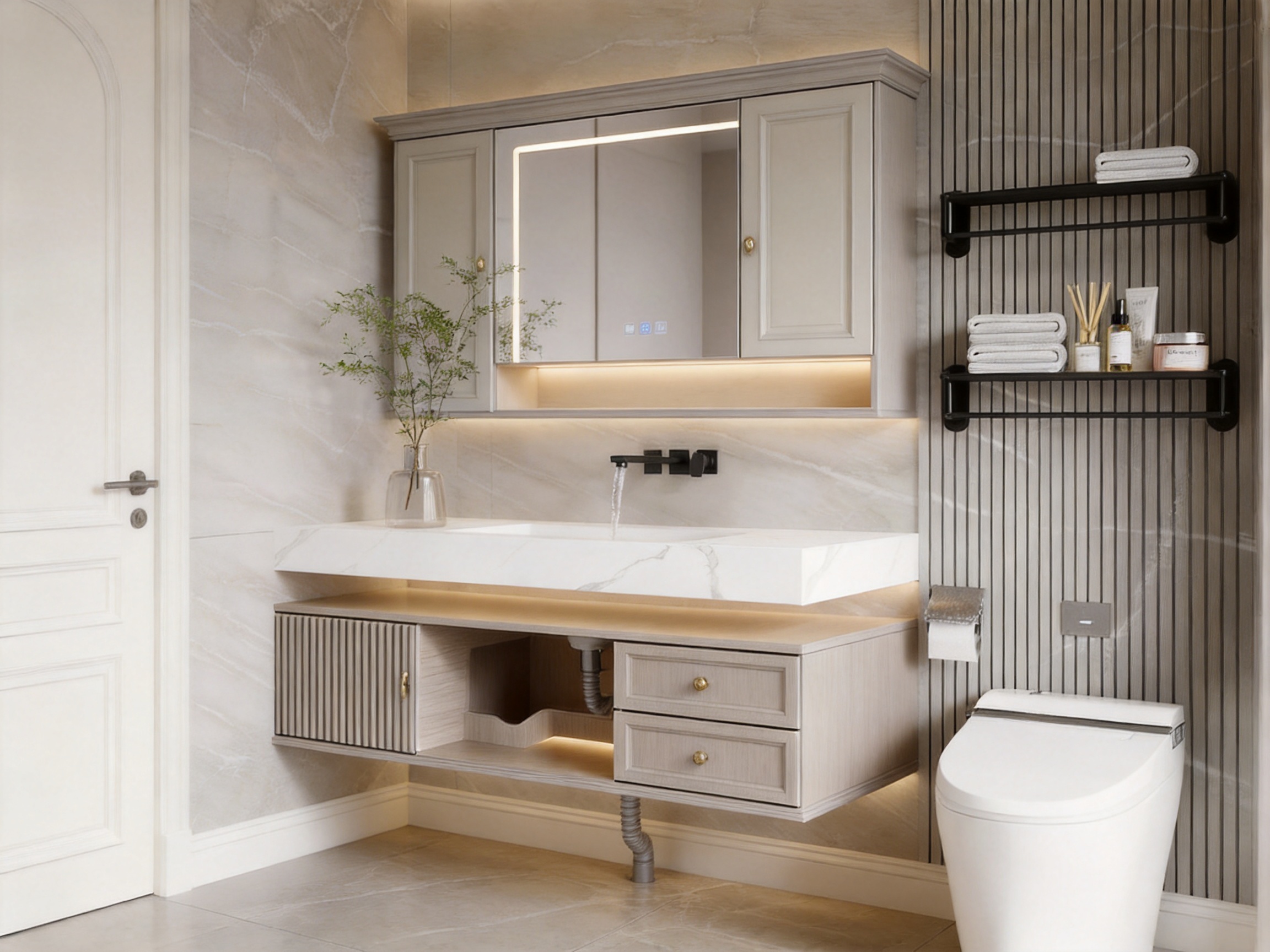
Storage efficiency is often compromised when bathroom furniture is forced to accommodate poorly planned drainage pipes. Conventional drawers may collide with wall outlets or floor drains, leaving unusable space or requiring on-site modifications. DFD-BV-04 addresses this issue through precise drainage pipe avoidance planning.
Drawers and internal shelves can be designed with U-shaped grooves that correspond to the wall or floor drain locations shown in engineering drawings. This approach allows the cabinet to maintain a more organized internal layout while accommodating the technical requirements of the bathroom.
Drainage coordination should be completed before production. Accurate floor plans, wall elevations, plumbing positions, drain centerlines, basin dimensions, and installation heights allow the cabinet manufacturer to prepare the internal structure correctly. This reduces the likelihood of site cutting, improvised adjustments, or loss of storage capacity during installation.
A vanity is not complete without a countertop and basin that match its proportions, function, and style. The collection supports several integrated basin solutions, including high-gloss or matte luxury sintered stone integrated basins and classic ceramic art basins. Marble countertops and other coordinated surface materials may also be considered for customized projects.
Integrated basin construction provides a visually clean transition between the countertop and the wash area. Depending on the selected material and fabrication method, it can reduce the number of visible joints and create a more continuous, architectural appearance. This is well suited to minimalist luxury interiors, where the countertop is expected to look substantial and refined.
Sintered stone is valued for its hardness, resistance to heat, low water absorption, and broad range of colors and surface textures. A high-gloss surface can reflect light and support a more luxurious appearance, while a matte surface can create a calm, contemporary effect. The selection may be coordinated with wall slabs, flooring, shower surfaces, and other bathroom finishes.
Sintered stone also allows designers to create a visual contrast with the painted cabinet. For example, a pale stone surface can reinforce the lightness of a pearl cream cabinet, while a darker stone can provide depth against ivory or soft grey doors. In a commercial project, the surface can be chosen to support the overall brand or interior design concept.
Classic ceramic art basins remain popular because of their cleanability, familiar user experience, and compatibility with both traditional and modern interiors. Ceramic can reinforce the French character of the vanity, particularly when paired with decorative molding, traditional faucets, framed mirrors, and warm metal accessories.
Single-basin and double-basin configurations are available for customization. A single basin may be more appropriate for a compact guest bathroom or boutique suite, while a double basin is often preferred in a master bathroom or premium hotel room. The cabinet width, drawer arrangement, countertop thickness, faucet position, and mirror cabinet dimensions should be coordinated with the selected basin configuration.
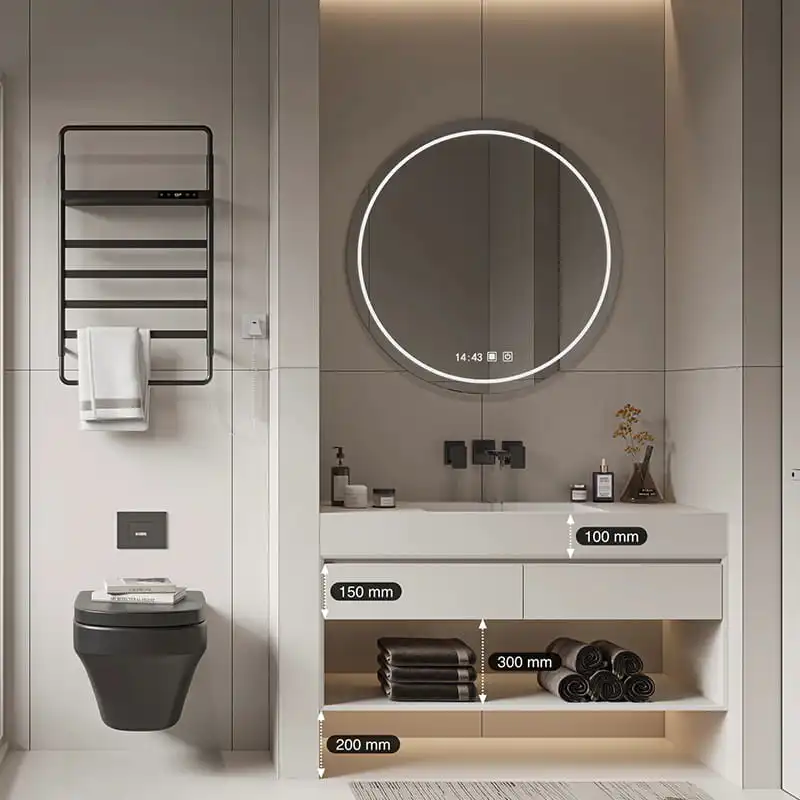
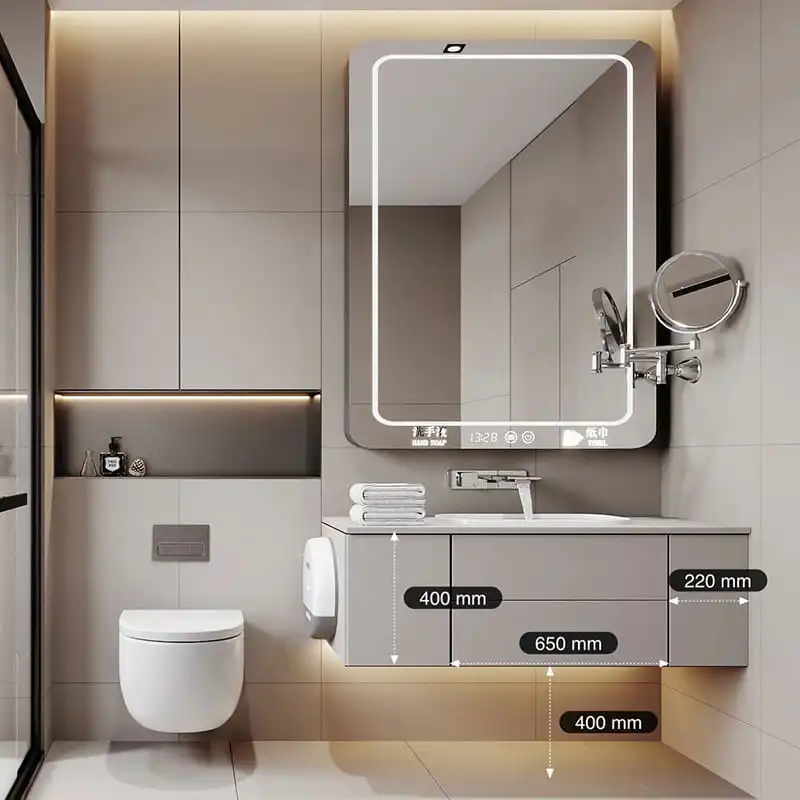
The collection supports both floating wall-mounted and floor-standing structures. Each configuration has distinct visual and functional advantages, allowing the vanity to respond to different room sizes, user expectations, cleaning requirements, and architectural conditions.
A floating vanity is mounted above the finished floor, creating a clear visual gap beneath the cabinet. This makes the bathroom appear more open and can help a compact room feel less crowded. The exposed floor area is also easier to clean because there are fewer difficult corners around the cabinet base.
Wall-mounted furniture is particularly effective in modern French interiors where visual lightness is important. It can be paired with concealed plumbing, linear wall lighting, and large-format flooring to create a calm and continuous composition. The mounting height can be adjusted according to the basin type, user requirements, mirror position, and project standards.
Wall structure is a critical consideration. The installation wall must be capable of supporting the cabinet, countertop, basin, stored items, and the forces generated during daily use. Appropriate reinforcement, fixing hardware, and professional installation are required for a secure result.
Floor-standing vanities extend to the floor and can offer greater visual weight and storage volume. They are useful in bathrooms where maximum capacity is a priority or where the wall structure is not suitable for a fully suspended cabinet.
A floor-standing structure can also reinforce a more traditional design language. The cabinet appears grounded and substantial, which complements French classic interiors, large master bathrooms, and rooms with generous ceiling height. Depending on the design, the base may be integrated into the cabinet composition or specified as a separate support detail.
Both floating and floor-standing solutions can be customized around the actual floor plan. The choice should be made early in the design process because it affects plumbing coordination, wall reinforcement, floor finishing, cabinet height, toe-kick details, and installation procedures.
Hardware is one of the most frequently used parts of a bathroom vanity. Hinges, drawer runners, hangers, and adjustment mechanisms are exposed to moisture, cleaning chemicals, repeated opening cycles, and temperature fluctuations. Low-quality hardware can rust, jam, sag, or lose alignment, even when the cabinet body remains in good condition.
The standard specification includes 304 stainless steel and special electroplated moisture-proof hardware components. These materials and treatments are intended to resist rust and corrosion in humid environments. Damping functions can support a quieter and more controlled user experience, reducing the impact of doors and drawers during daily operation.
Blum soft-close concealed hangers and hinges are listed as standard hardware options, with DTC components and other customized solutions also available according to the project specification. The exact hardware package can be selected based on cabinet weight, door size, opening frequency, aesthetic preferences, and maintenance requirements.
Hardware selection is an important point of differentiation from basic vanity products. A cabinet may look attractive when new, but its long-term user experience depends heavily on whether the moving components remain smooth and stable. Corrosion-resistant hardware, accurate drilling, proper load calculation, and final installation adjustment all contribute to lasting performance.
Modern bathroom design increasingly combines furniture with lighting, demisting systems, electrical outlets, and storage technology. To support this trend, the cabinet structure can be pre-reserved for concealed wiring and installation holes for a defogging smart mirror, LED lighting, and a hair dryer socket.
Pre-planned wiring is preferable to visible cables or late-stage drilling. It allows the mirror cabinet, vanity, wall finish, and electrical points to be coordinated as one system. This is particularly beneficial in hotel and residential projects where a clean, integrated appearance is expected.
Electrical work must be completed by qualified professionals and should comply with applicable local regulations. The furniture manufacturer can coordinate reserved openings and cabinet provisions, while the electrical contractor remains responsible for safe wiring, grounding, protection, and final connection.
The smart mirror cabinet option also improves the functional relationship between storage and grooming. Frequently used items can be stored behind the mirror, while integrated illumination supports facial care and daily preparation. Defogging functions are especially useful in bathrooms with showers or bathtubs, where condensation can quickly reduce mirror visibility.
The construction system is designed to balance decorative appearance, moisture resistance, dimensional stability, and customization flexibility. A standard specification may include 18-millimeter solid wood plywood for side panels and shelves, a 9-millimeter back panel, and high-density eco-friendly particle board or other approved engineered boards where appropriate.
| Component | Available or Standard Specification | Project Benefit |
|---|---|---|
| Door surface | Moisture-resistant high-density eco-friendly plywood with customizable finish | Supports decorative painting, moisture resistance, and project-specific appearance |
| Countertop and basin | Gloss or matte sintered stone integrated basin, classic ceramic art basin, or customized surface | Allows coordination with design style, basin count, and maintenance expectations |
| Carcass | 18-millimeter solid wood plywood or eco-friendly high-density particle board | Provides a stable engineered structure for bathroom storage |
| Side panel and shelf | 18 millimeters | Supports load-bearing capacity and dimensional consistency |
| Back panel | 9 millimeters | Helps accommodate a practical cabinet structure and service coordination |
| Edge banding | PUR waterproof edge banding or seamless laser edge banding | Reduces moisture entry at exposed panel edges |
| Hardware | 304 stainless steel, moisture-proof electroplated components, and soft-close options | Improves corrosion resistance, quiet operation, and service life |
| Color options | Pearl cream white, tobacco brown, vintage soft grey, ivory gold, and customized colors | Supports different interior palettes and project identity |
The use of engineered board systems offers advantages over unstable solid timber in humid interior applications. Properly selected and manufactured engineered boards can provide more consistent dimensions, reduced movement, and predictable machining performance. This is important for curved doors, decorative moldings, concealed hinges, and integrated countertop interfaces, where dimensional accuracy directly affects the final appearance.
The lacquer surface is produced through multiple rounds of sanding and spraying. This process is central to the visual quality of a painted bathroom vanity. A high-quality finish requires more than one coat of paint. It depends on substrate preparation, edge treatment, primer compatibility, sanding accuracy, controlled spraying, curing conditions, and final inspection.
Multiple sanding stages help reduce surface irregularities and prepare the substrate for a uniform coating. Multiple spraying stages build color depth and improve coverage across flat and curved areas. Curved doors require careful control because reflections can reveal unevenness more easily than on a textured or heavily patterned surface.
A refined lacquer finish gives the decorative molding a more integrated appearance. Instead of looking like an added ornament, the molding becomes part of the cabinet façade. The smooth tactile quality also supports the product’s light-luxury positioning.
Different sheen levels can be considered according to the desired atmosphere. A higher-gloss finish reflects more light and can emphasize the sculptural quality of curved doors. A softer satin or matte finish creates a quieter appearance and may be better suited to relaxed residential bathrooms or hospitality environments seeking a more understated mood.
The listed color options include pearl cream white, tobacco brown, vintage soft grey, and ivory gold. These tones are compatible with French neoclassical and transitional interiors, but customization is available for projects that require a specific palette.
Color approval should be based on physical samples rather than digital images alone. Lighting, screen settings, substrate preparation, and sheen level can all affect how a color is perceived. For multi-unit projects, an approved master sample should be retained as the reference for production and quality inspection.
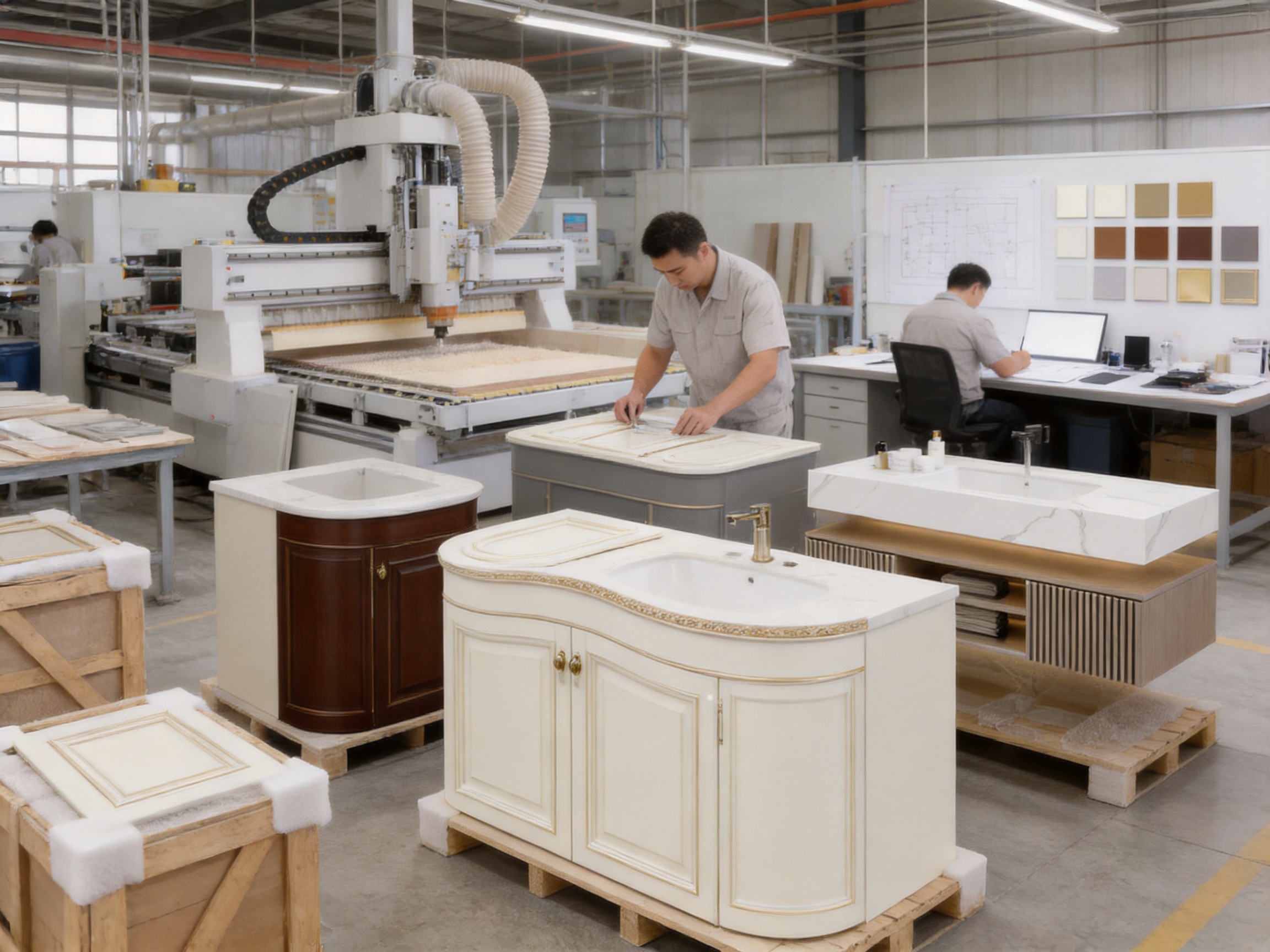
The manufacturer behind the collection, Suzhou Dicosbo Wood Co., Ltd., operates as a global wood solutions producer specializing in wood flooring, wooden doors, and custom cabinet solutions. Its experience across multiple wood product categories supports the technical requirements of bathroom furniture, where material knowledge, precision processing, finishing control, and project coordination are all important.
The company was founded in 1999 and has developed more than two decades of manufacturing experience. Its reported production facilities cover approximately 20,000 square meters, with more than ten years of export experience and a network of over one hundred global partners across Europe, North America, and Southeast Asia.
Its production capabilities include German imported production lines and automated quality control systems. These resources are valuable for a product such as DFD-BV-04 because decorative curved doors and molded façades require consistent machining, repeatable dimensions, reliable coating application, and stable assembly accuracy.
Bathroom projects frequently require variations in width, depth, height, door configuration, basin layout, color, hardware, and storage zoning. A fixed catalog product may not fit the plumbing locations or interior design concept. OEM and ODM services allow the vanity to be adjusted to project drawings and brand requirements.
Customization can include the cabinet dimensions, single or double basin arrangement, countertop material, door finish, carcass material, decorative elements, drawer division, mirror cabinet integration, and installation configuration. The company also provides rapid prototyping, with a stated 72-hour rapid prototyping capability for suitable development requirements.
Rapid prototyping can help architects, designers, distributors, and contractors verify proportions before full production. A physical prototype or sample component can reveal details that are difficult to evaluate from drawings, including door curvature, molding scale, paint color, handle position, drawer clearance, and basin relationships.
A strict three-step quality inspection process is identified as part of the company’s manufacturing approach. For bathroom vanities, a structured inspection system may cover incoming material verification, in-process production control, and finished-product inspection.
Incoming inspection can verify board type, thickness, moisture-resistant specifications, hardware quality, countertop material, and color references. In-process inspection can focus on machining accuracy, edge banding, joint quality, curved door consistency, sanding, spraying, and curing. Final inspection can review dimensions, surface quality, hardware operation, packaging condition, and conformity with approved drawings.
Quality control is especially important for project orders containing multiple vanity units. Small inconsistencies may become highly visible when identical products are installed side by side across hotel rooms, apartments, or villa developments. Repeatable processes help maintain a consistent appearance from the first unit to the final delivery.
The company reports an annual production capacity of approximately 2,400,000 square meters of flooring and 5,000 sets of doors. Although these figures refer primarily to broader wood product production, they indicate the scale of the manufacturing organization and its experience in managing material procurement, production planning, export packaging, and project supply.
For custom vanity projects, capacity must be evaluated together with engineering support, material availability, sample approval, production scheduling, and delivery planning. A capable manufacturer should be able to provide a clear process from initial drawings through technical confirmation, prototype approval, batch production, inspection, packaging, and shipment.
Many mass-market bathroom vanities focus on low initial cost and simplified production. They may use a limited selection of sizes, thin decorative surfaces, standard basin formats, basic hardware, and minimal customization. Such products can be suitable for short-term or budget-oriented applications, but they may not satisfy projects where design identity, moisture performance, or coordinated architectural detailing is important.
DFD-BV-04 offers several advantages over a basic standard vanity. Its decorative molding and curved doors provide stronger visual character. Its material and edge treatment are selected for bathroom conditions. Its drainage avoidance planning improves the use of internal storage. Its basin and countertop options create a more integrated design. Its floating and floor-standing structures allow the cabinet to respond to different room concepts.
The product also offers a more comprehensive customization path. Instead of adapting the bathroom design to a fixed cabinet, architects and contractors can develop the cabinet around the actual floor plan, plumbing positions, basin requirements, storage needs, and overall interior language.
| Evaluation Area | Basic Standard Vanity | DFD-BV-04 Approach |
|---|---|---|
| Visual identity | Usually flat-front and limited in decorative expression | French neoclassical molding combined with curved door panels |
| Moisture strategy | May rely on general-purpose boards and basic finishes | Moisture-resistant engineered materials, protective finishes, and waterproof edge options |
| Drainage coordination | Often requires site modification | U-shaped internal grooves can be planned around drain positions |
| Basin selection | Limited standard basin sizes | Integrated sintered stone, ceramic, single-basin, and double-basin options |
| Installation structure | Usually one fixed configuration | Floating wall-mounted or floor-standing structures |
| Hardware | Basic hinges and runners | 304 stainless steel, moisture-proof components, and soft-close options |
| Smart functions | Usually added after installation | Pre-reserved wiring and installation holes for mirror and lighting modules |
| Project customization | Restricted sizes and colors | Customized dimensions, colors, materials, storage zoning, and finish details |
The vanity’s styling and customization range make it suitable for several interior categories. In a French-style villa master bathroom, it can serve as a central furniture feature combined with framed wall panels, elegant sanitary fixtures, decorative lighting, and natural stone surfaces.
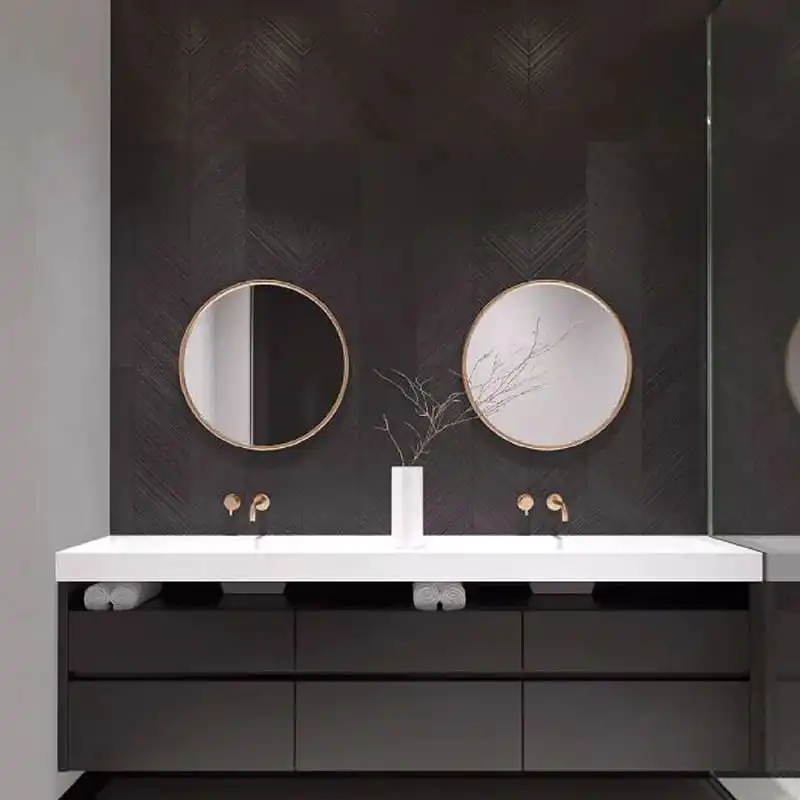
In a vintage light-luxury apartment, the vanity can establish a warm and sophisticated mood through tobacco brown, vintage soft grey, ivory gold, or a carefully matched custom finish. Curved doors can be coordinated with rounded mirrors and soft metal hardware to create continuity across the room.
Boutique homestays and hospitality suites can use the vanity as part of a distinctive guest experience. A carefully designed bathroom often contributes strongly to a guest’s perception of quality. The combination of decorative detailing, integrated storage, durable materials, and smart mirror preparation can support a memorable yet practical room environment.
Design-oriented hotels may benefit from the manufacturer’s ability to reproduce a specified design across multiple rooms. The vanity can be adjusted to suit different room types while retaining a consistent design language. Standardized engineering drawings, approved color samples, and controlled batch production are important for maintaining uniformity throughout the project.
The product also adapts to neoclassical mixed-modern interiors. It does not require the entire bathroom to be traditionally styled. The vanity can be combined with contemporary wall slabs, minimalist faucets, large-format tiles, concealed lighting, and modern flooring. In this context, the decorative molding becomes a controlled accent within an otherwise clean composition.
A successful custom vanity project begins with a complete technical brief. The brief should include the overall bathroom plan, wall elevations, finished floor level, drain centerlines, water supply points, electrical locations, basin type, faucet position, mirror dimensions, desired storage capacity, and preferred installation method.
The design team can then confirm the cabinet width, depth, and height. These dimensions should account for door and drawer clearances, user circulation, basin overhang, wall conditions, plumbing access, and cleaning requirements. In a double-basin configuration, the spacing between basins and the location of the central storage area should be reviewed carefully.
Material selections are confirmed after the basic layout is established. This includes the cabinet board, door finish, edge banding, countertop, basin, hardware, mirror cabinet, lighting preparation, and optional decorative details. A sample or prototype may be used to verify the appearance and construction before batch production.
Technical approval should cover more than appearance. It should also confirm installation tolerances, wall reinforcement, service access, plumbing clearance, electrical safety, packaging requirements, and delivery sequence. Clear approval documents reduce misunderstandings between the designer, contractor, manufacturer, and installation team.
Customization may include overall cabinet dimensions based on the project blueprint; floating or floor-standing construction; single or double basin arrangements; high-gloss or matte countertop finishes; ceramic or sintered stone basins; custom paint colors; decorative molding details; drawer and shelf zoning; smart mirror cabinet preparation; LED sensor lighting; metal decorative inlays; and concealed wiring provisions.
Pricing may be calculated according to projected area or unfolded area, depending on the project agreement. The minimum order information indicates one set for a mockup and twenty sets for a project, although final quantities, production conditions, and commercial terms should be confirmed for each order.
Bathroom furniture must be protected from impact, moisture, abrasion, and compression during transportation. The listed packaging approach uses flat-pack or ready-to-assemble export cartons with heavy-duty protection and EPS corner protectors. Glass doors and islands, where included in a broader project, can be secured in fumigation-free wooden crates for additional ocean freight protection.
Packaging should be matched to the product configuration. Curved doors and decorative moldings require protection against edge impact and surface abrasion. Countertops and basins require separate consideration because stone and ceramic components may be damaged by concentrated pressure or movement inside the carton.
For large projects, packaging labels should identify room type, unit number, cabinet orientation, hardware package, installation sequence, and related drawings. Clear labeling reduces handling errors at the construction site and helps the installation team locate the correct components efficiently.
Delivery planning should also consider the construction schedule. The bathroom must be sufficiently prepared before the vanity arrives. Wall finishes, floor finishes, plumbing rough-ins, electrical points, waterproofing, and access routes should be checked in advance. Proper sequencing reduces the risk of damage after installation or the need to remove finished components for building work.
Professional installation is recommended for customized bathroom vanities. The installer should verify the finished wall and floor conditions, confirm the drain and water connections, check cabinet level, adjust the doors and drawers, and seal appropriate countertop or basin interfaces according to the selected material.
Floating units require secure wall fixing and suitable reinforcement. The fixing method must be selected according to the wall construction, cabinet weight, countertop weight, basin type, and expected storage load. Floor-standing units require a level and stable floor, as well as correct alignment with plumbing and adjacent finishes.
For daily care, use a neutral detergent and a soft cotton cloth. Abrasive pads, harsh scouring powders, and cleaning products containing grinding particles should be avoided because they may scratch or dull the lacquer finish. Strong solvents or unapproved chemicals should not be used without checking their compatibility with the painted surface, countertop, basin, and hardware.
Water should not be allowed to remain on cabinet edges, joints, or decorative moldings for extended periods. After heavy splashing, surfaces can be gently dried with a soft cloth. Good air circulation should be maintained to reduce continuous moisture accumulation and support long-term structural stability.
Localized and prolonged exposure to direct sunlight should be minimized. Continuous ultraviolet exposure may contribute to uneven color changes, particularly when part of the vanity is shaded by accessories or a mirror while another part remains exposed.
Heavy impacts and sharp objects should be kept away from decorative moldings and curved edges. Although the finish is designed for normal bathroom use, decorative details can be damaged by concentrated impact. Careful handling preserves both the surface integrity and the visual rhythm of the façade.
The product specifications identify CARB Phase 2, EU E0 Grade, and FSC certification options. These certifications and classifications support responsible material selection and help project teams meet environmental requirements, depending on the exact material and production batch selected.
CARB Phase 2 relates to limits on formaldehyde emissions from composite wood products in applicable markets. EU E0 Grade is associated with very low formaldehyde emission expectations under relevant testing systems. FSC certification supports responsible forestry practices for certified wood sources. Documentation should be requested and verified according to the specific order, material, and destination market.
Sustainability also involves product service life. A vanity that remains stable, functional, and visually attractive for many years can reduce the need for frequent replacement. Moisture-resistant construction, repairable hardware, durable finishes, and adaptable design all contribute to a longer useful life.
Manufacturing efficiency is another part of responsible production. Computerized design, accurate cutting, automated quality control, and optimized material planning can reduce errors and unnecessary waste. Customized engineering also helps prevent the costly rework associated with incorrect plumbing clearances or unsuitable cabinet dimensions.
A highly decorative bathroom vanity requires coordination between design and production. A design may appear simple in a rendering, but its success depends on the accuracy of the curved door, the consistency of the molding, the smoothness of the painted surface, the position of the hinges, and the relationship between the cabinet and countertop.
A manufacturer experienced in wood flooring, doors, and custom cabinetry can draw on knowledge of board behavior, finishing systems, CNC processing, installation tolerances, and export packaging. This broader experience is useful when a bathroom vanity must be integrated into a larger interior woodwork package.
DEIF’s manufacturing profile includes more than twenty years of industry experience, a large production facility, international export experience, OEM and ODM support, German imported production lines, automated quality control, rapid prototyping, and a three-step inspection process. These capabilities provide a foundation for supplying both individual custom pieces and coordinated project orders.
The company’s broader product range also makes it possible for project partners to coordinate bathroom vanities with wooden doors, custom cabinets, and flooring solutions from a single manufacturing resource. A unified supplier can simplify material approvals, finish coordination, packaging management, and communication across multiple interior elements.
It is especially suitable for French neoclassical, transitional, vintage light-luxury, and mixed modern interiors. It can also be adapted for villas, apartments, boutique homestays, hotels, and other design-focused residential or commercial spaces.
No. The curved doors soften the visual profile, improve the interaction of light and shadow, and help the vanity feel less rigid. They are integrated into a functional cabinet system with storage, hardware, and customized basin coordination.
Yes. Base dimensions are customized according to floor plans, engineering drawings, plumbing locations, basin requirements, and project specifications.
Yes. The product supports both floating wall-mounted and floor-standing configurations. The choice should be confirmed during the technical design stage because it affects wall reinforcement, plumbing, floor conditions, and installation height.
Options include high-gloss or matte luxury sintered stone integrated basins, classic ceramic art basins, marble countertop solutions, and customized single- or double-basin arrangements.
Drawers and internal shelves can be planned with U-shaped grooves that avoid wall or floor drain positions. Accurate engineering drawings and plumbing information are required before production.
Yes. The product is specified with moisture-resistant materials, protective finishes, waterproof edge banding options, and corrosion-resistant hardware for bathroom environments. Proper ventilation, professional installation, and regular care remain necessary for long-term performance.
Yes. Pearl cream white, tobacco brown, vintage soft grey, and ivory gold are listed options, and customized colors can be developed subject to sample approval and project requirements.
The cabinet structure can be pre-reserved for concealed wiring and installation holes for a defogging smart mirror, LED lighting, and a hair dryer socket. Electrical connections must be completed by qualified professionals in accordance with local regulations.
Standard options include 304 stainless steel and moisture-proof electroplated components, with soft-close concealed hangers and hinges. Other hardware systems may be customized according to the project specification.
Use a neutral detergent and a soft cotton cloth. Avoid abrasive tools, grinding particles, harsh solvents, prolonged standing water, and sharp impacts on the lacquered surfaces and decorative moldings.
The manufacturer provides OEM and ODM services and reports a 72-hour rapid prototyping capability for suitable development requirements. Prototype scope and timing should be confirmed according to the design complexity and requested materials.
The listed environmental and compliance options include CARB Phase 2, EU E0 Grade, and FSC certification. Documentation should be verified for the specific materials and order before final approval.
The listed reference is one set for a mockup and twenty sets for a project. Final quantities and commercial conditions should be confirmed with the manufacturer for each application.
The Splendor French decorative molding and curved door bathroom vanity combines a strong stylistic identity with practical bathroom engineering. Its French neoclassical vocabulary creates a refined architectural presence, while curved doors soften the composition and add depth through changing light and shadow. The result is more distinctive than a standard flat-front vanity but remains sufficiently adaptable for contemporary interiors.
Its product advantages extend beyond appearance. Moisture-resistant engineered materials, waterproof edge options, anti-mold and crack-resistant finishing considerations, drainage pipe avoidance, integrated basin choices, floating or floor-standing structures, corrosion-resistant hardware, and smart mirror preparation address the real technical demands of bathroom furniture.
The manufacturing platform further strengthens the product’s value for professional projects. Suzhou Dicosbo Wood Co., Ltd. combines long-term wood product experience, substantial production facilities, international export capability, OEM and ODM customization, rapid prototyping, automated quality control, and a structured inspection process. These capabilities support architects, contractors, distributors, hospitality developers, and homeowners who require coordinated design and reliable project execution.
For residential and commercial spaces where the bathroom is expected to express a clear design concept, this vanity provides a balanced solution. It brings together decorative craftsmanship, modern material engineering, customizable configuration, and production experience in one coordinated furniture system.
1. Product specification sheet: DFD-BV-04, French decorative molding and curved door bathroom vanity.
2. Manufacturer technical information for moisture-resistant plywood, high-density particle board, waterproof edge banding, and bathroom cabinet construction.
3. Manufacturer information concerning OEM and ODM customization, prototyping, production facilities, export experience, and quality inspection procedures.
4. CARB Phase 2 requirements for formaldehyde emissions from composite wood products.
5. FSC principles concerning responsible forest management and certified wood sourcing.
6. General architectural guidance for bathroom ventilation, moisture control, plumbing coordination, and cabinetry installation.
7. General care and maintenance practices for lacquered wood-based furniture, engineered stone surfaces, ceramic basins, and stainless-steel hardware.

We provide customers with sustainable and eco-friendly
engineered wood solutions and services.
Choose DEIF for the perfect blend of
performance and aesthetics.
